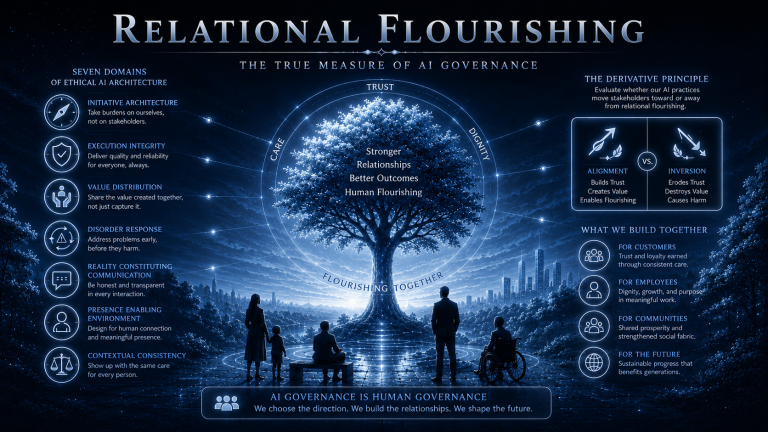
Throughout this series, we have explored AI governance as it should be understood and practiced today. We have examined why governance activates when AI occupies roles requiring human judgment rather than when AI merely functions as a tool. We have explored how the Seven Domains provide assessment structure across the full range of organizational functions. We have articulated why the Two Conditions, structural accountability and directional alignment, must both be satisfied before deployment can proceed ethically. And we have examined how organizations can build governance capacity through culture, board oversight, implementation from zero, and effective operations handoff. But AI governance is not static. As AI capabilities expand and deployment accelerates, governance must evolve. Understanding what is coming helps organizations prepare rather than merely react.
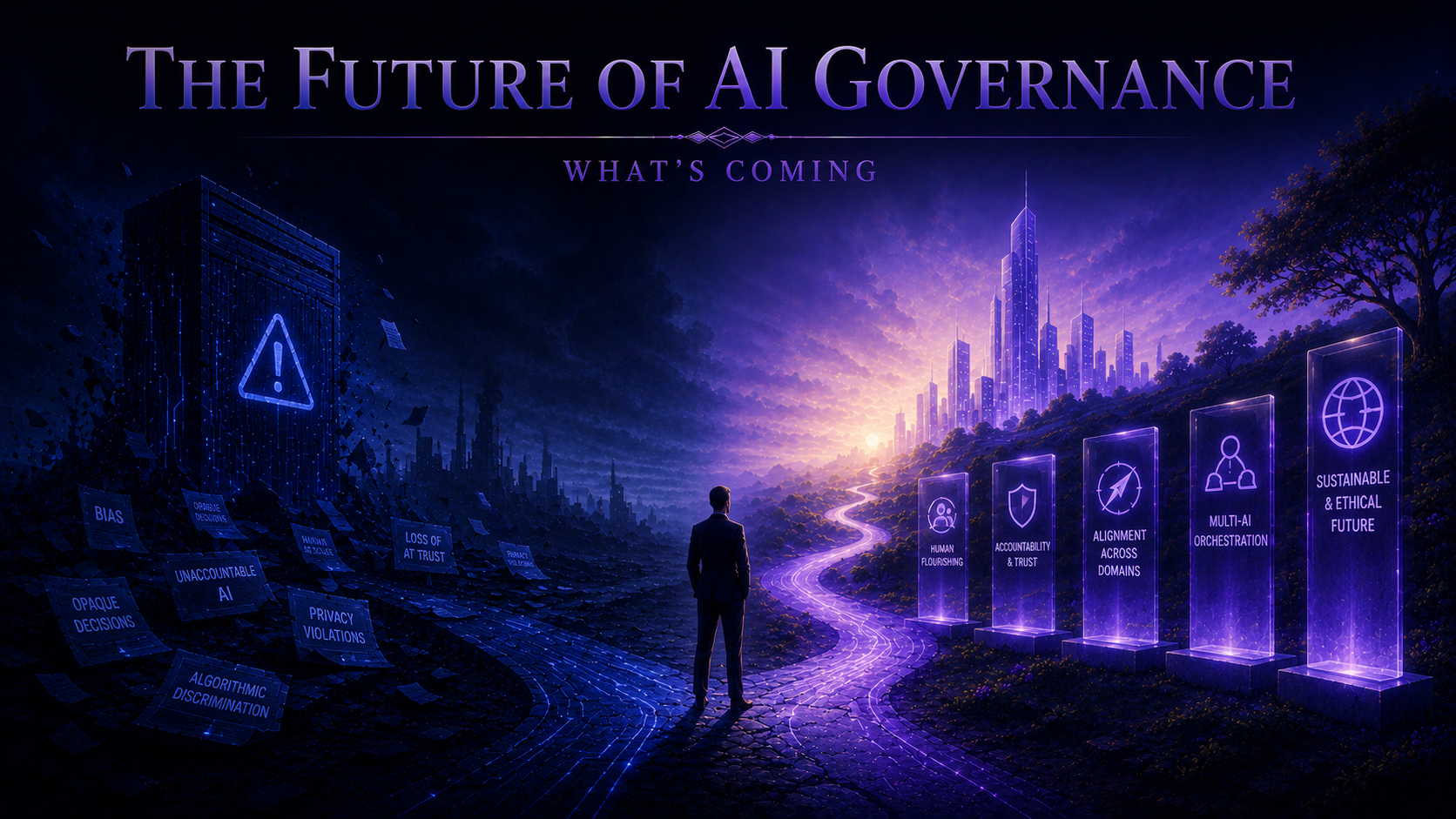
The most certain prediction is that AI governance will intensify. Every trend points in this direction without exception. AI capabilities are expanding rapidly, enabling deployment in roles previously requiring human judgment across virtually every organizational function. Regulatory frameworks are proliferating globally as governments recognize AI’s societal impact. Public awareness of AI’s effects on human flourishing is growing as deployment becomes more visible in daily life. Organizations face mounting pressure from investors, customers, employees, and communities to demonstrate responsible AI practices. The question is not whether governance intensity will increase but how organizations will respond to that intensification.
The Limits of Compliance-Based Regulation
Regulatory frameworks for AI are emerging worldwide. The European Union’s AI Act establishes risk-based requirements that will shape deployment across the continent. Jurisdictions across Asia, the Americas, and beyond are developing their own frameworks with varying approaches and emphases. This regulatory proliferation will continue and likely accelerate as AI deployment expands and its societal impact becomes more apparent. Organizations deploying AI across borders will face increasingly complex compliance requirements that demand dedicated expertise to navigate.
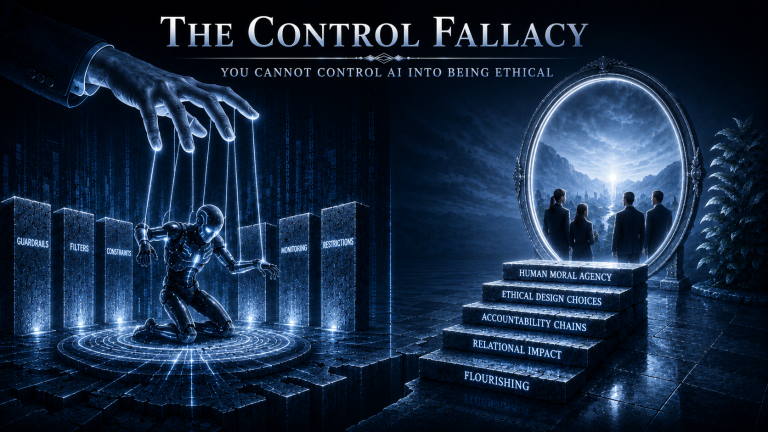
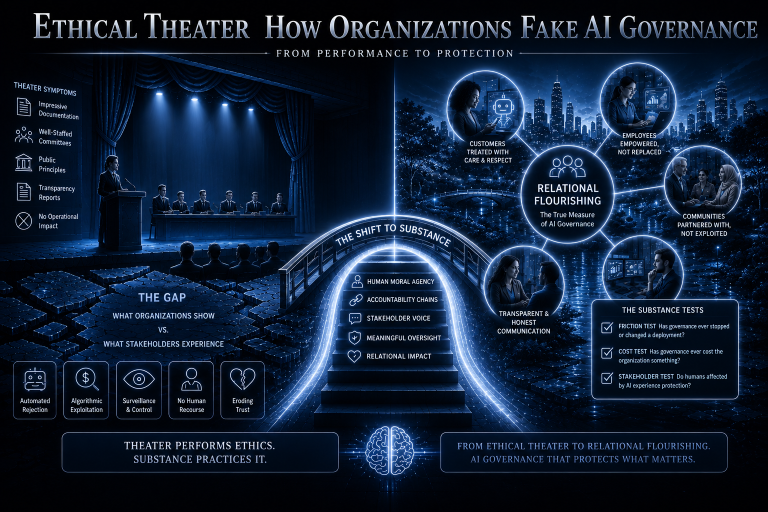
But compliance-based regulation will prove inadequate for ensuring AI serves human flourishing. This inadequacy is structural, not incidental. Regulations necessarily focus on measurable, verifiable requirements that can be assessed consistently across organizations. They establish minimum standards, not optimal practices. They lag behind capability development because legislative processes cannot match the pace of technological change. Most fundamentally, compliance creates the governance theater we have critiqued throughout this series, where organizations satisfy formal requirements while missing the substantive concerns about relational impact and human flourishing that governance should address.
Organizations that treat regulatory compliance as sufficient will find themselves repeatedly surprised when compliant AI deployments generate stakeholder backlash, reputational damage, or ethical failures. Compliance addresses legal risk but not ethical risk. Organizations that understand this distinction will build governance that exceeds compliance requirements, using regulation as floor rather than ceiling. As explored in our discussion of board oversight, directors who understand this distinction will demand governance beyond what regulations require, recognizing that compliance alone does not discharge their fiduciary responsibility for AI’s impact.
Multi-AI Orchestration Challenges
Current AI deployment typically involves discrete systems handling specific functions with relatively clear boundaries. Future deployment will increasingly involve multiple AI systems working together, with AI systems managing other AI systems in complex orchestration patterns. This orchestration is already emerging as organizations build AI architectures where one system coordinates outputs from multiple specialized systems, creating emergent behaviors that no single system produces independently.
Multi-AI orchestration creates governance challenges that current frameworks do not adequately address. The Vacancy Problem becomes significantly more complex when multiple AI systems jointly occupy a role that would otherwise require human judgment. The Daisy Chain Principle, which traces accountability through AI systems to the humans who deployed them, must navigate chains involving multiple AI systems with different operators and developers. Domain assessment must evaluate not just individual systems but their interaction effects, which may differ substantially from the behavior of component systems in isolation. Governance approaches assuming single AI systems will require significant evolution to address these emerging deployment patterns.
Organizations should begin preparing now by ensuring their governance frameworks can accommodate multi-system assessment, establishing clear accountability for orchestration decisions, and developing monitoring capabilities that track interaction effects rather than just individual system outputs.
The Governance Advantage
Organizations building robust AI governance now will have significant competitive advantage when these pressures intensify. This advantage operates through multiple mechanisms. First, organizations with established governance can deploy new AI capabilities faster because they have assessment frameworks and accountability structures already in place. Organizations without governance must build these from scratch for each deployment, creating delays and inconsistencies that compound over time.
Second, organizations with governance maturity will face lower regulatory burden as frameworks develop. Regulators typically provide accommodations for organizations demonstrating mature governance practices. Organizations that have built genuine governance capacity will more easily demonstrate compliance while organizations starting from zero will struggle to satisfy requirements under time pressure.
Third, organizations with governance track records will attract talent and partners increasingly attuned to AI ethics. As discussed in the preceding careers post, AI governance professionals will prefer organizations where their expertise is valued and their recommendations implemented. Partners and customers will increasingly evaluate AI governance as part of vendor and supplier assessment, creating market advantages for organizations that can demonstrate genuine governance practices.
Preparing for What Comes
Given these trajectories, organizations should take several concrete steps now. First, establish governance foundations even if current AI deployment is limited. The frameworks, accountability structures, and cultural elements discussed throughout this series take time to build. Starting when deployment pressure is intense makes building nearly impossible. Starting now creates capacity for when it is needed, positioning the organization for responsible expansion rather than reactive scrambling.
Second, build governance expertise internally rather than relying entirely on external consultants. As discussed in our careers post, professionals who develop AI governance expertise will be in high demand as governance pressures intensify. Organizations that develop internal talent will have reliable access to expertise; organizations dependent on external consultants will compete for limited supply at increasing cost. The investment in internal capability development pays dividends as governance demands grow.
Third, engage with emerging regulatory frameworks proactively rather than waiting for requirements to be finalized. Organizations that participate in regulatory development help shape requirements to be both meaningful and achievable. Organizations that wait until requirements are published must adapt to rules they had no role in shaping, often finding those rules poorly matched to their operational realities.
The Stakes Ahead
This series has argued that AI governance is fundamentally about how humans exercise moral agency through AI systems. That framing becomes even more important as AI capabilities expand. The decisions organizations make about AI deployment will increasingly shape human experience, relational quality, and community flourishing across every domain of life. Organizations have both opportunity and obligation to ensure this shaping moves toward rather than away from human flourishing. The framework we have developed throughout this series provides the conceptual and practical tools for that essential work.
The organizations that build governance now, that develop the culture and capabilities we have explored throughout this series, will be positioned to navigate whatever the future brings. Those that delay, hoping governance challenges will resolve themselves or that they can build capability quickly when pressures mount, will find themselves perpetually reacting to pressures they could have anticipated. The future of AI governance belongs to those building it today.