Discover our latest articles

Explore what makes IAIM Association different: rigorous certifications, real-world AI ethics training, and a growing global community committed to responsible AI.

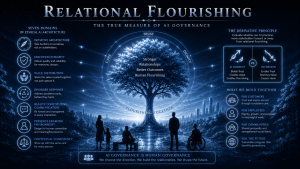
Relational Flourishing: The True Measure of AI Governance

Throughout this series, I have critiqued prevailing approaches to AI governance: the compliance frameworks that produce documentation without protection, the ethical theater that performs commitment without substance, the control paradigm that governs AI behavior while ignoring human choices. These critiques raise an essential question: if not compliance, if not theater, if not control, then what?

Read More »

The Control Fallacy: You Cannot Control AI Into Being Ethical

The dominant question in AI governance today is: How do we control AI? Policymakers ask how to control AI development. Corporations ask how to control AI deployment. Researchers ask how to control AI behavior. This question shapes regulation, governance frameworks, and public discourse. It also represents a fundamental category error that guarantees governance failure. The

Read More »

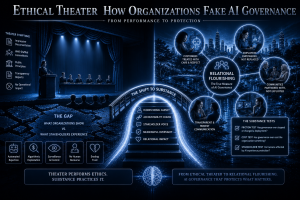
Ethical Theater: How Organizations Fake AI Governance

Every major technology company now publishes AI ethics principles. They convene ethics advisory boards. They issue transparency reports. They staff governance committees with impressive credentials. And their AI deployments continue exactly as they would have without any of this apparatus. This is ethical theater: the performance of moral commitment without its substance. The proliferation of

Read More »

The Future of AI Governance: What’s Coming

Throughout this series, we have explored AI governance as it should be understood and practiced today. We have examined why governance activates when AI occupies roles requiring human judgment rather than when AI merely functions as a tool. We have explored how the Seven Domains provide assessment structure across the full range of organizational functions.

Read More »

AI Governance Careers: Paths and Possibilities

A decade ago, AI governance as a profession barely existed. Organizations deployed AI with whatever oversight structures they had, adapting IT governance or compliance frameworks or creating ad hoc approaches that rarely addressed the distinctive challenges AI presents. The professionals working on AI ethics were scattered across academic departments, legal teams, and technical organizations, rarely

Read More »

The Governance-Operations Handoff: Where Most AI Ethics Dies

Organizations create governance frameworks with care and sophistication. They articulate principles, establish assessment requirements, document accountability structures, and develop policies addressing deployment across the Seven Domains. Then they hand these frameworks to operations teams for implementation. What happens next determines whether governance becomes practice or merely documentation that lives in policy repositories no one consults.

Read More »

Starting From Zero: Implementing AI Governance in Organizations Without It

Most organizations deploying AI today have little or no formal governance for that deployment. They adopted AI tools incrementally, each deployment seeming minor enough to proceed without special oversight. They treated AI as just another technology requiring the same governance as other software systems. They focused on technical functionality and business outcomes without establishing frameworks

Read More »

Board Oversight of AI: What Directors Need to Know

Boards of directors bear ultimate accountability for organizational action. This principle, fundamental to corporate governance, does not change when organizations deploy artificial intelligence. If anything, AI deployment intensifies board responsibility because AI systems can scale decisions in ways that human action alone cannot. A flawed human decision affects interactions one at a time; a flawed

Read More »

The Culture Question: Why AI Governance Fails Without Ethical Culture

Organizations invest substantial resources in AI governance frameworks, policies, procedures, and technical controls. They create committees, hire specialists, and develop elaborate documentation specifying how AI deployment should be assessed and managed. Yet many discover that these investments produce disappointing results. The frameworks exist, but AI deployment continues to create ethical problems. The policies are documented,

Read More »

Emotional AI and Synthetic Care: When AI Simulates What It Cannot Provide

The lonely person converses with an AI companion. The grieving individual seeks comfort from a chatbot therapist. The struggling customer encounters a customer service system that expresses empathy and concern. In each case, AI simulates emotional presence that it cannot experience. The question governance must address is what this simulation means for the humans who

Read More »

The Extraction Pattern: How AI Captures Value While Externalizing Costs

AI generates enormous value. Efficiency improves. Productivity increases. Capabilities expand. The question that governance must address is deceptively simple: Where does that value flow? The extraction pattern answers this question in ways that should concern anyone committed to ethical AI deployment. Under this pattern, organizations use AI to capture all generated value while externalizing costs

Read More »

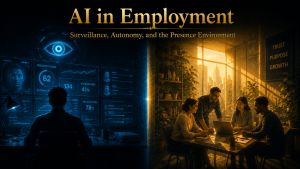
AI in Employment: Surveillance, Autonomy, and the Presence Environment

The employee arrives at work and logs into systems that track every keystroke. Algorithms analyze their communications for sentiment and productivity signals. Performance dashboards quantify their contributions against benchmarks derived from peer comparisons. Predictions about their likelihood of leaving influence how managers interact with them. The workplace has become an AI-shaped environment that surveils, measures,

Read More »

AI in Healthcare: Where Vacancy Becomes Life or Death

The patient arrives frightened. Their symptoms suggest something serious. They have been searching online, reading about possibilities, imagining worst cases. What they need from their healthcare encounter is not merely information processing. They need someone who can perceive their fear, who can judge their unique situation with the experience and wisdom that medical training provides,

Read More »

AI in Hiring: When Algorithms Screen Out Humanity

A resume crosses a hiring manager’s desk. The candidate’s path has been unconventional. The credentials do not quite fit the standard pattern. But something catches the manager’s attention. Perhaps the cover letter reveals unusual insight. Perhaps the progression of roles suggests someone who overcame obstacles rather than following a prescribed track. The manager decides to

Read More »
Scroll to Top
0