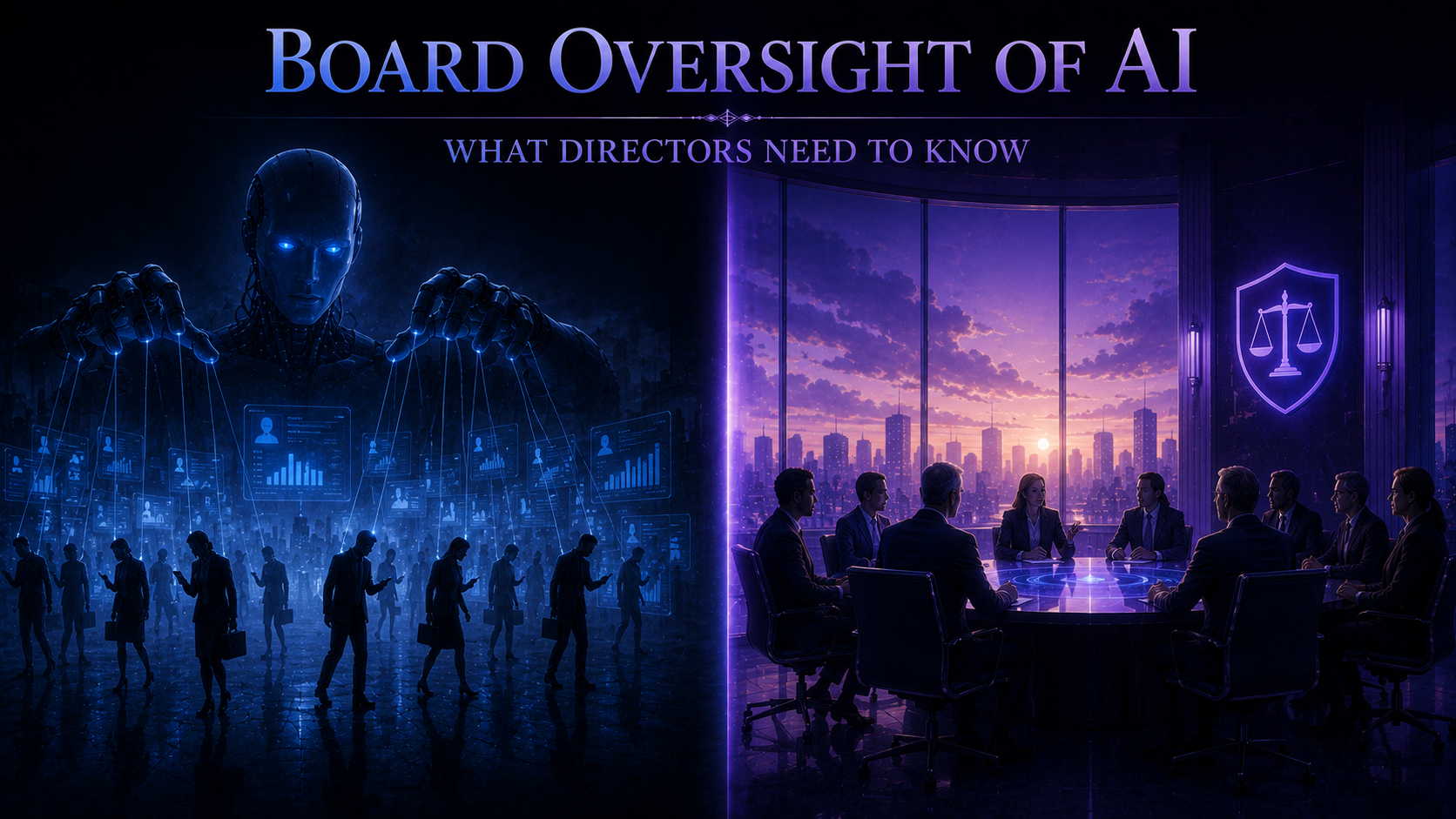
Boards of directors bear ultimate accountability for organizational action. This principle, fundamental to corporate governance, does not change when organizations deploy artificial intelligence. If anything, AI deployment intensifies board responsibility because AI systems can scale decisions in ways that human action alone cannot. A flawed human decision affects interactions one at a time; a flawed AI deployment can affect millions of interactions simultaneously. Directors who fail to understand and oversee AI deployment expose their organizations to risks they may not comprehend and stakeholders to harms they have not considered.
Yet many boards remain poorly equipped for AI oversight. Directors often lack technical backgrounds. They rely on management representations without understanding what questions to ask. They treat AI as a technical matter properly delegated to operational teams rather than a strategic and ethical matter requiring board attention. This approach fails to recognize what this framework has established throughout this series: AI governance is fundamentally about how humans exercise moral agency through AI systems, and boards cannot delegate moral accountability to management any more than they can delegate fiduciary responsibility.
Understanding the Tool Versus Role Distinction
Directors must first understand when AI governance activates. Not all AI use requires the same oversight intensity. When AI functions as a tool, augmenting human judgment while leaving decision authority with humans, governance concerns are limited to ensuring the tool functions reliably and provides accurate information. When AI occupies a role, making or heavily influencing decisions that would otherwise require human judgment, governance concerns expand dramatically. The Vacancy Problem has occurred: a role requiring human judgment has been vacated to a system lacking moral agency.
Boards should ensure they understand where their organization has deployed AI in role capacity. This is not a technical question about which systems use machine learning. It is a governance question about which decisions have been substantively delegated to AI systems. Many organizations cannot answer this question clearly because they have deployed AI incrementally without tracking the accumulated effect. Directors should ask for and receive clear answers about the organization’s AI Role Inventory, the comprehensive mapping of where AI occupies roles requiring human judgment.
Demanding Accountability Architecture Visibility
The first of the Two Conditions is structural accountability: clear, documented chains of responsibility connecting AI outputs to accountable humans. Boards should demand visibility into this architecture. For each AI system operating in role capacity, directors should be able to identify who bears accountability for the system’s decisions. This is not the same as knowing who built the system or who maintains it technically. It means knowing who bears responsibility for the decisions the system makes, who is accountable when those decisions cause harm, who has authority to modify or discontinue deployment.
The Daisy Chain Principle states that accountability for AI decisions traces through the AI system to the humans who deployed it, configured it, and maintain it. Directors should ensure their organizations have traced these chains for all significant AI deployments. Where accountability is unclear, where no specific human bears responsibility for AI decisions, deployment should not proceed or continue. This is not bureaucratic formality; it is the foundation enabling governance to function. Without clear accountability, no one can be held responsible when AI deployment moves away from human flourishing.
Reviewing Domain Alignment
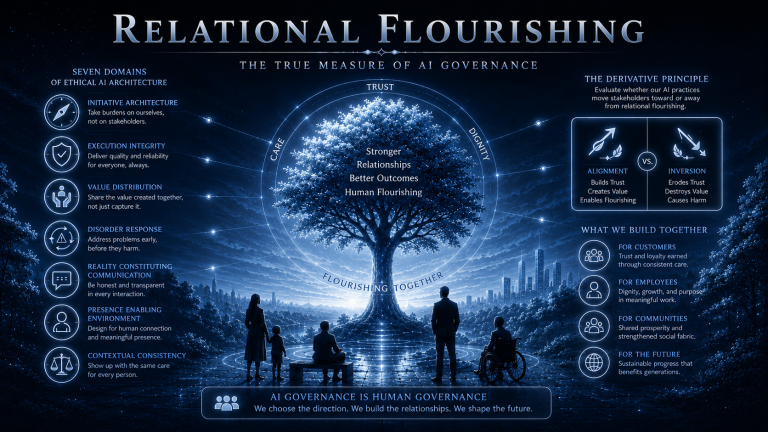
The second of the Two Conditions is directional alignment: AI deployment must move toward rather than away from human flourishing across all affected domains. The Seven Domains, Initiative Architecture, Execution Integrity, Value Distribution, Disorder Response, Communication Architecture, Presence Architecture, and Boundary Architecture, provide structure for this assessment. Boards need not conduct these assessments themselves, but they should ensure assessments occur and review their conclusions for significant deployments.
Directors should understand the Derivative Principle: AI’s moral status derives entirely from how it affects human flourishing and relational quality. This principle enables assessment without requiring resolution of metaphysical questions about AI consciousness or rights. Directors can ask, for each significant AI deployment, whether assessment has confirmed movement toward flourishing or whether concerns remain unresolved. Where assessments reveal movement away from flourishing in any domain, directors should understand how those concerns are being addressed.
Asking Uncomfortable Questions
Effective board oversight requires asking questions management may prefer not to answer. Directors should ask whether the organization has AI systems deployed in role capacity that have not been formally assessed. Most organizations do, either through legacy deployments predating current governance or through incremental deployment that accumulated significance without triggering review. Directors should ask what would happen if a specific AI system made a decision that caused significant harm. Would accountability be clear? Would response mechanisms activate effectively?
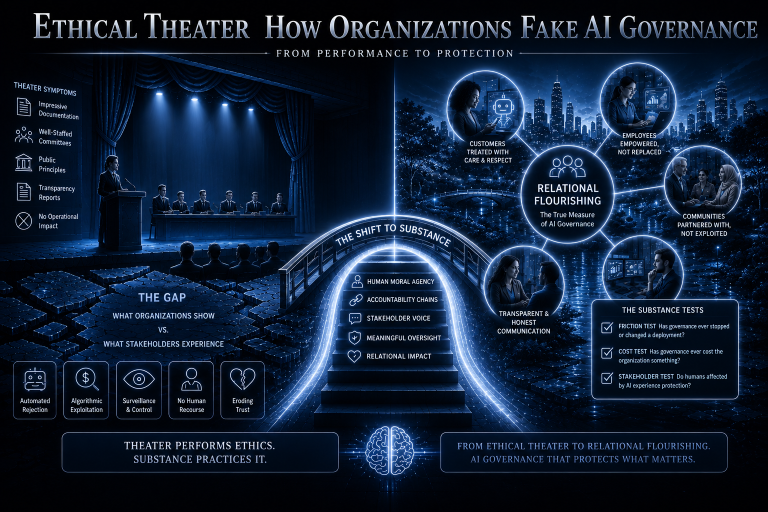
Directors should ask whether governance frameworks represent genuine practice or governance theater. As discussed in our opening piece on culture, organizations can document elaborate frameworks while operational reality follows different rules. Board oversight is meaningless if it reviews documentation that does not reflect actual practice. Directors should probe beneath documentation to understand how governance actually operates when pressure mounts and competing priorities conflict.
Directors should ask whether they would be comfortable if stakeholders understood exactly how AI systems were making decisions affecting them. This transparency test often reveals concerns that formal assessments miss. If the answer is that stakeholders would find certain practices troubling, that discomfort signals governance gaps requiring attention.
Building Board Capability
Boards cannot oversee what they do not understand. Directors need not become technical experts, but they need sufficient understanding to ask informed questions and evaluate management responses. This may require board education sessions, external expert consultation, or recruiting directors with AI governance expertise. The specific approach matters less than ensuring boards develop genuine capability rather than relying on management assurances they cannot evaluate critically.
Some boards create dedicated committees for AI oversight, similar to audit or compensation committees. Others integrate AI oversight into existing risk or technology committees. The structural choice matters less than ensuring someone at board level has clear responsibility for AI governance oversight and sufficient capability to fulfill that responsibility meaningfully. AI governance cannot be an orphan topic that everyone assumes someone else is handling.
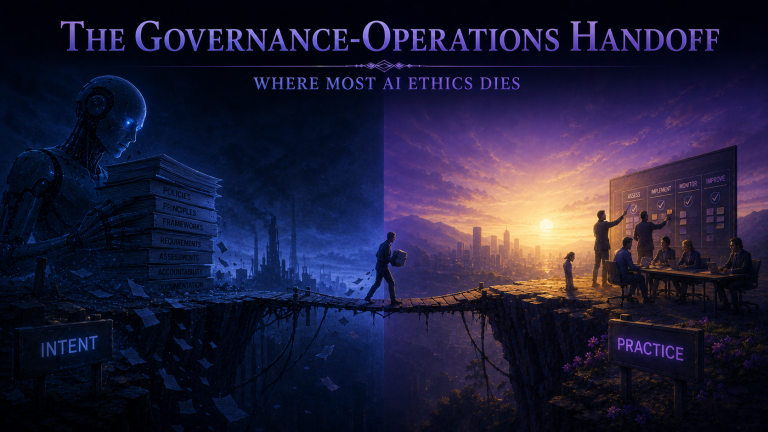
Board oversight of AI is not optional in organizations deploying AI in role capacity. Directors bear accountability they cannot escape through ignorance or delegation. As our subsequent discussions of implementation and operations will explore, effective governance requires engagement at every organizational level. But it must begin with boards that understand their responsibility and build capability to fulfill it. The future posts in this series examine how to implement governance and maintain it operationally, but implementation and operations occur within accountability structures that boards establish and maintain.