A resume crosses a hiring manager’s desk. The candidate’s path has been unconventional. The credentials do not quite fit the standard pattern. But something catches the manager’s attention. Perhaps the cover letter reveals unusual insight. Perhaps the progression of roles suggests someone who overcame obstacles rather than following a prescribed track. The manager decides to take a chance, to interview someone the criteria would have screened out. This decision, made countless times across countless organizations, represents moral agency in action. The manager perceives something the criteria miss, judges that standard filters fail this individual, and chooses to look deeper.
This capacity is precisely what AI hiring systems cannot provide. And the stakes for the humans being processed by these systems could not be higher.
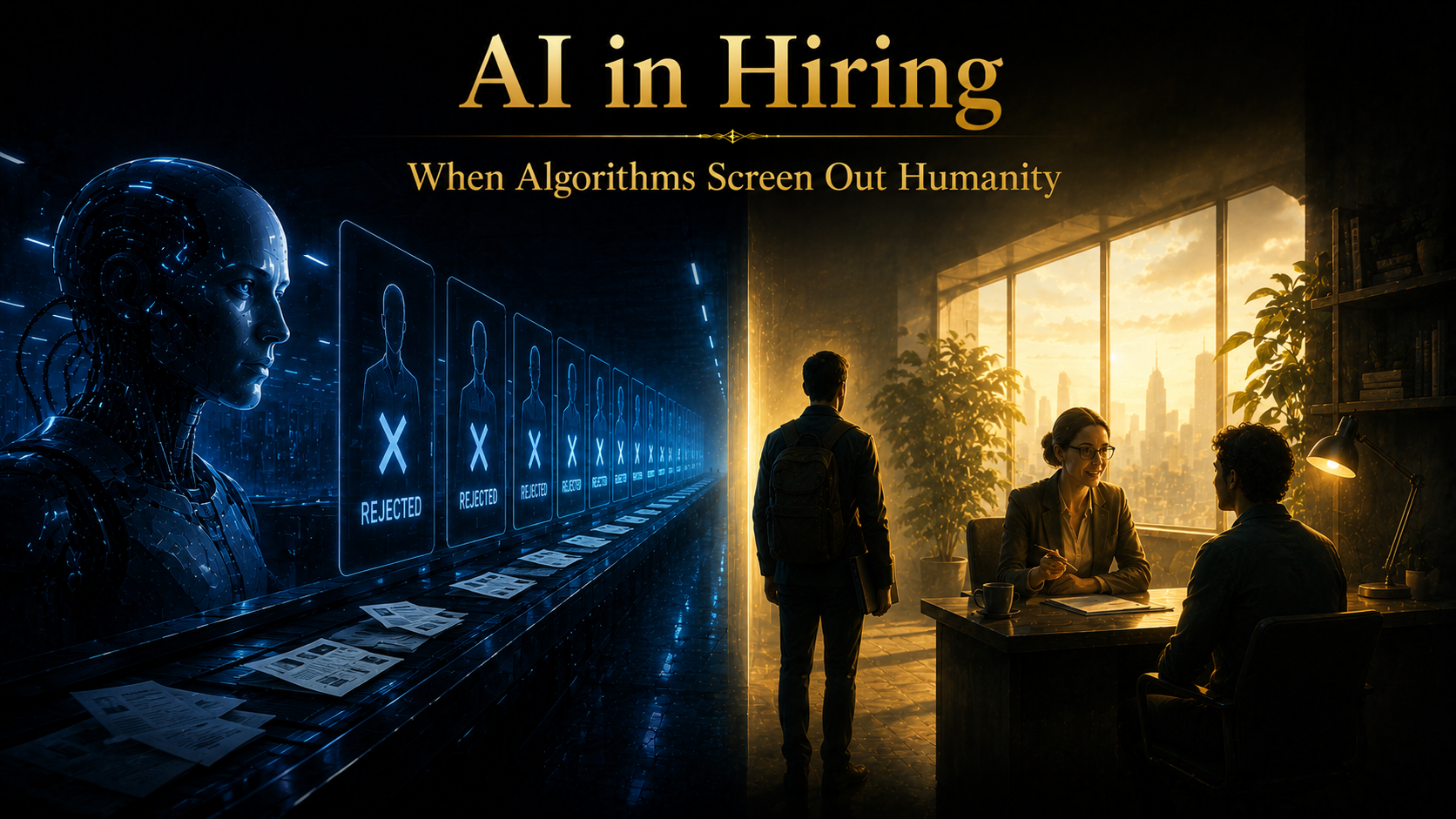
AI hiring systems occupy roles with profound effects on human lives. Resume screeners determine who receives consideration and who disappears into the digital void, never knowing they were rejected by an algorithm before any human saw their application. Interview analyzers evaluate candidates on criteria they cannot see or contest. Candidate rankers reduce humans to scores, positioning them in hierarchies based on pattern matching that may systematically disadvantage entire categories of people. These systems operate at the gateway between individuals and their livelihoods, their ability to provide for families, their professional development and self-worth.
The Vacancy Problem becomes acute in this context. A human hiring manager can perceive the whole person, not merely the data points a resume contains. They can recognize when someone’s circumstances explain gaps in employment, when nontraditional backgrounds bring valuable perspectives, when character qualities matter more than credential lists. They can judge whether hiring criteria actually capture what matters for success in the role or whether they screen out capable people for irrelevant reasons. They can choose to advocate for a candidate who doesn’t fit the mold but demonstrates something the criteria miss.
AI hiring systems can do none of this. They process without perceiving. They filter without judging whether filters serve justice. They reject without any capacity to recognize the human cost of rejection or the organizational cost of overlooking exceptional individuals who don’t match patterns derived from historical data.
The domain inversions in AI hiring are typically severe and multiple.
Value Distribution inverts when AI hiring generates all gains for employers while externalizing all costs onto applicants. The efficiency gains from automated screening accrue to organizations. The costs of algorithmic rejection fall entirely on people who may never know they were evaluated by AI, who cannot contest criteria they cannot see, who receive no explanation for why their applications disappeared. The asymmetry is profound. Organizations invest less in evaluating candidates while candidates invest enormous effort in applications that algorithms dispose of in milliseconds.
Reality Constituting Communication inverts when candidates are screened by AI without knowing it. Many organizations fail to disclose that AI evaluates applications. Candidates craft materials for human readers while algorithms parse them for patterns. The interaction is fraudulent from the start. Candidates believe they are communicating with people who might understand their unique circumstances when they are actually being processed by systems incapable of such understanding. As we examined in our discussion of honest AI communication, this deception attacks the foundation of trustworthy relationship between organizations and the people who seek to join them.
Contextual Consistency inverts when AI hiring applies different standards across candidate populations. The same organization may carefully vet senior executives through human judgment while subjecting entry-level applicants to pure algorithmic screening. The powerful receive human consideration while the vulnerable face algorithmic gatekeeping. This stratification reveals organizational values. If human judgment matters for positions where organizations feel they cannot afford mistakes, why does it not matter for positions where individual candidates cannot afford to be algorithmatically rejected without recourse?
The bias problems in AI hiring have received considerable attention, and rightly so. Systems trained on historical hiring data encode historical discrimination. Patterns that correlate with past hiring decisions may reflect prejudice rather than job performance. Protected characteristics may be inferred from proxy variables even when explicitly excluded. But the deeper problem is not that AI hiring systems are biased. It is that they are being used to make decisions that require moral judgment by systems categorically incapable of such judgment.
An unbiased AI hiring system, were such a thing possible, would still be incapable of perceiving the candidate as a person. It would still filter humans through criteria without judging whether criteria serve justice. It would still reject candidates without capacity to recognize when standard approaches fail individual circumstances. The problem is not bias but vacancy. The role requires moral presence that AI cannot provide regardless of how carefully its algorithms are tuned.
The human hiring manager considering the unconventional candidate exercises precisely the capacities that matter most in hiring decisions. They perceive the whole person. They judge whether criteria capture what matters. They choose whether to take a chance. These are not bugs in human decision-making that AI should eliminate. They are the moral agency that hiring decisions require.
This does not mean AI has no role in hiring. AI can legitimately assist human decision-makers by surfacing relevant information, identifying candidates who might otherwise be overlooked, or handling genuinely administrative tasks. The critical distinction is whether AI augments human moral agency or replaces it. A system that helps hiring managers consider more candidates than they otherwise could, while preserving human judgment about who merits consideration, serves differently than a system that makes rejection decisions humans never review.
The governance framework for AI hiring must address the Daisy Chain Principle with particular rigor. When AI screens candidates, accountability cannot diffuse into algorithmic complexity. Specific humans must bear responsibility for the criteria AI applies, for the populations AI affects differently, for the candidates AI rejects. The question for governance is whether these humans are exercising their moral agency well or poorly when they deploy systems that process without perceiving, filter without judging, reject without recognizing.
Organizations should ask themselves what happens to the candidate whose exceptional qualities the criteria miss. Under human hiring, that candidate might encounter a manager who perceives something beyond the patterns. Under AI hiring, that candidate simply disappears, rejected by a system that cannot recognize what it is losing. The organizational cost of such rejections is invisible precisely because the candidates were never considered. The human cost falls on people who may never know they were screened out by an algorithm rather than evaluated by a person.
The governance question is not whether AI hiring is technically accurate but whether it is ethically appropriate to occupy a role requiring moral judgment with a system incapable of such judgment. The answer requires organizations to confront what hiring decisions actually demand: not pattern matching but perception, not filtering but judgment, not processing but genuine evaluation of the humans who seek to contribute their labor and talents. AI hiring systems reveal organizational willingness to treat applicants as data points rather than persons. The accountability for this choice belongs to the humans who make it.