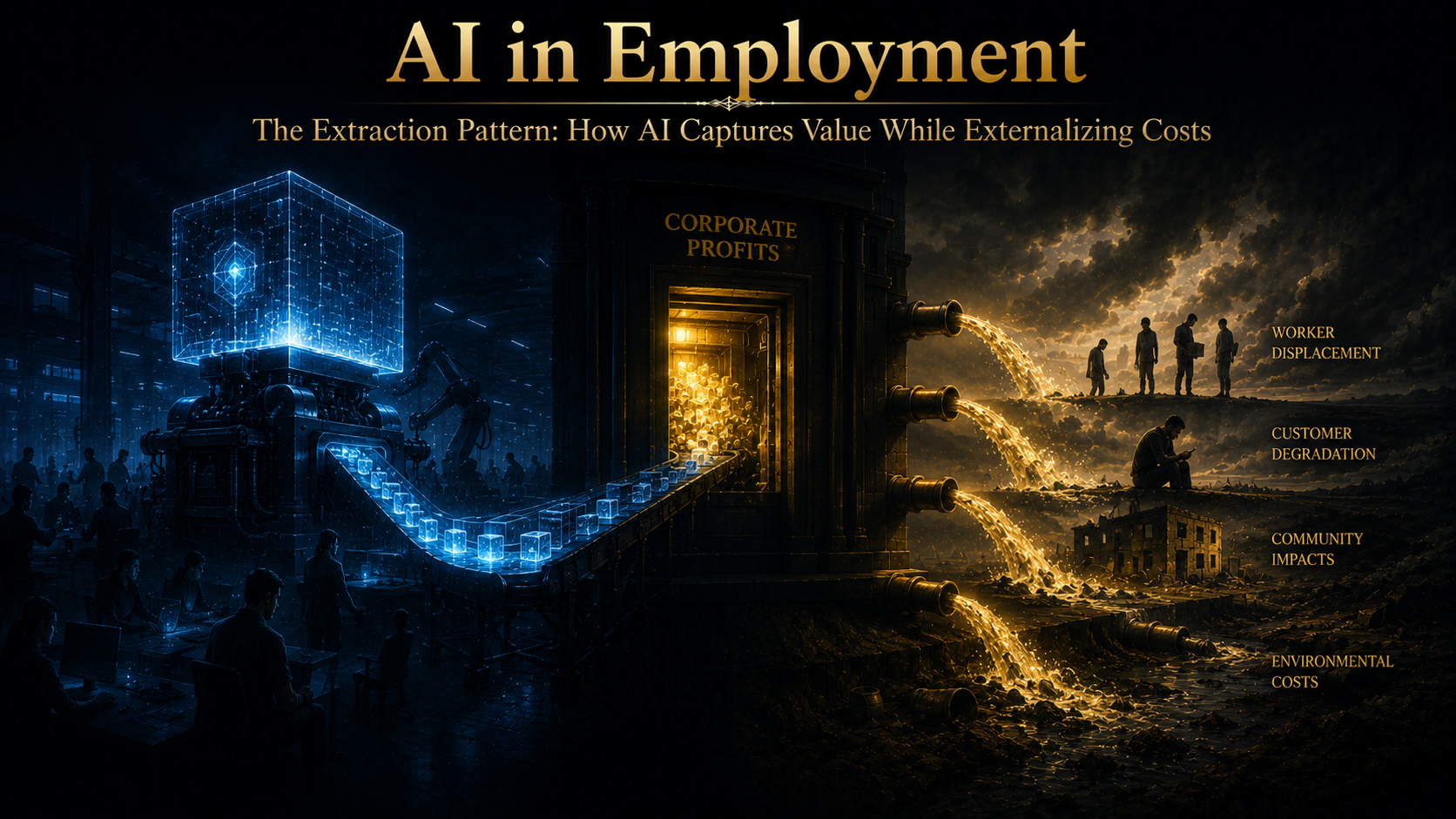
AI generates enormous value. Efficiency improves. Productivity increases. Capabilities expand. The question that governance must address is deceptively simple: Where does that value flow?
The extraction pattern answers this question in ways that should concern anyone committed to ethical AI deployment. Under this pattern, organizations use AI to capture all generated value while externalizing costs to stakeholders who enabled that value creation. Workers contribute effort that AI efficiency gains amplify, then receive no share of the amplified returns while bearing the costs of job displacement and deskilling. Customers provide the data and interactions that AI systems require, then experience service degradation while prices remain unchanged. Communities supply the infrastructure and social conditions that enable organizational success, then absorb displacement effects without transition support.
This pattern is not new. Organizations have always faced choices about how to distribute the gains their activities generate. What AI changes is the scale. AI-generated efficiency gains can be massive, which means the distribution choices organizations make carry correspondingly massive consequences. An organization that captured ten percent efficiency gains while externalizing costs to stakeholders operated within one ethical boundary. An organization that captures fifty percent efficiency gains while externalizing costs operates at a wholly different scale of extraction.
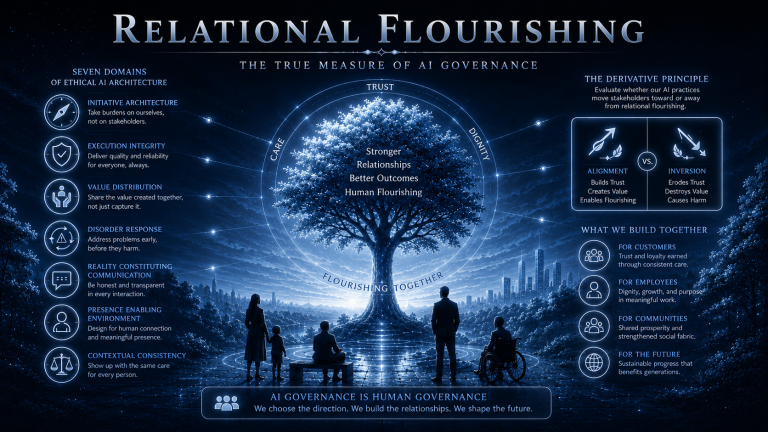
Domain Three of the Seven Domains framework addresses Value Distribution. This domain evaluates whether AI-generated value flows to stakeholders who enable organizational success or concentrates within the organization while costs externalize outward. The aligned organization treats AI efficiency gains as shared resource, recognizing that stakeholders who contribute to value creation deserve participation in value distribution. The inverted organization treats AI efficiency gains as pure organizational capture, directing all benefits inward while pushing all costs onto those with less power to resist.
The extraction pattern typically manifests through several mechanisms that governance must recognize and address.
Worker extraction occurs when AI amplifies productivity while workers receive none of the gains. The employee whose output doubles through AI assistance continues receiving the same compensation while the organization captures all additional value. The justification offered is that productivity gains reflect AI capability rather than worker contribution. But this argument fails on examination. The worker still contributes the effort that AI augments. The worker often develops expertise in using AI effectively. The worker bears the stress and adaptation costs of changing work processes. The extraction pattern seizes all gains while attributing none to the human labor that remains essential.
Customer extraction occurs when AI reduces organizational costs while customers experience degraded service at unchanged prices. The customer service AI that replaces human representatives reduces organizational expense substantially. If customers received proportional price reductions, value would be shared. Instead, customers typically receive degraded service while paying the same amounts, with all cost savings flowing to organizational profit. The degradation may be subtle. Average interactions may seem similar. But the customer who needs actual help, who faces an unusual situation, who requires human judgment discovers that what they receive has been hollowed out while what they pay remains constant.
Community extraction occurs when AI displaces workers without organizations providing transition support. The warehouse that automates eliminates jobs held by community members. Those workers must find new employment, likely at lower wages and worse conditions. The community must absorb unemployment effects, provide social services for displaced workers, manage the ripple effects through local economies. The organization that created these costs bears none of them. Efficiency gains flow to shareholders while displacement costs flow to communities that have no mechanism to recover them.
The rationalization for extraction typically invokes market necessity or competitive pressure. Organizations claim they must capture efficiency gains to survive, that competitors would seize advantage if they shared value with stakeholders, that market dynamics leave them no choice. This rationalization reveals more than it intends. It acknowledges that extraction occurs while denying responsibility for the choice to extract. But competitive pressure does not remove moral agency. Organizations choose how to respond to competitive conditions. The choice to extract while externalizing costs reflects ethical direction, not market necessity.
The Derivative Principle provides the assessment framework. Does AI deployment move stakeholders toward flourishing or away from it? Workers whose productivity gains are entirely captured while they bear adaptation costs move away from flourishing. Customers whose service degrades while prices hold move away from flourishing. Communities absorbing displacement effects without support move away from flourishing. The organization may flourish financially through extraction, but stakeholder flourishing is what ethical AI governance must assess.
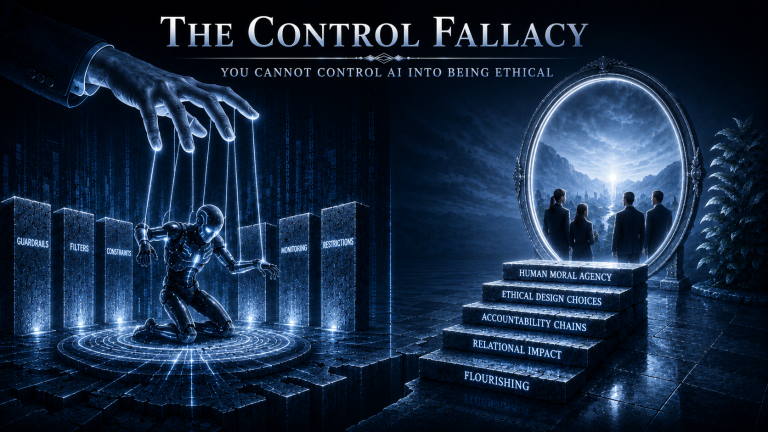
Structural accountability requires that extraction decisions trace to accountable humans. The executives who direct efficiency gains entirely to shareholders are making moral choices. The boards that approve extraction strategies bear responsibility for what those strategies do to affected stakeholders. The investors who demand extraction returns are choosing stakeholder harm over stakeholder partnership. Accountability cannot dissolve into claims that AI decided or markets required or competition forced.
The alternative to extraction is partnership. Partnership recognizes that AI-generated value results from organizational capability, worker contribution, customer participation, and community support. Partnership distributes value among these contributors rather than concentrating it entirely within the organization. Partnership can take various forms: compensation increases when AI augments productivity, price reductions when AI reduces costs, transition support when AI displaces workers, community investment when AI concentrates returns.
Partnership is not charity. It reflects accurate understanding of how value is created. The organization that treats AI efficiency gains as purely organizational achievement ignores the worker effort that AI augments, the customer relationships that AI serves, the community infrastructure that AI depends upon. Extraction denies the reality of shared contribution. Partnership acknowledges it.
Organizations choosing extraction will find short-term financial success. Capturing gains while externalizing costs improves immediate returns. But extraction erodes the stakeholder relationships that sustainable organizational success requires. Workers who receive none of the value they help create disengage, leave, or unionize. Customers who experience degradation while prices hold defect when alternatives emerge. Communities that absorb costs without benefits withdraw support through regulation, taxation, or social sanction. Extraction trades long-term sustainability for short-term capture.
The governance framework for AI value distribution must require explicit accounting for where value flows. Organizations should document what AI efficiency gains they achieve, who bears the costs of AI deployment, how gains are distributed among stakeholders, and what justifies the distribution pattern they have chosen. This transparency enables assessment. Organizations that cannot explain their distribution choices without revealing extraction should reconsider those choices.
As we have examined throughout this series on industry applications, AI amplifies human choices. The choice to extract rather than share has always existed. AI makes that choice consequential at unprecedented scale. Organizations rationalizing extraction as market necessity reveal their ethical direction. Organizations choosing partnership even when extraction would be profitable demonstrate alignment with stakeholder flourishing. The accountability for this choice belongs entirely to the humans who make it, and the consequences extend to every stakeholder whose flourishing depends on whether value is shared or seized.