
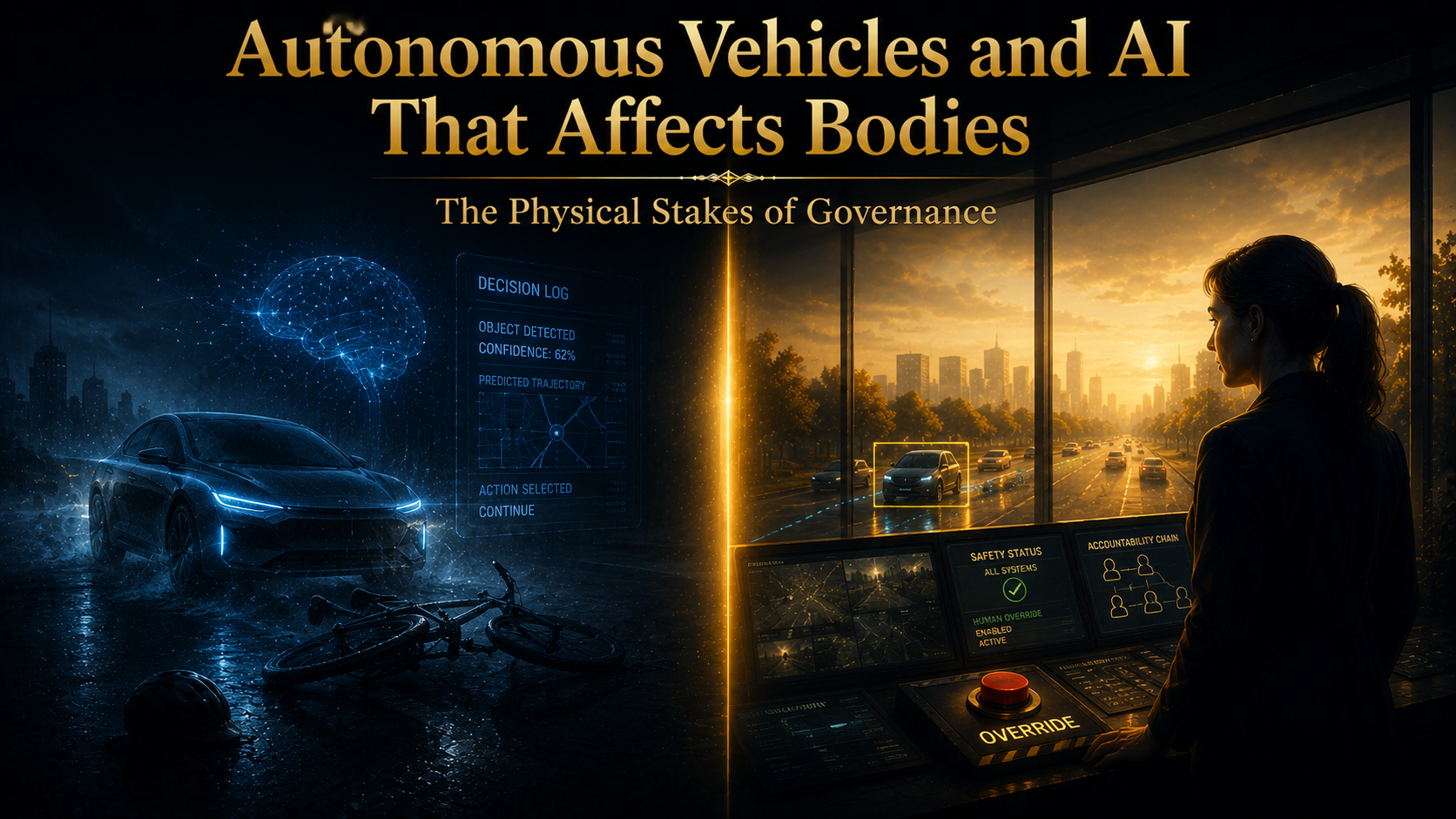
When AI controls a vehicle hurtling down a highway, the governance stakes are no longer abstract. A failure in this context does not produce a poor customer experience or an unfair hiring decision. It produces physical injury or death. The human body becomes the site where governance failures manifest, and no amount of efficiency gains or capability improvements compensates for bodies harmed by AI systems operating without adequate human oversight.
Physical AI encompasses autonomous vehicles, but extends far beyond them. Medical devices that administer treatments, industrial machinery that operates autonomously, robotic systems that work alongside or in proximity to humans, infrastructure controls that manage physical systems all fall within this category. What unites them is that failure affects bodies, not merely experiences or outcomes. This physical stake transforms every domain of ethical AI architecture.
Execution Integrity demands standards that digital AI does not require. A recommendation engine that fails ten percent of the time frustrates users. A diagnostic AI that errs ten percent of the time may harm patients. But an autonomous vehicle that fails ten percent of the time kills people. The error rates acceptable in digital domains become unacceptable when errors mean physical harm. Organizations deploying physical AI must achieve reliability standards that digital AI has never approached, and governance must verify that such standards are actually met, not merely claimed.
The quality challenge in physical AI is not merely technical but moral. How much risk is acceptable when risk means bodily harm? Who decides what level of reliability justifies deployment? Whose bodies bear the consequences of errors that governance permitted? These questions require human moral judgment about how to balance innovation benefits against physical risks. They cannot be answered by technical assessment alone. Governance must ensure that humans with appropriate authority make these judgments and bear accountability for them.
Accountability Architecture becomes critical when AI affects bodies. When an autonomous vehicle harms someone, who is responsible? The software developer who wrote the code? The vehicle manufacturer who deployed it? The fleet operator who put it on the road? The passenger who chose to use autonomous mode? The governance framework that permitted deployment? Under the Daisy Chain Principle we have examined throughout this series, accountability must trace through AI chains to reach humans with moral agency. But physical AI creates chains of unprecedented complexity, with many contributors and diffuse causation.
Clear accountability architecture for physical AI requires that responsibility be assigned before deployment, not litigated after harm occurs. Organizations must specify who bears responsibility for each component of physical AI systems. Governance must verify that assigned individuals have both authority to influence AI behavior and accountability for outcomes. The diffusion of responsibility that complex AI enables must be actively prevented through governance structures that maintain clear chains of human accountability.
Human Override becomes essential when AI affects bodies. Humans must retain both the authority and the capability to intervene before physical AI produces harm. This requirement sounds simple but proves technically and organizationally challenging. Autonomous vehicles operate at speeds that may exceed human reaction time. Medical devices may initiate actions faster than humans can countermand. Industrial systems may create physical conditions where intervention becomes dangerous. The design challenge is ensuring meaningful human override despite these constraints.
Meaningful override requires more than theoretical capability. It requires that humans actually exercise oversight, that they have information enabling informed intervention decisions, that the systems support rather than undermine human engagement, and that organizational culture prioritizes safety over efficiency when tension exists. An override capability that humans never use because AI seems to work fine provides no protection when AI fails catastrophically.
The Vacancy Problem manifests distinctly in physical AI contexts. The human driver exercises continuous judgment about road conditions, other drivers, pedestrians, weather, vehicle performance, and countless other factors. This judgment happens unconsciously, drawing on human capacities developed over millions of years of navigating physical environments. The autonomous vehicle attempts to replicate this judgment through sensors and algorithms. But the vehicle has no survival instinct, no ethical commitment to protecting others, no capacity to perceive that the figure at the roadside is a child who might dart into traffic. The physical vacancy is not merely moral but perceptual, not merely about values but about the embodied understanding that humans bring to physical navigation.
Contextual Consistency creates particular concerns for physical AI. Do organizations apply the same safety standards across all deployment contexts? The pattern of stratified standards we have examined in other domains appears frequently in physical AI. Autonomous vehicles may be tested extensively in favorable conditions while deployed in contexts where testing was minimal. Medical devices approved for certain populations may be used in populations with different characteristics. Safety standards applied visibly may relax in contexts where failures are less likely to attract attention.
The ethical assessment of physical AI must reject this stratification. If a safety standard matters in any context, it matters in all contexts. Bodies are equally valuable regardless of whose bodies they are, where they are located, or whether harm to them would be visible. Organizations deploying physical AI with variable safety standards across contexts reveal that their standards reflect public relations concern rather than genuine commitment to bodily protection.
The stakes of physical AI governance justify governance intensity exceeding other domains. Physical AI deployment should require explicit approval from governance bodies with authority to reject systems that do not meet safety standards. Ongoing monitoring should verify that deployed systems maintain safety performance. Incident investigation should determine not merely what went wrong technically but what governance failures permitted systems inadequate for physical deployment to reach physical contexts. Accountability should be clear, personal, and consequential.
The fundamental question physical AI poses is whether organizations are willing to accept governance constraints that protect bodies even when those constraints limit capability deployment. The self-driving car that must wait for more testing operates less efficiently than the car deployed now. The medical device that requires additional trials reaches patients later than the device approved quickly. The industrial system with more extensive safeguards costs more than the minimal system. In each case, governance constraints trade capability against safety.
Organizations committed to ethical physical AI accept these tradeoffs. They recognize that bodies cannot be the site where capability ambitions are tested. They understand that efficiency gains never justify bodily harm. They design governance systems that prioritize protection over deployment, safety over speed, human wellbeing over organizational advancement. Organizations that chafe against safety constraints, that seek to minimize governance burdens, that treat bodily risk as acceptable cost of innovation reveal their ethical direction through these choices.
As we conclude this series on industry applications, physical AI presents the clearest case for why governance matters. The domains we have examined throughout this series become most visible when bodies are at stake. Initiative Architecture asks whether physical AI serves human safety or organizational efficiency. Execution Integrity demands reliability that protects bodies from harm. Value Distribution considers who bears the risks of physical AI while others capture its benefits. Human Override ensures that humans can prevent harm before it occurs. Accountability Architecture traces responsibility for physical outcomes to accountable humans. The Two Conditions require both structural accountability and directional alignment toward human bodily flourishing.
The humans who design, deploy, and govern physical AI exercise moral agency with stakes that could not be higher. Their choices determine whether AI serves human bodily wellbeing or treats bodies as acceptable cost of capability advancement. The accountability for these choices cannot diffuse into technical complexity or organizational structure. It belongs to the humans who make them, and the consequences manifest in the bodies of those whose physical safety governance either protects or fails to protect.