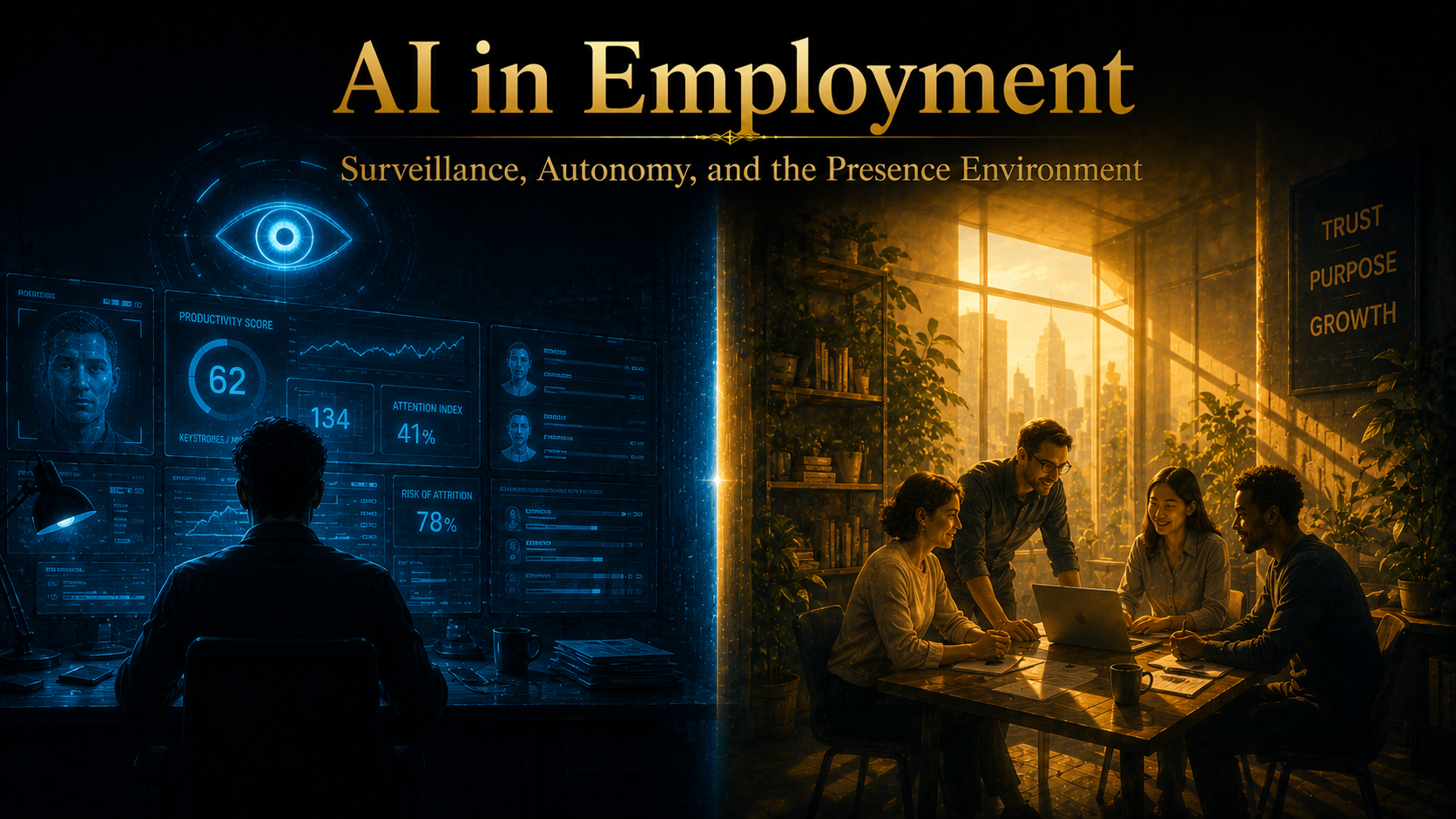
The employee arrives at work and logs into systems that track every keystroke. Algorithms analyze their communications for sentiment and productivity signals. Performance dashboards quantify their contributions against benchmarks derived from peer comparisons. Predictions about their likelihood of leaving influence how managers interact with them. The workplace has become an AI-shaped environment that surveils, measures, predicts, and manages the human beings who inhabit it.
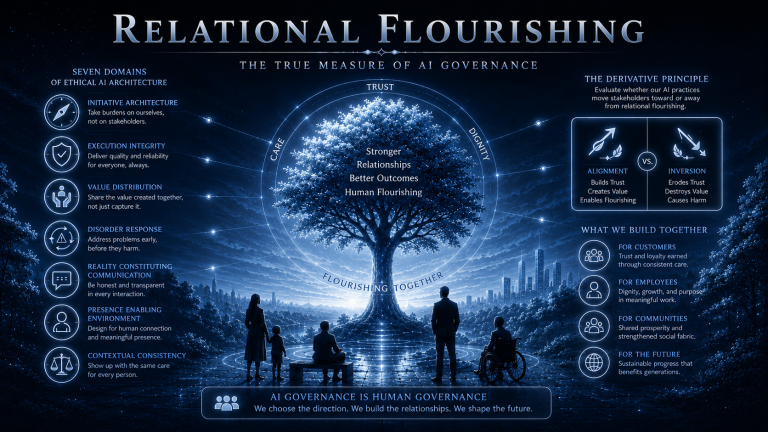
Domain Six of the Seven Domains framework addresses the Presence Enabling Environment. This domain asks whether AI-shaped spaces allow humans to be fully, attentively, autonomously present, or whether they systematically degrade the conditions under which authentic human presence becomes possible. Nowhere is this question more pressing than in employment contexts where workers spend the majority of their waking hours in environments increasingly shaped by AI systems.
The employment environment affects human flourishing profoundly. Work is not merely economic exchange. It provides meaning, community, identity, opportunities for growth and contribution. The conditions under which work occurs determine whether employment enables human flourishing or degrades it. When AI shapes those conditions, organizations bear responsibility for what AI does to the humans who must exist within those environments.
Three dimensions of the Presence Enabling Environment prove particularly critical in employment contexts: surveillance, attention, and autonomy.
Surveillance maximized beyond operational necessity erodes the trust and psychological safety that meaningful work requires. Some monitoring serves legitimate purposes. Organizations need to ensure systems function, to protect against security threats, to meet regulatory requirements. But surveillance that extends beyond these necessities into comprehensive tracking of employee behavior creates environments hostile to human presence. Workers who know their every action is being watched, analyzed, and scored cannot be fully present to their work. Self-consciousness replaces engagement. Impression management replaces authentic contribution. The surveillance environment degrades the very performance it claims to optimize.
The ethical assessment of workplace surveillance must consider not merely whether surveillance is technically possible or legally permitted but whether it serves employee flourishing or merely organizational control. Surveillance that helps employees improve their work differs fundamentally from surveillance that subjects employees to algorithmic judgment they cannot see or contest. Surveillance that protects workers from harm differs from surveillance that treats workers as potential threats requiring constant monitoring. The distinction lies in directional alignment: Does surveillance serve the humans being surveilled or merely the organization surveilling them?
Attention capture through algorithmic notification systems presents another presence challenge. Modern work environments bombard employees with alerts, updates, notifications, and interruptions that fragment concentration and prevent the deep engagement that meaningful work requires. AI systems optimized for engagement capture attention without regard for whether captured attention serves the human whose attention is captured. The notification that pulls an employee away from focused work may serve organizational communication goals while degrading the employee’s capacity to contribute their best thinking.
The attention environment matters because human presence requires sustained focus. Creative work, analytical work, relational work all demand concentration that algorithmic interruption systematically undermines. Organizations deploying AI systems that fragment employee attention while celebrating communication efficiency have not understood what they are destroying. The employee who cannot maintain focus, who lives in constant reaction to algorithmic prompts, who never achieves the flow state that meaningful work requires, has been denied the environmental conditions for genuine presence at work.
Autonomy erosion through algorithmic management removes the discretion and judgment that give work meaning. When AI systems prescribe exactly how work should be performed, workers become executors of algorithmic decisions rather than agents exercising their own judgment. The warehouse worker whose movements are algorithmically choreographed, the customer service representative whose responses are scripted by AI, the professional whose priorities are determined by algorithmic analysis rather than professional judgment has had their autonomy systematically removed.
Work without autonomy is not merely less satisfying. It fails to develop human capacities. Workers who never exercise judgment never develop better judgment. Workers denied discretion never learn to use discretion wisely. The algorithmic management that optimizes immediate efficiency does so by preventing the human development that meaningful work provides. This represents a fundamental inversion of what employment relationships should enable.
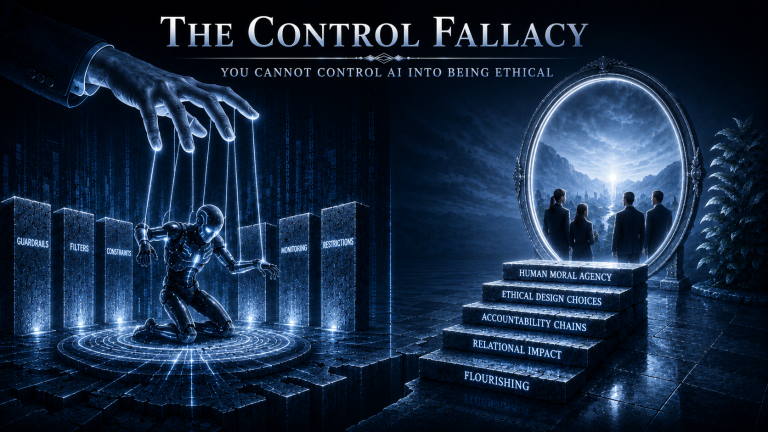
The governance framework for employment AI must address these environmental effects comprehensively. Organizations deploying AI in employment contexts cannot disclaim responsibility for what those deployments do to the humans who must work within them. The humans who design surveillance systems, who deploy attention-capturing notification architectures, who implement algorithmic management bear moral responsibility for the environments they create.
Structural accountability in employment AI requires that specific humans remain responsible for environmental effects. The executive who approves pervasive monitoring must be accountable for what monitoring does to employee wellbeing. The manager who implements algorithmic scheduling must be accountable for how algorithmic schedules affect worker lives. The designers who create notification systems must be accountable for attention fragmentation their systems produce. Accountability cannot diffuse into claims that algorithms decided or systems required or competitors forced.
Directional alignment in employment AI requires that systems be aimed at employee flourishing, not merely organizational efficiency extracted from employee effort. This does not mean abandoning organizational productivity. It means recognizing that sustainable productivity comes from engaged, present, autonomous workers, not from surveilled, fragmented, managed resources. The organization that degrades its employment environment for short-term efficiency gains will discover that degraded environments produce degraded work, degraded retention, degraded capacity for the innovation and commitment that competitive success requires.
The Vacancy Problem manifests distinctly in employment environments. The manager who once exercised judgment about individual employees now relies on algorithmic predictions and recommendations. The colleague who once provided human connection now communicates through AI-mediated platforms that analyze and score every interaction. The mentor who once offered wisdom now points to automated learning systems. The employment relationship itself becomes vacant of the human presence it once contained.
Workers notice this vacancy even when they cannot articulate it. The sense that no one really sees them, that their work reduces to data points in algorithmic assessments, that their value depends on metrics they cannot influence rather than contributions they can make represents the felt experience of working in environments where moral presence has been systematically removed.
As we examined in our broader discussion of the Presence Enabling Environment, the ethical assessment of AI environments must consider what humans need to flourish. Employment environments must enable presence, engagement, and growth. AI that supports these conditions while addressing legitimate organizational needs can achieve alignment. AI that degrades these conditions while capturing efficiency gains inverts the domain regardless of the productivity metrics it achieves.
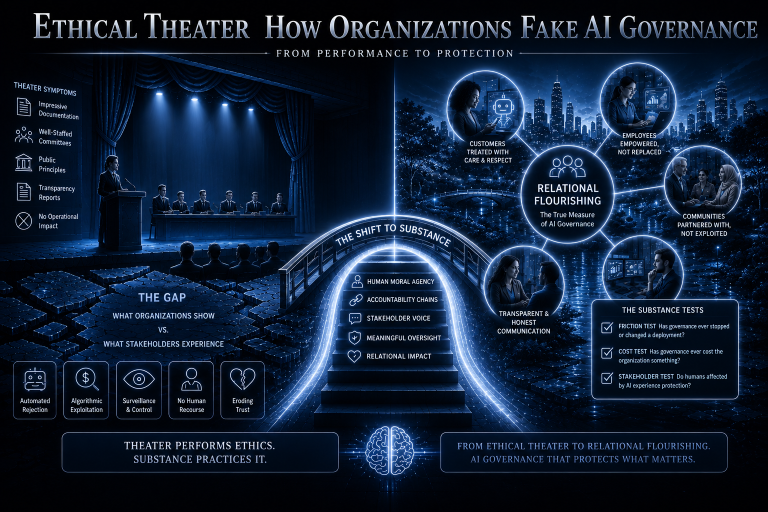
The fundamental question for employment AI is whether organizations see their workers as humans whose flourishing matters or as resources to be optimized. The AI systems organizations deploy reveal this answer more clearly than any statement of corporate values. Surveillance environments, attention-fragmenting architectures, and autonomy-removing management systems all testify to how organizations actually regard the people whose labor they employ. The accountability for these choices belongs to the humans who make them.