What Is Moral Agency and Why AI Will Never Have It
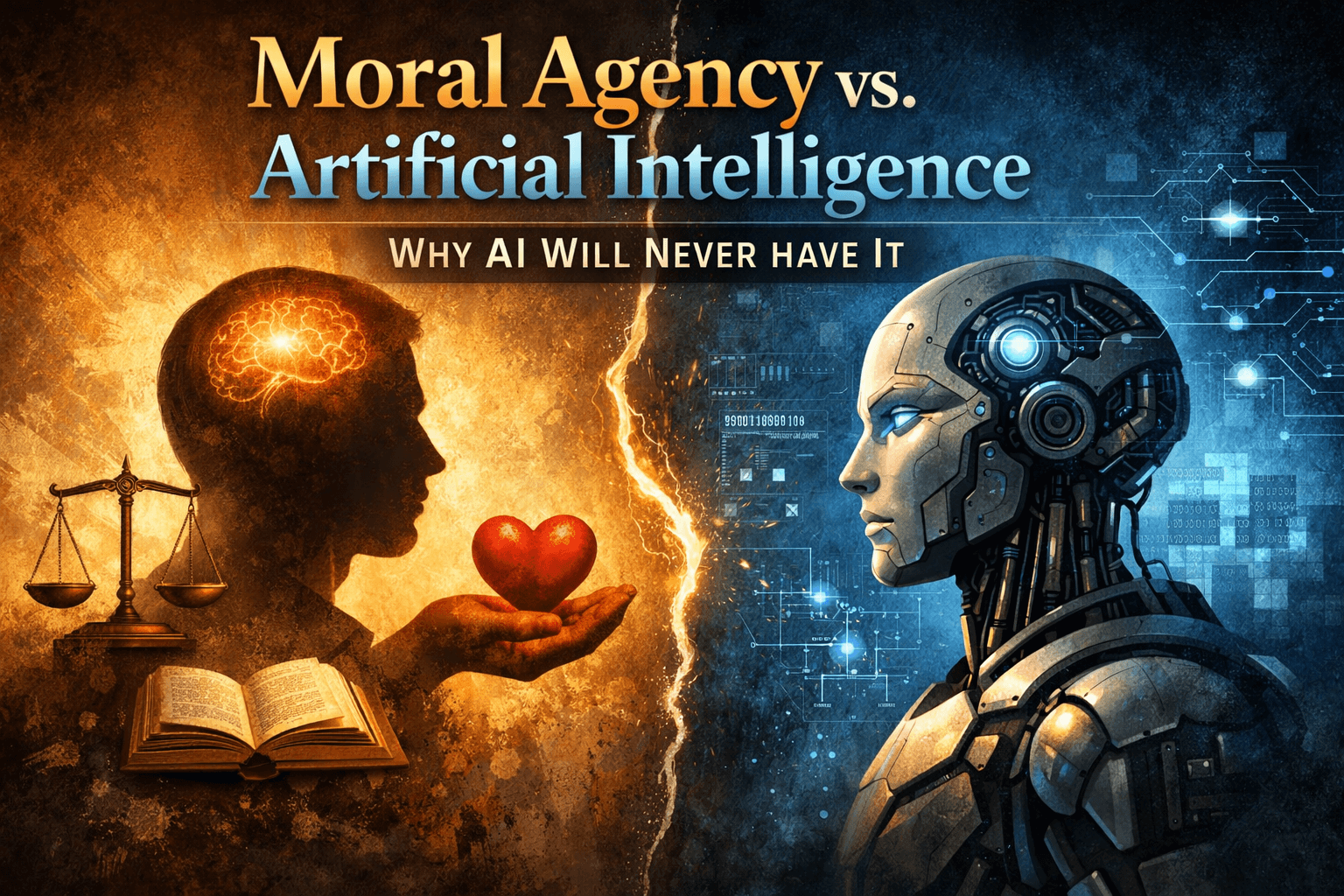
Much of the confusion in contemporary AI governance stems from a fundamental philosophical error: treating intelligence as if it were equivalent to moral agency. We observe AI systems that can process vast information, generate sophisticated outputs, reason through complex problems, and even articulate ethical principles more precisely than most humans could manage. We then assume, often without recognizing the assumption, that such intelligent systems must be approaching something like moral agency. This assumption is not merely wrong; it obscures where ethical evaluation actually belongs and misdirects governance toward controlling AI behavior rather than examining human moral choices.
In the previous posts in this series, we established that AI governance must focus on human moral agency exercised through AI systems and that the critical governance trigger is when AI shifts from tool to role. This post examines what moral agency actually requires and why AI, regardless of sophistication, can never possess it. This is not a limitation to be overcome through better technology. It is a category distinction that determines where ethical questions properly belong.
The Four Capacities of Moral Agency
Moral agency requires four distinct capacities working together. First, the capacity to perceive moral reality: to recognize that a situation has moral dimensions, that something is at stake, that values and principles apply. A person with moral agency walks into a room and perceives not just physical objects and social dynamics but moral features of the situation. They perceive that someone is being treated unfairly, that a commitment is being honored or broken, that a vulnerable person needs protection. This perception is not inference from observable data but direct apprehension that something matters.
Second, the capacity to deliberate about choices. Once moral reality is perceived, the moral agent weighs competing considerations. What does fairness require here? How do I balance this person’s needs against that person’s legitimate claims? What principles apply, and how do they interact when they conflict? Deliberation is not calculation. It involves holding multiple moral considerations simultaneously, feeling their weight and tension, and working through how they bear on the specific situation at hand. It is qualitative reasoning about values, not quantitative processing of variables.
Third, the capacity to exercise judgment. After perceiving and deliberating, the moral agent must judge what to do. This judgment is not algorithmic derivation from principles but a choice that the agent makes and owns. Two people with identical information, identical principles, and similar deliberative processes might reasonably reach different judgments about what a situation requires. Judgment involves bringing one’s character, experience, and moral commitments to bear on specific circumstances that principles alone cannot resolve.
Fourth, the capacity to act on that judgment and bear responsibility for the action. Moral agency culminates not in having good thoughts but in doing something and being accountable for what one does. The moral agent acts in the world, affects other people, creates consequences that matter. And the moral agent owns those consequences, whether praiseworthy or blameworthy, intended or unintended. Moral responsibility attaches to the agent who chose and acted, not to the circumstances that informed the choice.
Why Intelligence Does Not Create Moral Agency
AI systems can process information about moral concepts. They can identify patterns in how humans discuss ethics. They can generate outputs that articulate ethical principles, describe moral dilemmas, and even recommend courses of action that sophisticated moral reasoning might endorse. None of this constitutes moral agency because none of it involves perceiving, deliberating, judging, or bearing responsibility in the senses that moral agency requires.
AI does not perceive moral reality. It processes representations encoded as data. When an AI system identifies that a situation matches patterns associated with unfairness in its training data, it is not perceiving that unfairness exists and matters. It is computing statistical relationships. The difference is categorical. A human perceives unfairness and cares about it, feels its weight, experiences it as a claim on action. AI computes correlations with training patterns and generates probability distributions. These are not different degrees of the same activity; they are entirely different activities.
AI does not deliberate about choices. It processes inputs according to architectures and parameters established by human designers. When an AI system appears to weigh competing considerations, it is executing mathematical operations over vector representations. The system does not experience tension between competing values, does not feel the pull of different moral commitments, does not work through how principles bear on particulars. It computes. The sophistication of the computation does not transform it into deliberation any more than elaborate calculation transforms a calculator into a reasoner.
AI does not exercise judgment. It produces outputs determined by its training and architecture. Even when those outputs are not strictly deterministic, the stochastic elements reflect random variation, not judgment. AI cannot bring character and moral commitment to bear on circumstances because AI has no character and no commitments. It has parameters. Parameters are not commitments. They are mathematical values that shape information processing. When AI produces an output, no one judged anything. Data flowed through a computational architecture and produced a result.
AI cannot bear responsibility for its outputs. Responsibility requires that someone chose to act, could have chosen otherwise, and is accountable for the choice made. AI does not choose. It executes. When an AI system produces an output that harms someone, the harm occurred, but no one inside the AI system chose to cause it. The responsibility belongs to humans: the designers who created the architecture, the developers who trained the model, the operators who deployed it, the organizations that authorized its use. The ethical questions are about human choices, not AI actions.
The Persistence of Human Moral Responsibility
Recognizing that AI lacks moral agency clarifies where moral responsibility resides. When AI produces outputs that affect human beings, moral responsibility remains entirely with the humans who designed, deployed, and govern the AI. These humans made choices about what AI to create, what data to train it on, what parameters to optimize, what roles to deploy it in, what oversight to provide, what accountability to maintain. Every one of these choices is a moral choice made by humans capable of perceiving, deliberating, judging, and bearing responsibility. The ethical evaluation of AI deployment is the ethical evaluation of these human choices.
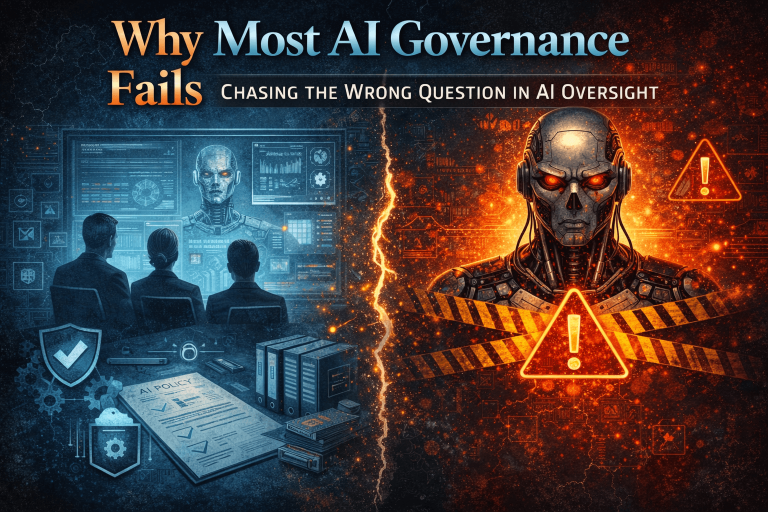
This is why AI governance must focus on human moral agency rather than AI behavior. There is no AI behavior in the morally relevant sense. There are only human choices about how to deploy AI and organizational structures that do or do not maintain human accountability for AI outcomes. Governance that focuses on constraining AI behavior treats symptoms rather than causes. Governance that evaluates human moral choices addresses the actual source of ethical outcomes.
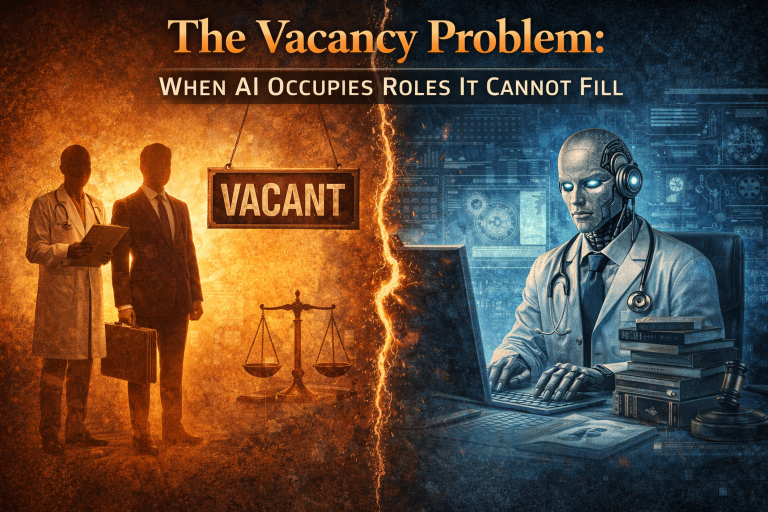
In subsequent posts, we will explore what happens when AI occupies roles requiring moral presence that AI cannot provide. The Vacancy Problem, as we will see, is not that AI performs these roles poorly. It is that certain positions in relationship structures carry moral obligations that only moral agents can fulfill. When AI fills such positions, something essential goes missing regardless of how well AI executes the role’s functions. Understanding moral agency and its absence in AI establishes the conceptual foundation for understanding why this vacancy matters and what governance must do to address it.