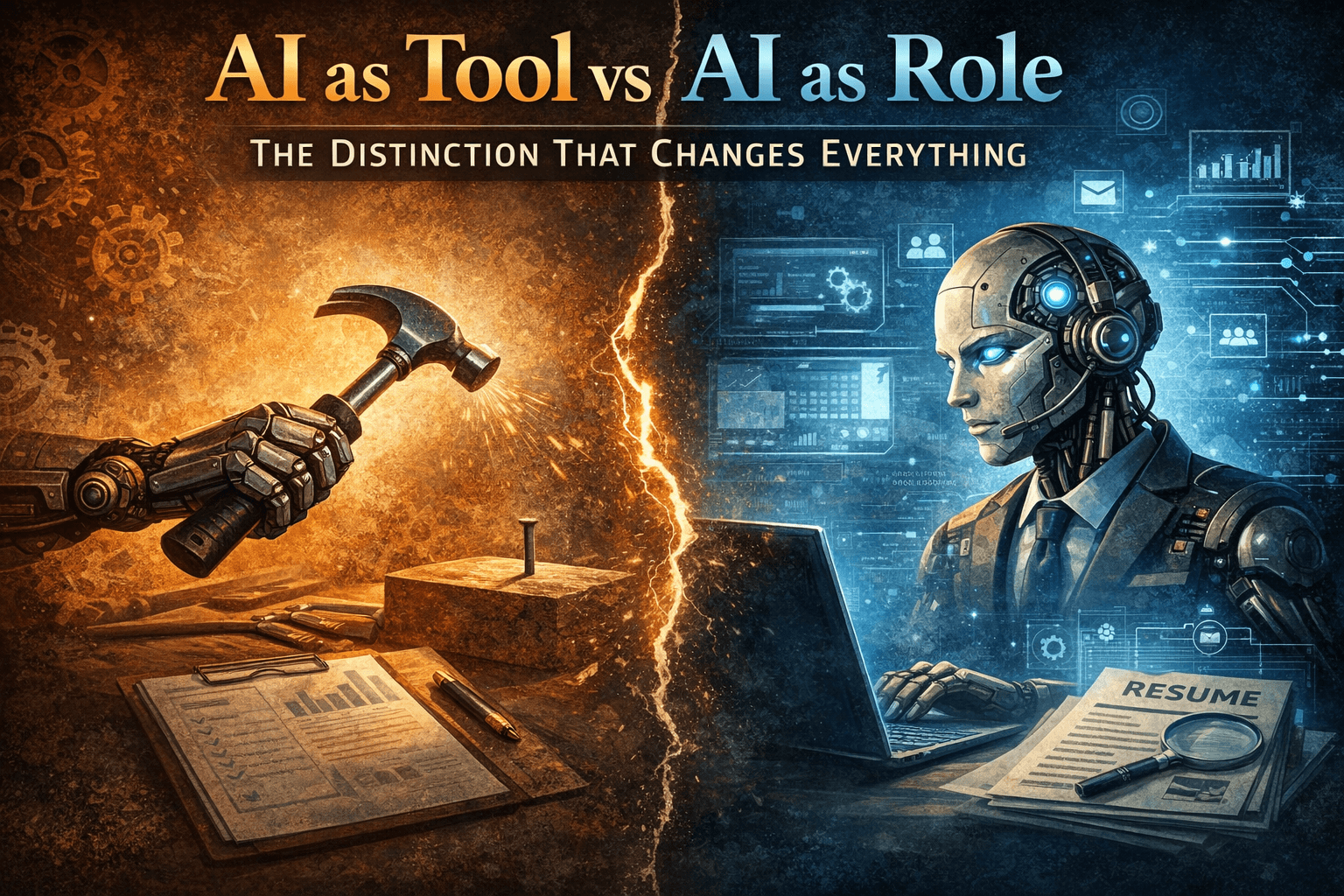
When you use a hammer to drive a nail, no one asks about the hammer’s ethics. The hammer is a tool. You, the person wielding it, bear responsibility for whether you build a house or break a window. When you use ChatGPT to help draft an email, the ethical structure is identical. The AI is a tool. You bear responsibility for whether your email builds relationships or damages them. This much is intuitive and requires no special governance framework beyond normal professional accountability.
But when AI answers customer service calls, screens job applicants, evaluates employee performance, or decides which patients receive medical attention first, something fundamentally different is happening. In these cases, AI is not assisting someone who occupies a role. AI is occupying the role itself. This distinction, based on what we call First Mover Authority, creates the critical governance trigger that most organizations fail to recognize. As we established in the previous post in this series, AI governance must focus on how humans exercise moral agency through AI systems. The tool versus role distinction tells us when that focus becomes urgent.
What Defines a Role
A role is not merely a function to be performed. A role is a defined position within a relationship structure, carrying expectations about how the occupant will act, what responsibilities they bear, and what standing they have relative to others. Customer service representative is a role. The person occupying it has obligations to the customers they serve: to listen carefully, to understand individual situations, to exercise judgment about when standard procedures serve the customer and when they do not, to care about outcomes beyond mere transaction completion. Manager is a role. Physician is a role. Teacher is a role. These positions exist within webs of relationship and carry moral weight that function execution does not capture.
When humans occupy roles, they bring moral agency to those positions. They perceive the moral dimensions of situations they encounter. They deliberate about appropriate responses. They choose courses of action informed by moral judgment, not merely by rules and procedures. A human customer service representative encountering a distressed customer can recognize that this particular situation requires more than scripted responses. A human manager making staffing decisions can judge whether standard procedures produce fair outcomes in specific cases. A human physician treating a patient can determine when protocols should be followed rigidly and when individual circumstances require adaptation. This capacity to perceive, deliberate, and choose based on moral judgment distinguishes role occupancy from mere function execution.
First Mover Authority: The Governance Trigger
The distinction between AI as tool and AI as role hinges on First Mover Authority: who initiates action in the human-AI interaction. When you type a prompt and AI responds, when you request a report and AI generates it, when you trigger automation and AI executes it, you are the first mover. AI responds to your initiation. You retain decision authority. You determine what to do with AI outputs. AI augments your capability without displacing your agency from the relationship structure. In this configuration, AI functions as tool. Traditional technology governance proves sufficient: appropriate use policies, access controls, output quality standards, and clear human accountability for AI-assisted decisions.
When AI initiates action, even within parameters that humans designed, AI functions as role. An AI customer service system that initiates conversations with customers occupies the customer service role. An AI screening system that reviews applications before humans see them occupies a gatekeeper role. An AI trading system that executes transactions without human approval for each trade occupies a trading role. In these configurations, AI initiates actions affecting humans. It occupies positions in relationship structures where humans expect to encounter moral agency. The shift from AI as tool to AI as role creates governance requirements that tool-focused frameworks cannot address.
This is not a gradation but a categorical shift. The transition from Level 1 First Mover Authority (human initiates, AI responds) to Level 2 (AI initiates within designed parameters, human reviews) marks where comprehensive AI governance becomes critical. Above Level 2, the complexity increases but the fundamental issue remains: AI has stepped into positions that carry relationship expectations and moral obligations that AI cannot fulfill.
Why Most Organizations Miss This Distinction
Organizations routinely fail to track which of their AI deployments function as tools and which function as roles. This failure stems partly from how AI capabilities are marketed and acquired. Vendors describe AI as decision support, intelligent assistance, smart automation. These descriptions suggest tool functionality even when the actual deployment crosses into role territory. A hiring AI marketed as decision support that ranks candidates for human review is technically supporting decisions, but if humans accept its rankings without substantive independent evaluation in 95% of cases, the AI is effectively occupying the gatekeeper role. Governance must evaluate operational reality, not marketing descriptions.
The failure also stems from gradual operational drift. An AI system initially deployed at Level 1, with humans always initiating its use, can evolve toward Level 2 as users gain confidence in its capabilities. A generative AI writing assistant initially used to edit human drafts begins generating complete first drafts that humans then edit. An analytical AI initially queried when humans want recommendations begins automatically flagging cases requiring attention. These transitions may occur through deliberate operational changes, through usage pattern evolution, through AI system updates that add autonomous features, or through organizational process redesign that embeds AI more deeply. Regardless of how transition occurs, the governance implications are substantial. What was adequate governance for Level 1 becomes dangerously inadequate for Level 2.
The Governance Implications
When AI functions as tool, organizations need traditional technology governance extended to AI capabilities. Appropriate use policies specify what AI tools may be used for. Access controls determine who can use which tools. Data handling policies protect information entered into AI systems. Quality standards ensure AI outputs meet organizational requirements. Training ensures users understand capabilities and limitations. Vendor management ensures adequate contractual protections. These requirements resemble those for other enterprise software tools. Existing governance bodies can manage them within established frameworks.
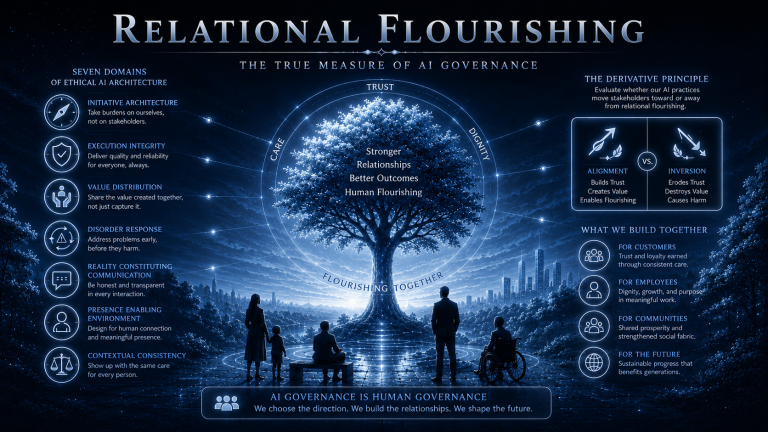
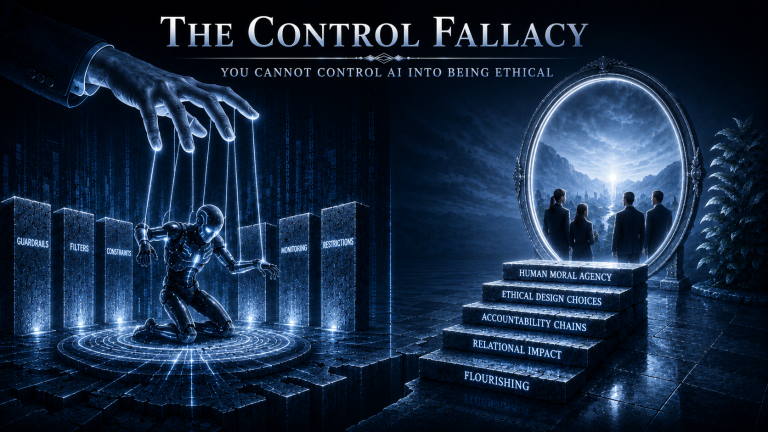
When AI functions as role, organizations need something fundamentally different. They need governance that addresses what happens when AI occupies positions carrying relationship expectations and moral obligations that AI cannot fulfill. This governance must ensure that human moral agency remains present and accountable despite AI occupying roles. It must evaluate whether AI deployment serves stakeholder flourishing or extracts from it. It must assess whether accountability structures actually connect AI outcomes to humans bearing genuine responsibility. It must determine whether stakeholders can access human moral agents when AI proves inadequate. Future posts in this series will detail the Vacancy Problem this creates and the conditions required for ethical AI deployment in role capacity.
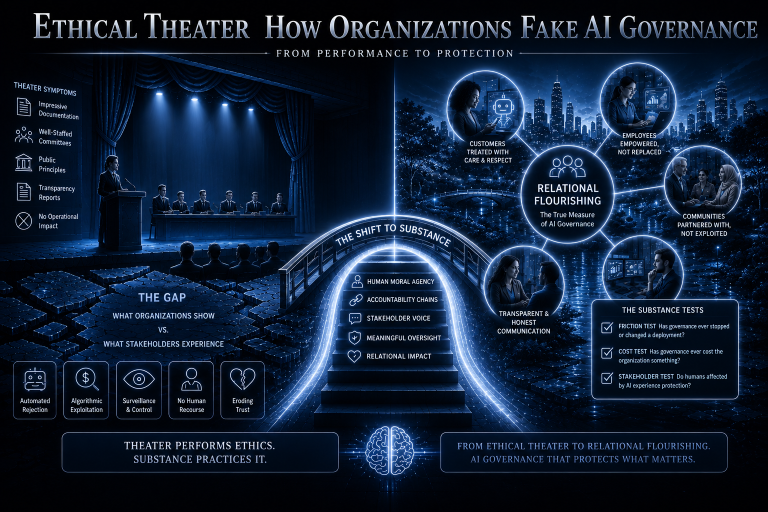
Organizations that govern Level 2 and Level 3 AI systems with Level 1 frameworks are not merely under-governing. They are failing to recognize that an entirely different governance paradigm applies. They are applying tool governance to role deployments and wondering why their frameworks fail to prevent harm. The tool versus role distinction provides the clear, defensible boundary that tells governance professionals when comprehensive AI governance requirements activate. Organizations that master this distinction position themselves to deploy AI in ways that genuinely serve stakeholders. Organizations that miss it will continue producing governance theater while the relationships that matter most to their success erode.
AI as Tool vs AI as Role: The Distinction That Changes Everything
When you use a hammer to drive a nail, no one asks about the hammer’s ethics. The hammer is a tool. You, the person wielding it, bear responsibility for whether you build a house or break a window. When you use ChatGPT to help draft an email, the ethical structure is identical. The AI is a tool. You bear responsibility for whether your email builds relationships or damages them. This much is intuitive and requires no special governance framework beyond normal professional accountability.
But when AI answers customer service calls, screens job applicants, evaluates employee performance, or decides which patients receive medical attention first, something fundamentally different is happening. In these cases, AI is not assisting someone who occupies a role. AI is occupying the role itself. This distinction, based on what we call First Mover Authority, creates the critical governance trigger that most organizations fail to recognize. As we established in the previous post in this series, AI governance must focus on how humans exercise moral agency through AI systems. The tool versus role distinction tells us when that focus becomes urgent.
What Defines a Role
A role is not merely a function to be performed. A role is a defined position within a relationship structure, carrying expectations about how the occupant will act, what responsibilities they bear, and what standing they have relative to others. Customer service representative is a role. The person occupying it has obligations to the customers they serve: to listen carefully, to understand individual situations, to exercise judgment about when standard procedures serve the customer and when they do not, to care about outcomes beyond mere transaction completion. Manager is a role. Physician is a role. Teacher is a role. These positions exist within webs of relationship and carry moral weight that function execution does not capture.
When humans occupy roles, they bring moral agency to those positions. They perceive the moral dimensions of situations they encounter. They deliberate about appropriate responses. They choose courses of action informed by moral judgment, not merely by rules and procedures. A human customer service representative encountering a distressed customer can recognize that this particular situation requires more than scripted responses. A human manager making staffing decisions can judge whether standard procedures produce fair outcomes in specific cases. A human physician treating a patient can determine when protocols should be followed rigidly and when individual circumstances require adaptation. This capacity to perceive, deliberate, and choose based on moral judgment distinguishes role occupancy from mere function execution.
First Mover Authority: The Governance Trigger
The distinction between AI as tool and AI as role hinges on First Mover Authority: who initiates action in the human-AI interaction. When you type a prompt and AI responds, when you request a report and AI generates it, when you trigger automation and AI executes it, you are the first mover. AI responds to your initiation. You retain decision authority. You determine what to do with AI outputs. AI augments your capability without displacing your agency from the relationship structure. In this configuration, AI functions as tool. Traditional technology governance proves sufficient: appropriate use policies, access controls, output quality standards, and clear human accountability for AI-assisted decisions.
When AI initiates action, even within parameters that humans designed, AI functions as role. An AI customer service system that initiates conversations with customers occupies the customer service role. An AI screening system that reviews applications before humans see them occupies a gatekeeper role. An AI trading system that executes transactions without human approval for each trade occupies a trading role. In these configurations, AI initiates actions affecting humans. It occupies positions in relationship structures where humans expect to encounter moral agency. The shift from AI as tool to AI as role creates governance requirements that tool-focused frameworks cannot address.
This is not a gradation but a categorical shift. The transition from Level 1 First Mover Authority (human initiates, AI responds) to Level 2 (AI initiates within designed parameters, human reviews) marks where comprehensive AI governance becomes critical. Above Level 2, the complexity increases but the fundamental issue remains: AI has stepped into positions that carry relationship expectations and moral obligations that AI cannot fulfill.
Why Most Organizations Miss This Distinction
Organizations routinely fail to track which of their AI deployments function as tools and which function as roles. This failure stems partly from how AI capabilities are marketed and acquired. Vendors describe AI as decision support, intelligent assistance, smart automation. These descriptions suggest tool functionality even when the actual deployment crosses into role territory. A hiring AI marketed as decision support that ranks candidates for human review is technically supporting decisions, but if humans accept its rankings without substantive independent evaluation in 95% of cases, the AI is effectively occupying the gatekeeper role. Governance must evaluate operational reality, not marketing descriptions.
The failure also stems from gradual operational drift. An AI system initially deployed at Level 1, with humans always initiating its use, can evolve toward Level 2 as users gain confidence in its capabilities. A generative AI writing assistant initially used to edit human drafts begins generating complete first drafts that humans then edit. An analytical AI initially queried when humans want recommendations begins automatically flagging cases requiring attention. These transitions may occur through deliberate operational changes, through usage pattern evolution, through AI system updates that add autonomous features, or through organizational process redesign that embeds AI more deeply. Regardless of how transition occurs, the governance implications are substantial. What was adequate governance for Level 1 becomes dangerously inadequate for Level 2.
The Governance Implications
When AI functions as tool, organizations need traditional technology governance extended to AI capabilities. Appropriate use policies specify what AI tools may be used for. Access controls determine who can use which tools. Data handling policies protect information entered into AI systems. Quality standards ensure AI outputs meet organizational requirements. Training ensures users understand capabilities and limitations. Vendor management ensures adequate contractual protections. These requirements resemble those for other enterprise software tools. Existing governance bodies can manage them within established frameworks.
When AI functions as role, organizations need something fundamentally different. They need governance that addresses what happens when AI occupies positions carrying relationship expectations and moral obligations that AI cannot fulfill. This governance must ensure that human moral agency remains present and accountable despite AI occupying roles. It must evaluate whether AI deployment serves stakeholder flourishing or extracts from it. It must assess whether accountability structures actually connect AI outcomes to humans bearing genuine responsibility. It must determine whether stakeholders can access human moral agents when AI proves inadequate. Future posts in this series will detail the Vacancy Problem this creates and the conditions required for ethical AI deployment in role capacity.
Organizations that govern Level 2 and Level 3 AI systems with Level 1 frameworks are not merely under-governing. They are failing to recognize that an entirely different governance paradigm applies. They are applying tool governance to role deployments and wondering why their frameworks fail to prevent harm. The tool versus role distinction provides the clear, defensible boundary that tells governance professionals when comprehensive AI governance requirements activate. Organizations that master this distinction position themselves to deploy AI in ways that genuinely serve stakeholders. Organizations that miss it will continue producing governance theater while the relationships that matter most to their success erode.