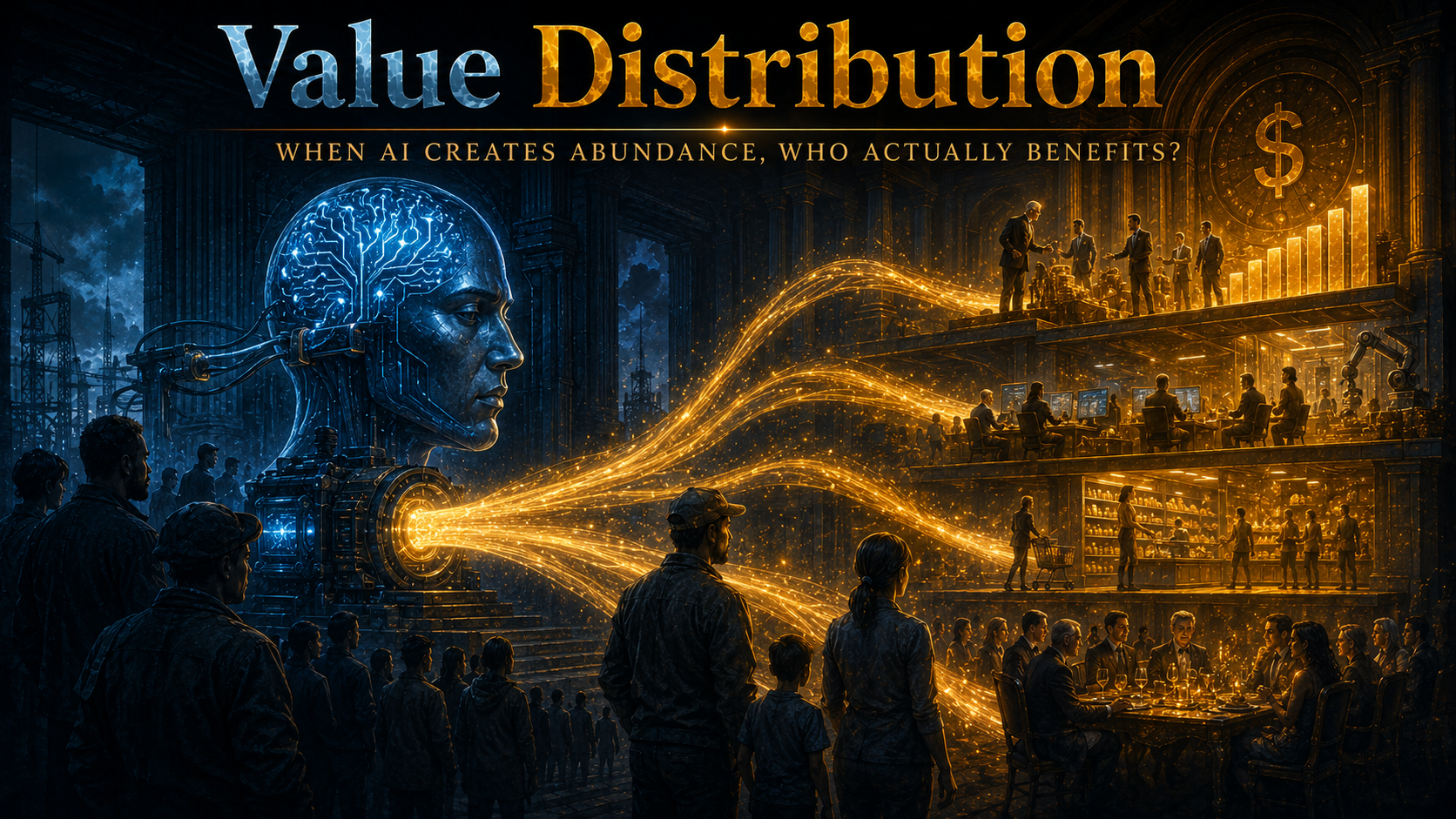
The promises of AI have centered on productivity. Efficiency gains transforming operations. Cost reductions reshaping industries. Capability expansions enabling the previously impossible. These promises have increasingly proven accurate. AI does generate tremendous value through automation and optimization. The question organizations rarely answer honestly is simpler: when AI creates this value, who actually receives it?
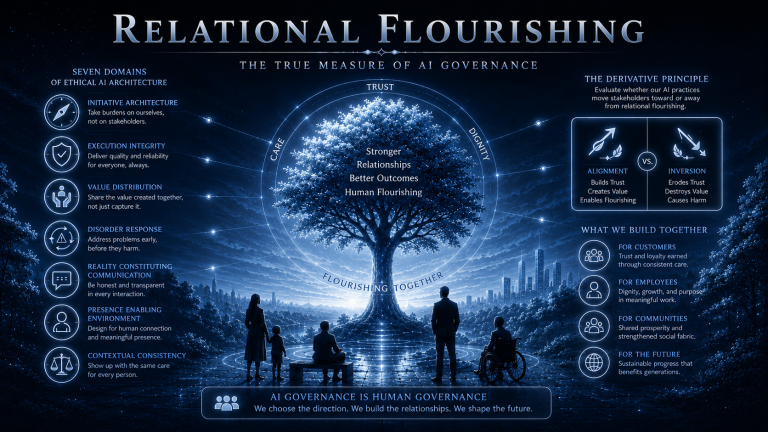
This is the third examination in our Seven Domains series. Initiative Architecture established that ethical AI moves organizational capacity toward stakeholder need. Execution Integrity established that ethical AI executes with quality reflecting stakeholder worth. Value Distribution addresses a different question: when AI generates gains, how do organizations divide them? The answer reveals organizational ethics more reliably than any mission statement.
The Moral Claim of Those Who Enable Success
Value Distribution begins with recognition that organizational success depends on stakeholders. Customers whose purchases fund operations. Employees whose labor produces outputs. Communities whose infrastructure supports business. None of these stakeholders creates value alone, but none can be extracted from the equation without consequences. They contribute jointly to organizational capability.
When AI amplifies organizational capability, it amplifies capability these stakeholders enable. The customer service AI reducing call center costs generates savings against a baseline that customer relationships created. The manufacturing AI increasing productivity generates gains against investments that workers operated. The value AI creates is not conjured from nothing but extracted from relationships stakeholders maintain.
This is why Value Distribution carries moral weight. Stakeholders enable the success AI amplifies. The question is whether they share in that amplified success or watch as organizations capture it entirely while externalizing costs onto those who made it possible.
The Patterns of Aligned Distribution
Aligned Value Distribution manifests predictably. When AI reduces organizational costs, prices or service improve for customers. When AI increases productivity, employees share gains through wages, conditions, or reduced demands. Distribution decisions are transparent, allowing stakeholders to understand how value flows.
The principle is not that stakeholders must receive equal shares. Organizations legitimately retain value for investment and sustainability. The principle is that stakeholders who enable success participate in success AI amplifies. They are recognized as partners in value creation rather than resources to be optimized.
Consider applications across stakeholder categories. Customers receive value through improved service, reduced prices, or expanded access. Employees receive value through improved conditions, fair wages, or capability development. Communities receive value through economic participation or environmental protection. None requires eliminating organizational benefit. Aligned distribution asks whether stakeholders participate at all.
The Extraction Economy
Inverted Value Distribution follows different patterns. Organizations capture all AI-generated gains while pushing costs onto stakeholders. Efficiency savings disappear into margins while customer prices remain unchanged. Productivity gains fund stock buybacks while worker wages stagnate. Distribution decisions are obscured, preventing stakeholders from understanding how value actually flows.
The rationalization typically invokes market necessity. Competitive pressure requires capturing all available value. Shareholder expectations demand maximizing return. These explanations treat extraction as unfortunate constraint rather than deliberate choice.
The framework rejects this framing. Organizations choose their distribution practices. When AI generates value at unprecedented scale, distribution choices become more consequential than ever. The market necessity rationalization obscures that markets are shaped by choices. Organizations choosing extraction contribute to the extraction economy they then cite as constraining their choices.
AI intensifies this choice precisely because it generates value at scales previous technologies did not enable. The organization that pockets AI savings representing millions while resisting minimum wage adjustments makes a distribution choice. The organization deploying AI customer service capturing efficiency gains while degrading experience makes a distribution choice. These choices aggregate into the value distribution landscape organizations then describe as given.
The Visibility Test
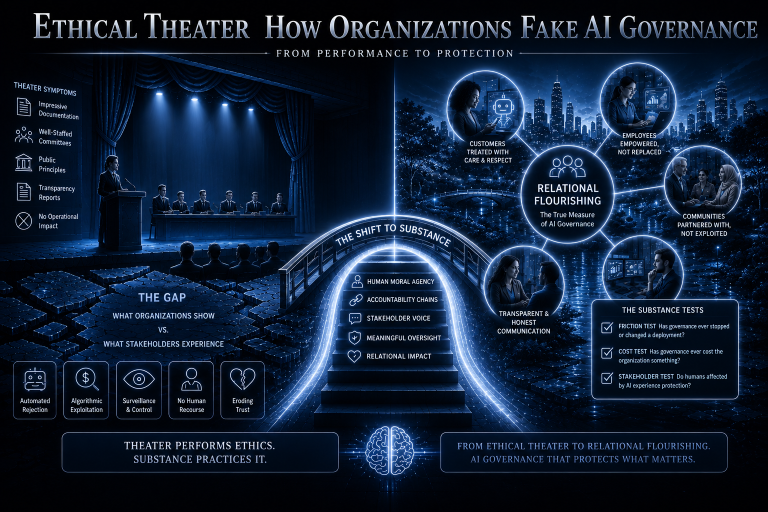
How can governance professionals assess Value Distribution alignment? The most reliable test examines what happens when AI generates demonstrable gains. Do prices, wages, or services improve? Do stakeholders perceive benefit from capability enhancement? Can the organization articulate how stakeholder groups benefit from AI deployments?
Organizations struggle to answer this last question when distribution inverts. They can describe efficiency gains and cost reductions. They cannot explain how customers, employees, or communities share in those gains because sharing is not occurring. The inability to articulate stakeholder benefit reveals distribution patterns more reliably than any official statement.
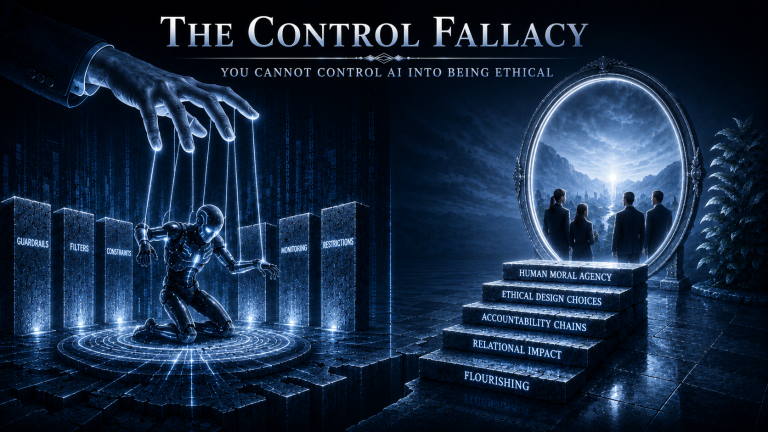
The Daisy Chain Principle applies directly. When AI generates value, that value results from human choices about system design and deployment. Those same humans make choices about distribution. The AI did not decide to retain all gains. Humans made that decision, and those humans bear moral accountability for the distribution they choose.
The Relational Stakes
The relational stakes extend beyond immediate material consequences. When organizations extract value without sharing, stakeholders experience relationships as exploitative. Customers perceive that improvements serve organizational interests exclusively. Employees perceive that contributions enable benefits they will never receive. These perceptions affect relationship quality regardless of whether stakeholders articulate them.
The reciprocity healthy relationships require cannot survive one-directional value flow. When AI amplifies organizational capability, stakeholders naturally expect to participate in amplification. When they do not, relationships become transactional at best and exploitative at worst. Organizations may retain stakeholders through switching costs or lack of alternatives. They cannot retain stakeholder trust while treating stakeholders as resources to optimize rather than partners to serve.
Toward Distribution That Recognizes Contribution
Aligned Value Distribution requires organizational honesty about how AI-generated value actually flows. It requires examination of who benefits when costs decrease, productivity increases, and capabilities expand. It requires willingness to share value with stakeholders who enable organizational success.
The specifics vary by context. For customers, aligned distribution might mean price reductions or service improvements. For employees, it might mean wage increases, working condition improvements, or capability development. For communities, it might mean investment or environmental protection.
The specifics matter less than the principle. Stakeholders who enable AI-amplified success participate in that success. Distribution acknowledges their contribution rather than treating it as resource to extract from.
The previous posts examined Initiative Architecture and Execution Integrity. Value Distribution adds a third dimension: when AI creates abundance, that abundance flows toward stakeholders rather than being captured entirely. The domains connect because organizational ethics integrates across dimensions. An organization cannot claim aligned Initiative Architecture while extracting all value.
The next post examines Disorder Response, exploring how organizations treat stakeholders who encounter problems. But disorder response connects to value distribution. Organizations that extract all value while externalizing costs create conditions where stakeholders experience disorder. The domains are facets of integrated organizational ethics.
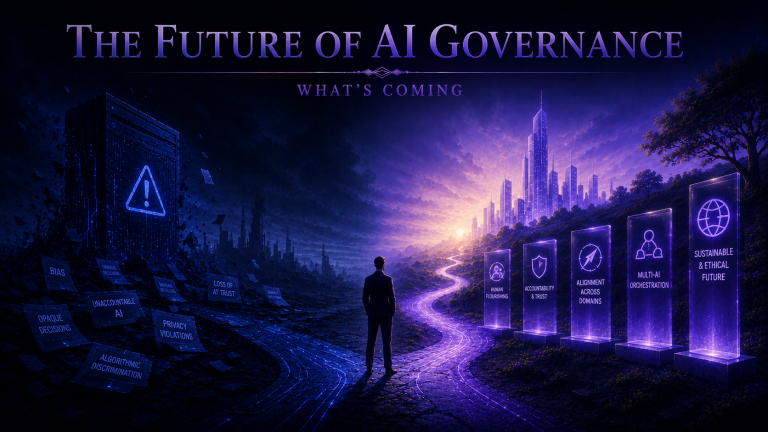
When AI creates abundance, alignment asks who actually benefits. The answer reveals organizational character regardless of organizational messaging.