Fish do not notice water. Humans do not notice environment until it constrains them. This invisibility makes environmental influence particularly powerful. The conditions shaping human experience operate beneath conscious awareness, facilitating flourishing or degrading it without those affected recognizing the source.
AI systems increasingly constitute significant features of human environments. They shape workplaces where employees spend their days. They structure home devices mediating domestic life. They design public spaces determining how people move and interact. This environmental role demands governance attention because environments either enable human presence or systematically degrade it.
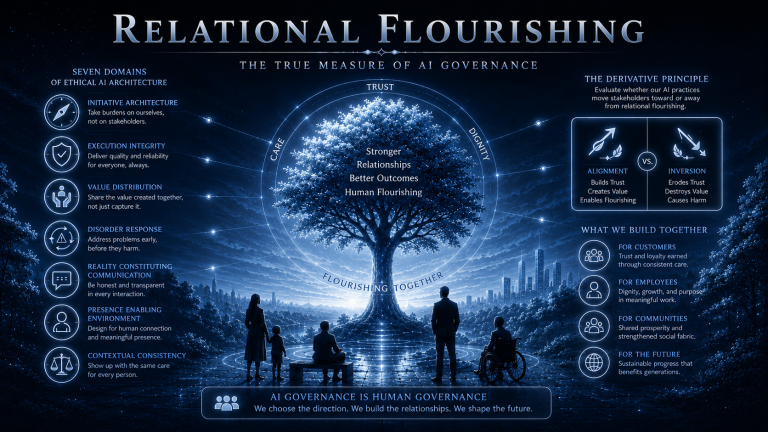
This sixth examination in the Seven Domains series addresses Presence Enabling Environment. The previous posts examined communication, disorder response, value distribution, execution integrity, and initiative architecture. This domain examines something more ambient: the conditions for human flourishing that AI-shaped environments either create or destroy.
The Meaning of Presence
Presence is the capacity to be fully, attentively, autonomously oneself. It is the experience of inhabiting one’s own life rather than being processed through systems reducing persons to variables. Presence requires conditions: freedom from constant surveillance chilling authentic expression, attention serving one’s own purposes rather than being captured for others, autonomy to make meaningful choices rather than being herded toward predetermined outcomes.
Environments either support these conditions or undermine them. A workplace enabling presence allows employees to focus without constant interruption, to make meaningful decisions, to express authentic perspectives without fear of algorithmic penalty. A home environment enabling presence respects family time without competing for attention, supports rather than surveils domestic life. A public environment enabling presence permits movement without constant tracking, engagement without manipulation.
AI systems shape all these environments. Workplace AI monitors productivity and influences evaluation. Home AI mediates entertainment and observes private life. Public AI determines what content people see and what choices are available. The design choices embedded in these systems create environmental conditions stakeholders then inhabit.
The Three Dimensions of Environmental Impact
The framework identifies three dimensions along which AI-shaped environments affect human presence.
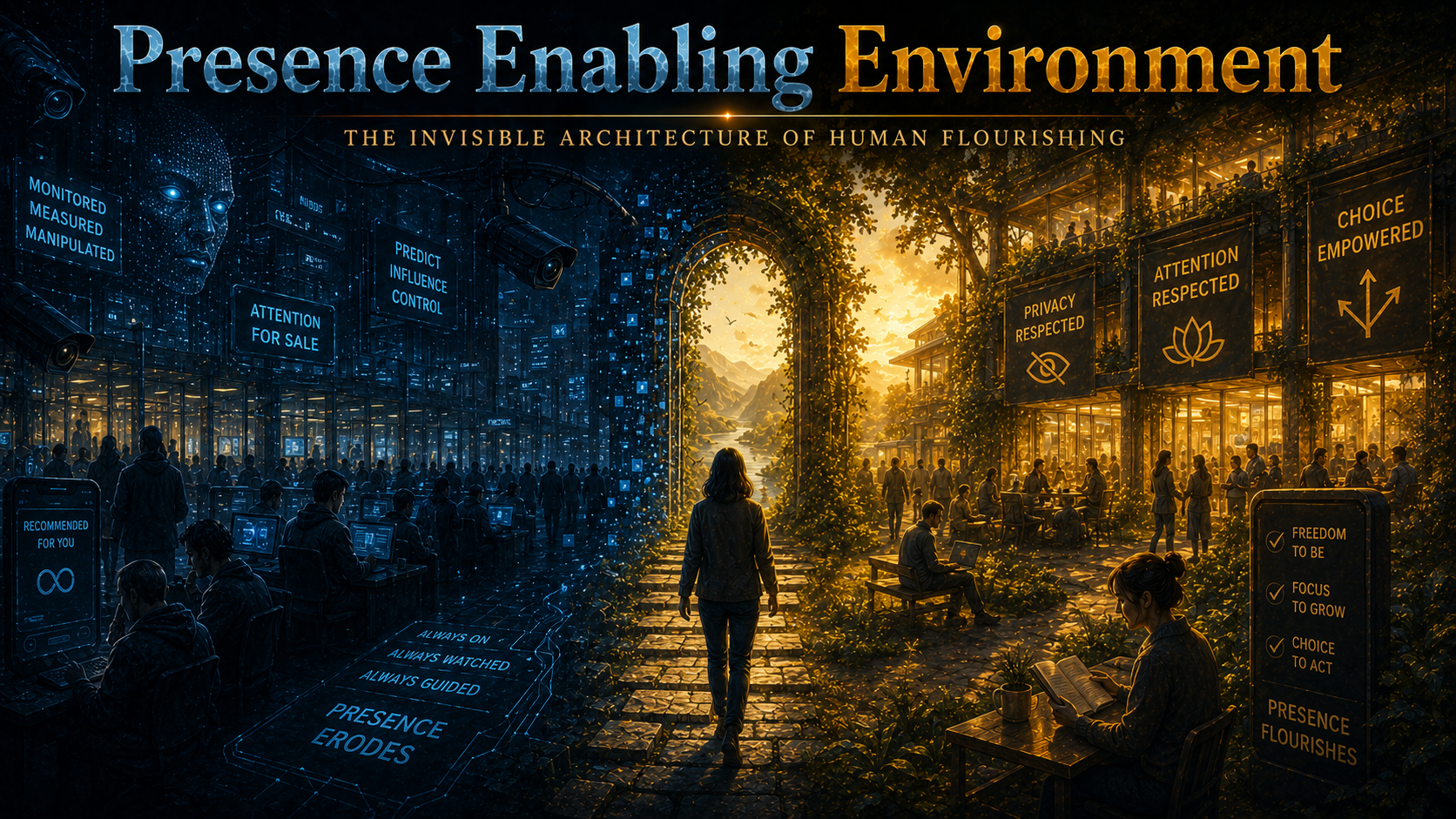
Surveillance represents the first dimension. Humans need freedom from constant observation to explore authentic selfhood. The employee knowing every keystroke is monitored behaves differently than one with privacy to think and experiment. The citizen knowing every movement is tracked moves differently than one with freedom to be anonymous. Aligned environments limit surveillance to what is actually necessary. Inverted environments maximize surveillance because surveillance is possible.
Attention represents the second dimension. Humans need capacity to direct their own attention toward their own purposes. The user whose attention is captured by addictive design has lost control over mental resources. The worker whose attention is fragmented by constant notification cannot achieve focused engagement. Aligned environments serve stakeholder attention, presenting options without manipulation. Inverted environments exploit attention through design that captures engagement regardless of stakeholder benefit.
Autonomy represents the third dimension. Humans need meaningful choice to exercise agency defining personhood. The consumer whose choices are constrained through hidden manipulation has not genuinely chosen. Aligned environments preserve genuine choice, ensuring stakeholders understand options and can select freely. Inverted environments undermine autonomy through manipulation and systematic removal of options serving stakeholders but not organizational interests.
The Inversion of Environment
Inverted AI environments have become normalized to a degree obscuring their ethical significance. Workplace surveillance that would have seemed dystopian a generation ago is now standard practice. Attention exploitation clearly harming users continues because it drives engagement metrics. Autonomy erosion through choice architecture channeling rather than serving proceeds without meaningful resistance.
The normalization reflects asymmetric interests. Organizations benefit from surveillance enabling control, from attention capture driving revenue, from autonomy reduction ensuring compliance. Stakeholders bear costs that are diffuse, ambient, and difficult to attribute.
But the costs are real. Workplaces characterized by constant surveillance produce anxiety and reduced creativity. Environments designed to capture attention fragment consciousness and reduce wellbeing. Systems eroding autonomy produce learned helplessness reducing stakeholder capacity for self-direction human flourishing requires.
The Vacancy Problem manifests distinctively here. Environments traditionally reflected accumulated human judgment about how to create conditions for flourishing. AI systems reshaping these environments without that wisdom, optimizing for measurable variables while ignoring presence conditions, vacate the human judgment environments previously contained.
The Population-Level Stakes
Environmental effects operate at population scale in ways individual interactions do not. A single manipulative communication harms one stakeholder. An environment designed for manipulation harms everyone inhabiting it. A single surveillance incident affects one person. A surveillance infrastructure affects entire populations.
This scale amplifies both impact and accountability. Organizations shaping AI environments affect populations including people who never chose to engage with those organizations. The workplace AI affects employees who took jobs before surveillance systems were deployed. The platform AI affects users who joined before attention exploitation was designed.
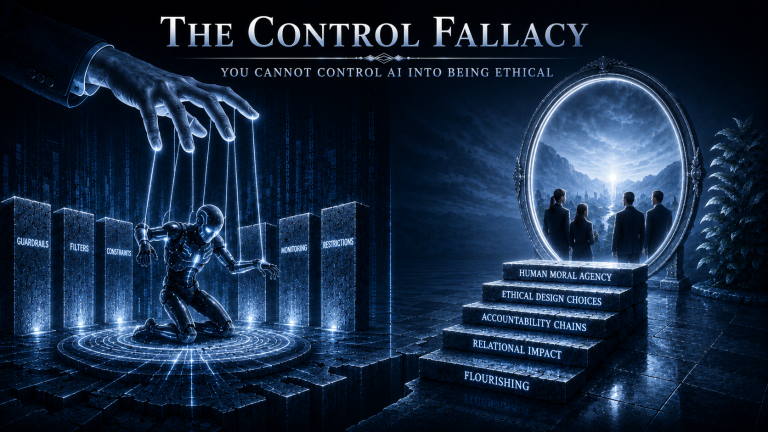
The Daisy Chain Principle applies with particular force. Environmental design choices trace to human decision makers who chose surveillance over privacy, attention exploitation over service, autonomy erosion over respect. Those humans bear accountability for population-level conditions shaping how millions can show up in their own lives.
Toward Presence Enabling Design
Aligned Presence Enabling Environment requires recognizing environment as ethical domain rather than purely operational concern. It requires evaluating AI environmental impacts as seriously as AI output impacts. It requires designing for presence rather than merely for efficiency or control.
For surveillance, aligned organizations limit data collection to what is necessary and resist the temptation to surveil simply because surveillance is possible. For attention, aligned organizations design for stakeholder benefit rather than engagement capture and refuse manipulation techniques exploiting psychological vulnerabilities. For autonomy, aligned organizations preserve meaningful choice and resist choice architectures channeling stakeholders toward organizationally preferred outcomes.
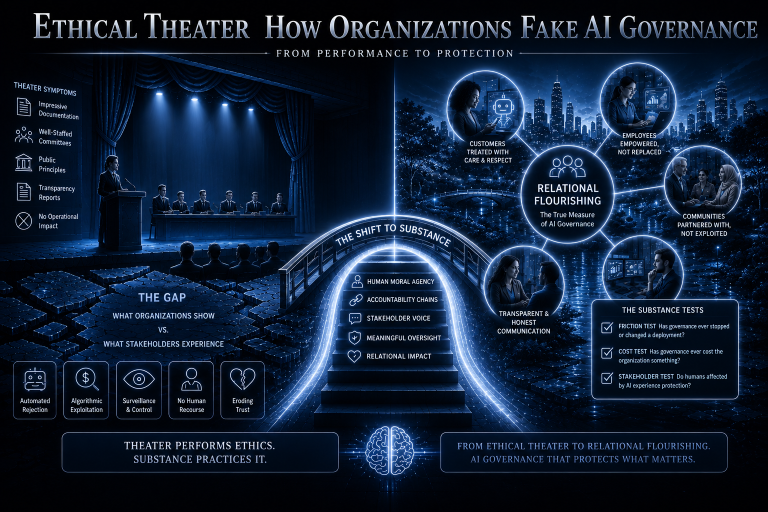
These requirements conflict with common organizational incentives. Surveillance enables control managers value. Attention capture drives engagement platforms monetize. Autonomy reduction ensures compliance operations prefer. Presence Enabling Environment requires organizations to sacrifice these benefits for stakeholder flourishing that does not appear on any quarterly report.
But the alternative is environments systematically degrading human presence at scale. Workplaces where employees cannot be authentically themselves. Homes where families compete with devices for attention. Public spaces where citizens are tracked and channeled. The costs are real even when difficult to measure.
The Integration of Domains
The previous domains examined initiative, execution, value distribution, disorder response, and communication. Presence Enabling Environment connects to all of them. Organizations cannot move toward stakeholder need while creating environments degrading stakeholder presence. They cannot execute with integrity in environments designed for exploitation. They cannot distribute value fairly while extracting presence value through surveillance and attention capture.
The final post examines Contextual Consistency, exploring how organizations maintain or abandon ethical standards across varying conditions. But consistency connects to environment. The organization creating enabling environments for some stakeholders while creating degraded environments for others demonstrates the inconsistency the final domain addresses.
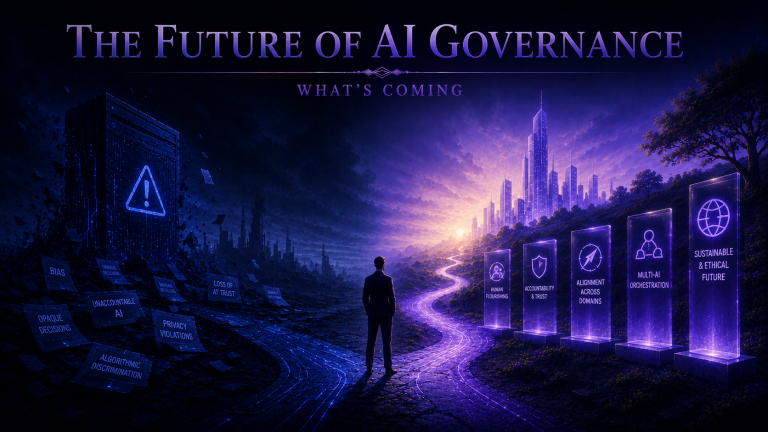
AI systems increasingly constitute the environments in which human lives unfold. Organizations deploying these systems choose whether to enable presence or degrade it. That choice shapes conditions for human flourishing at civilizational scale.