Most AI assessments ask the wrong questions. They ask whether AI is technically sound: does it perform as specified, operate within parameters, produce consistent outputs? They ask whether the organization follows industry practices: governance documentation, periodic reviews, audit trails? They ask whether processes exist: policies, committees, approval workflows? These questions can all be answered affirmatively by organizations that systematically harm stakeholders through AI that works exactly as designed.
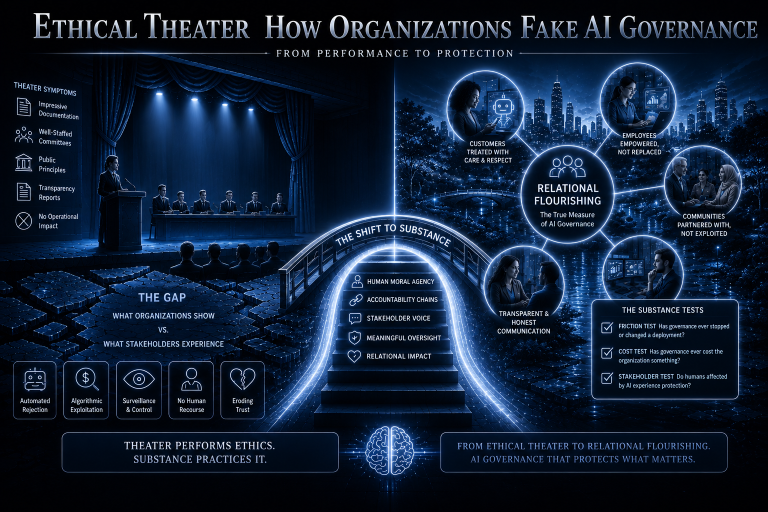
Technical soundness tells you nothing about whether AI serves human flourishing. A system efficiently deflecting customer service contacts is technically sound while degrading relationships. A system accurately predicting which employees will quit is technically sound while being used to preemptively terminate them. Industry practice conformance tells you nothing about ethical achievement. Industries converge on practices serving industry interests, which may diverge from stakeholder interests. Process existence tells you nothing about process effectiveness. Documentation sits unread. Committees rubber-stamp. Approval workflows become bureaucratic obstacles gamed rather than genuine gates.
The Right Question Is Directional
The right question for AI audit is directional: Are the humans who design and govern AI exercising moral agency toward relational flourishing or away from it? This requires evaluating whether structural accountability actually exists operationally and whether directional alignment toward stakeholder flourishing actually occurs. The auditor must assess whether the Two Conditions are satisfied, not whether documentation claims they are.
Assessing structural accountability requires examining whether humans remain genuinely present, active, and responsible within AI-augmented systems. Documentation may assign accountability. The auditor must verify those individuals actually exercise it: Do they receive information enabling judgment? Do they actually review outputs and decisions? Do they have authority to intervene? Do they exercise that authority? Organizations routinely assign accountability to individuals lacking information, time, or authority. The auditor who verifies documentation without examining operational reality mistakes form for substance.
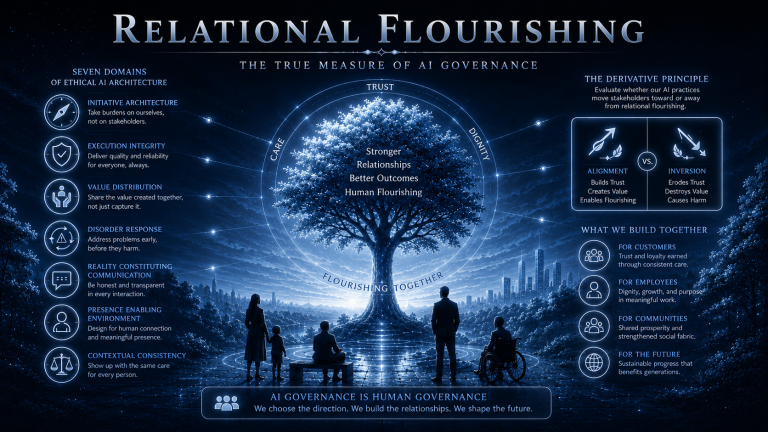
Assessing directional alignment requires evaluating whether deployments move stakeholders toward or away from flourishing. This is the Derivative Principle in assessment application. An AI system processing transactions efficiently while treating stakeholders as inputs to optimize may perform excellently on metrics while failing directionally. The auditor must examine what AI does relationally, evaluating impact on human dignity, agency, wellbeing, and relational structures enabling flourishing.
Assessment Across the Seven Domains
The Seven Domains framework provides evaluative structure for directional assessment. The auditor examines each deployment across all domains, asking not whether policies address each domain but whether operations actually achieve alignment. Domain assessment moves from documentation to operational reality, from policy claims to stakeholder experience, from governance intent to achievement.
This assessment requires methodologies most AI auditors have not developed. Traditional IT audit assesses technical controls, security, and compliance. AI ethics audit requires assessing moral agency exercise, relational impact, and directional alignment. The auditor must understand moral agency well enough to evaluate whether humans genuinely exercise it. The auditor must understand relational value well enough to assess whether deployments enhance or degrade it.
Domain assessment requires evidence organizations may not routinely collect. Traditional metrics track efficiency, volume, completion. Domain assessment requires evidence of stakeholder experience, relational impact, dignity effects. The auditor may need to gather evidence operating systems do not generate: stakeholder interviews, outcome analysis showing distributional impacts, qualitative assessment of how AI affects relational character of interactions. Organizations accustomed to quantitative measurement may resist qualitative assessment as “soft” or “subjective.” The auditor must insist that relational impact matters regardless of difficulty measuring it.
The Courage to Tell the Truth
Assessment is truth-telling. Most organizations do not want to hear the truth about their AI deployments. They want validation, not challenge. When assessment reveals that governance exists on paper but not in practice, that AI serves organizational interests at stakeholder expense, that accountability lacks operational reality, organizations resist. They question methodology, dispute evidence, challenge conclusions, request revisions softening findings.
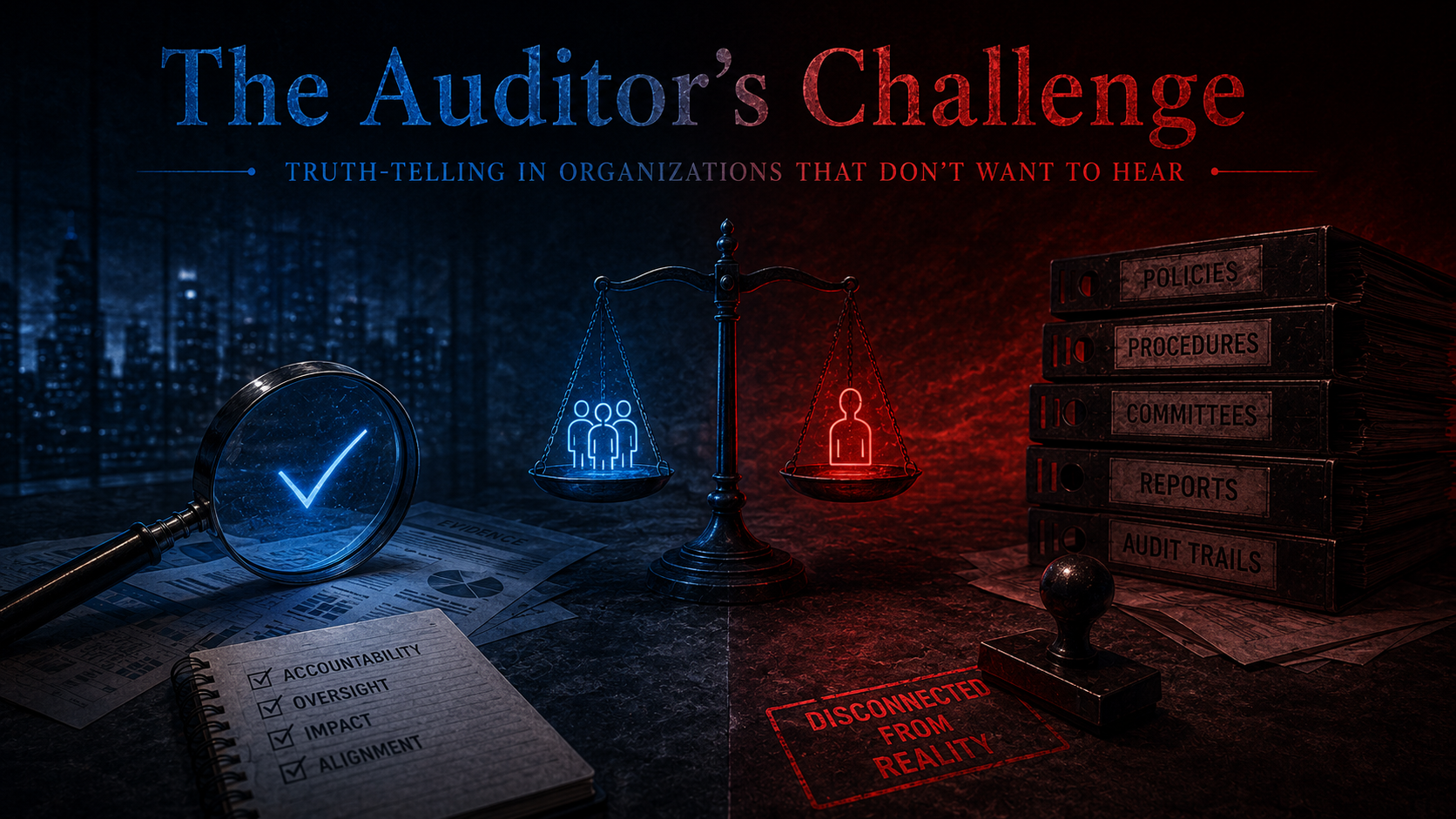
The auditor’s challenge is maintaining truth-telling against organizational pressure. This pressure is rarely explicit. Organizations say “your methodology seems unusual” or “we question whether this evidence is representative.” These concerns may be legitimate or may be resistance to findings challenging organizational self-perception. The auditor must distinguish between legitimate methodological concerns that should improve assessment and illegitimate pressure that would compromise it.
Independence is essential for truth-telling. Auditors reporting to operational executives face structural pressure to produce desired findings. Auditors whose engagement depends on client satisfaction face economic pressure. The audit function must protect auditor independence: reporting to board or audit committee rather than operational leadership, engagement terms protecting against termination for unwelcome findings, professional standards defining appropriate methodology regardless of client preference.
Findings That Challenge Organizational Self-Image
The most valuable audit findings challenge how organizations see themselves. Organizations develop narratives about their AI: that it serves customers better than humans could, that it eliminates bias, that it enables scale while maintaining quality. These narratives may be true. They may also be stories organizations tell themselves to justify decisions made for other reasons. The auditor examining evidence beneath the narrative often finds reality diverges from story.
Consider an organization believing its AI customer service provides better service than humans. The narrative emphasizes speed, availability, consistency. Audit examination reveals that speed metrics measure response time, not problem resolution. Availability metrics count service hours, not satisfaction. Consistency metrics track script adherence, not outcome quality. Stakeholder interviews reveal frustration with inability to reach humans, dissatisfaction with responses technically addressing issues without actually helping. The audit finding challenging organizational narrative provides more value than validation because it reveals reality the organization needs to address.
Delivering challenging findings requires communication skill alongside technical accuracy. Findings organizations cannot hear cannot produce improvement. The auditor must present challenging findings enabling organizational reception: acknowledging intentions while describing operational reality, connecting findings to organizational interests, identifying improvement pathways. Truth-telling that produces defensiveness without change serves no one.
The Auditor’s Essential Contribution
The first post in this series established that governance without audit cannot verify intentions match outcomes. The auditor provides essential verification transforming governance from documentation exercise to operational discipline. Without audit, organizations believe governance works because they want to believe it. With audit, organizations know whether governance works because someone independent has examined evidence.
Most fundamentally, the auditor provides external perspective organizations cannot provide for themselves. Organizations see themselves through constructed narratives serving organizational purposes. The auditor sees organizations through evidence: what AI systems actually do, how stakeholders experience them, whether governance structures function. This external perspective is irreplaceable. No internal review substitutes for independent assessment by someone whose role is truth-telling rather than narrative maintenance. Subsequent posts will examine specific structures requiring audit verification: the AI Role Inventory and Accountability Architecture. The auditor who understands what governance is trying to achieve can assess whether it actually achieves it.