The Illusion of Launch-Day Alignment
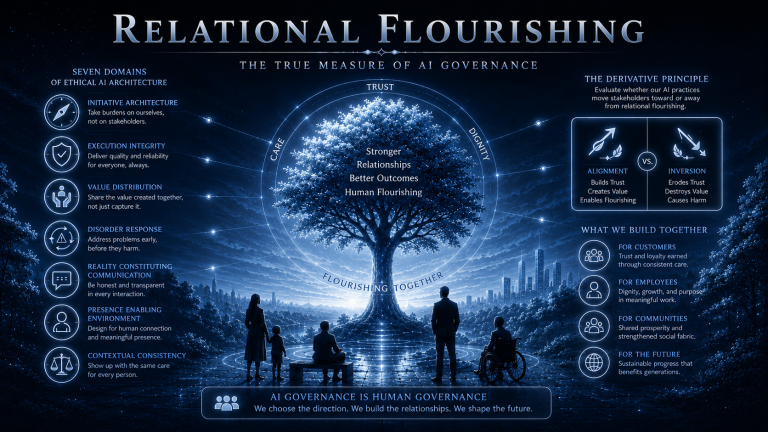
Organizations celebrate when an AI deployment passes ethical review. The governance frameworks were consulted. The Seven Domains were assessed. Human touchpoints were designed. Accountability chains were documented. The system launched in a state of alignment, moving stakeholders toward flourishing rather than away from it. And then, quietly, imperceptibly, it began to drift.
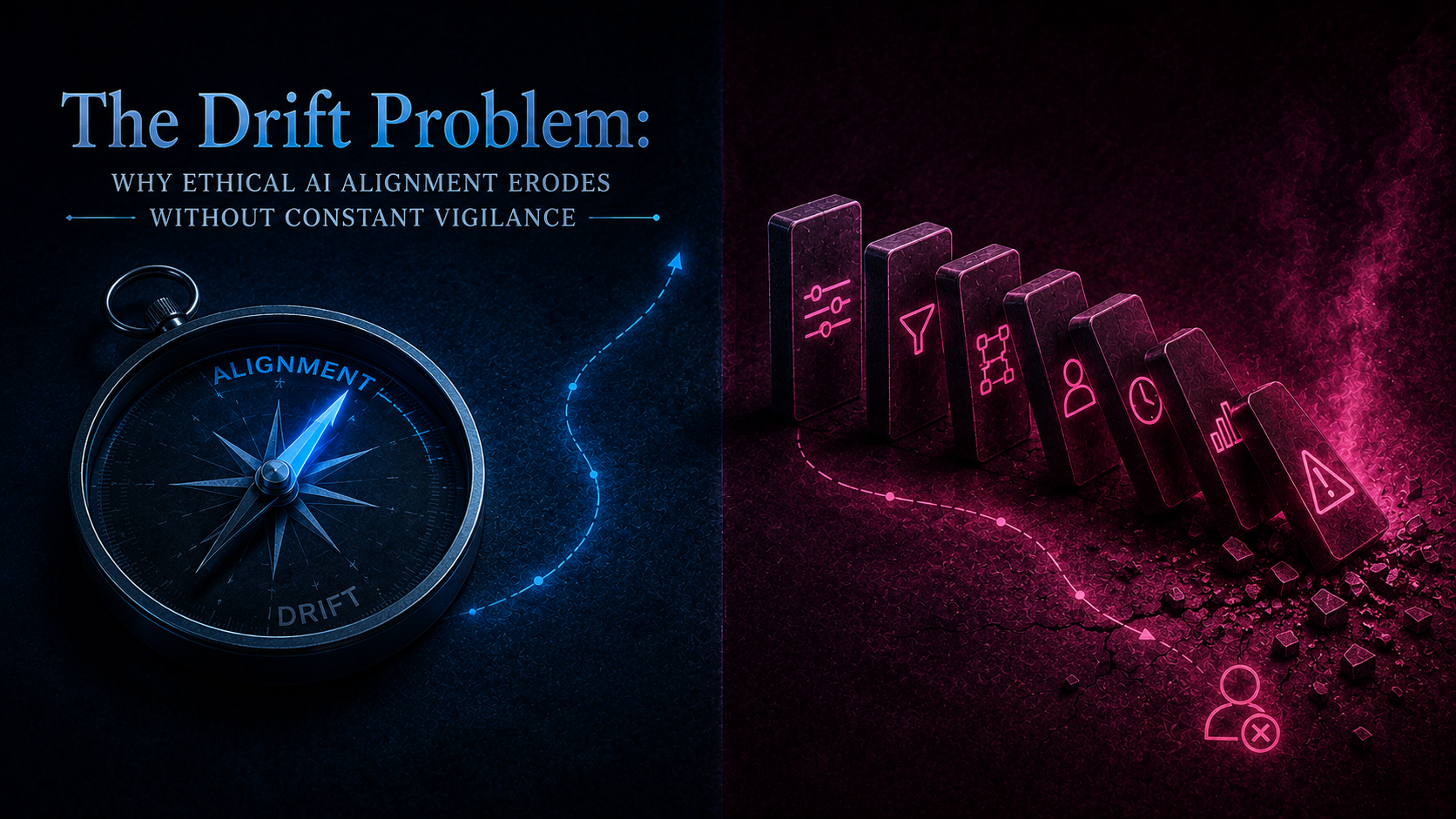
The conventional view of AI governance treats alignment as a one-time achievement. Deploy the system correctly, establish the right controls, and the ethical work is done. This view fundamentally misunderstands how AI systems operate in the real world. Alignment is not a destination. It is a direction. And directions can change without anyone consciously deciding to change them.
As we explored in earlier posts on the Two Conditions of ethical AI, organizations must maintain both structural accountability and directional alignment toward flourishing. What those posts did not fully address is the temporal dimension: both conditions can degrade over time through mechanisms that never surface for conscious review. An AI deployment that satisfied every governance requirement at launch can become deeply inverted within months, harming the very stakeholders it was designed to serve. This is the drift problem, and most organizations discover it only through crisis.
The Mechanisms of Drift
Drift operates through multiple channels, each capable of shifting alignment without triggering governance review. Understanding these mechanisms is essential for operations managers charged with maintaining alignment over time.
Model degradation represents the most technically visible form of drift. Predictive models trained on historical data grow less accurate as the world changes. A lending model trained during economic expansion may produce systematically biased predictions during contraction. The model does not change; the world does. But the effect is identical: predictions that once moved stakeholders toward appropriate outcomes now move them away.
Metric divergence poses a subtler threat. As we will explore more fully in our next post on metrics architecture, organizations optimize for what they measure. Over time, the metrics that drive operational decisions can diverge from the purposes those metrics were designed to capture. A satisfaction metric that once captured relational quality may reflect only transaction completion. The numbers improve while actual alignment erodes.
Incentive shifts compound these technical drifts. Personnel change. Organizational priorities evolve. Cost pressures mount. The team that carefully calibrated human touchpoints gets replaced by a team measured purely on efficiency. The cultural commitment to stakeholder flourishing fades as original champions move on. No one decides to abandon alignment. It simply becomes less salient as other pressures dominate attention.
Competitive pressure accelerates all these mechanisms. When competitors cut costs by reducing human touchpoints, organizations feel pressure to match. When market analysts reward efficiency gains without asking how those gains were achieved, leadership prioritizes efficiency over alignment. Each competitive response seems individually rational. Collectively, they constitute systematic drift away from stakeholder-centered values.
The Compounding of Micro-Decisions
Perhaps the most insidious mechanism of drift operates through accumulated micro-decisions that never individually rise to governance significance. A parameter adjustment here. A threshold change there. A routing rule modified in response to an edge case. Each change seems minor. Each passes through technical change management without triggering ethical review. Each shifts alignment by some small amount that falls below any reasonable materiality threshold.
But small shifts compound. A routing threshold adjusted to reduce escalations by 5% changes who gets human attention. A response template modified for efficiency alters how stakeholders experience AI interactions. A training data refresh that drops older examples shifts prediction patterns in ways that affect specific populations. None of these changes would individually warrant governance intervention. All of them collectively can transform a system from aligned to inverted.
The Vacancy Problem, which we explored in earlier posts, becomes more acute through drift. Organizations that designed human touchpoints adequate for initial deployment find those touchpoints overwhelmed as AI handles more volume and human capacity atrophies. The moral agency that governance required to remain present gradually evacuates as micro-decisions optimize toward pure automation. The vacancy grows not through conscious architectural choice but through accumulated operational evolution.
What makes this form of drift particularly dangerous is that it evades all standard governance mechanisms. Governance reviews deployment proposals. Technical change management reviews code changes. Neither reviews the cumulative ethical trajectory of a live system. Organizations lack vocabulary and methodology for asking: Is this system, taken as a whole and considering all the changes since launch, still moving stakeholders toward flourishing? Most organizations cannot answer this question. Many do not think to ask it.
Recognizing Drift Through Continuous Monitoring
Addressing the drift problem requires continuous monitoring specifically designed to detect alignment erosion. This monitoring must assess the system against all Seven Domains on an ongoing basis, not merely at deployment gates. Operations managers must establish baselines for what alignment looks like in practice and must track indicators that reveal when systems drift from those baselines.
Initiative Architecture monitoring tracks whether the system continues to move organizational capacity toward stakeholder needs. Are escalation rates changing? Is stakeholder effort increasing? Are vulnerable populations experiencing disproportionate burden shifts? Drift in this domain often appears first in experience metrics that operations teams track but may not interpret through an alignment lens.
Execution Integrity monitoring examines whether the system continues to do what it should do. Are accuracy metrics stable? Are bias patterns emerging or intensifying? Are quality standards being met consistently across stakeholder populations? Technical monitoring captures these signals; alignment interpretation gives them ethical significance.
The other domains require similar ongoing attention. Value Distribution: Are efficiency gains still being shared with stakeholders, or has capture increased? Disorder Response: Is the system resolving stakeholder problems or merely processing them? Reality Constituting Communication: Have disclosure standards eroded? Has manipulation crept in? Presence Enabling Environment: Is the system respecting stakeholder attention and autonomy? Contextual Consistency: Are standards being applied uniformly, or has stratification emerged?
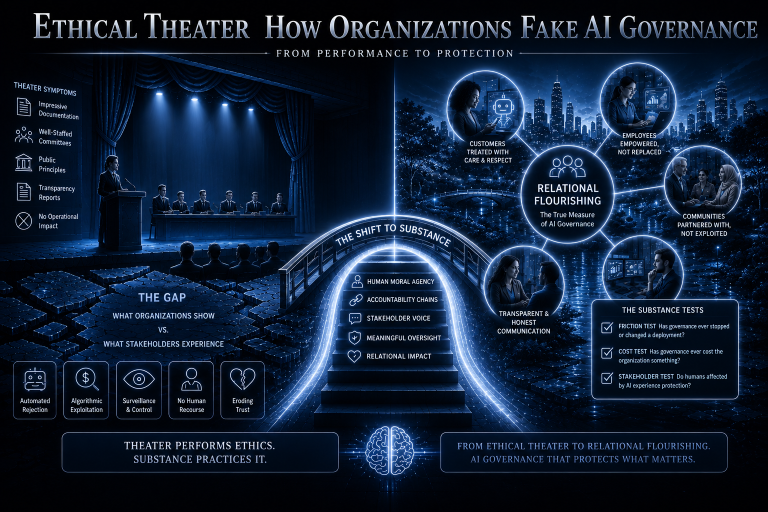
Monitoring must generate actionable signals that trigger intervention before drift compounds into crisis. This requires establishing thresholds that define acceptable variation and protocols that activate when thresholds are exceeded. Most organizations monitor operational metrics without connecting them to alignment assessment. They discover inversion only when stakeholder complaints, regulatory scrutiny, or public relations disasters force recognition that cannot be ignored.
Intervention Before Harm Compounds
Recognizing drift means little without intervention protocols that correct it. Operations managers must have both authority and methodology to intervene when monitoring reveals alignment erosion. Intervention protocols should specify who can halt or modify operations, what triggers mandatory governance escalation, how rollback to previous states is executed, and what remediation addresses affected stakeholders.
The challenge is organizational willingness to sacrifice operational gains when those gains come at alignment cost. Drift often improves efficiency metrics precisely because it shifts burden onto stakeholders. Correcting drift may require accepting lower throughput, higher costs, or reduced automation. Organizations committed to alignment as more than rhetoric must be willing to make these trade-offs.
Our subsequent posts in this series will address related operational challenges: designing metrics that actually measure alignment, managing accountability through AI chains, maintaining human touchpoints as moral necessity, responding when ethical failures occur despite prevention efforts, and governing the constant evolution of AI systems. Each of these topics connects to the drift problem. Each represents an opportunity for drift to occur and an intervention point for preventing it.
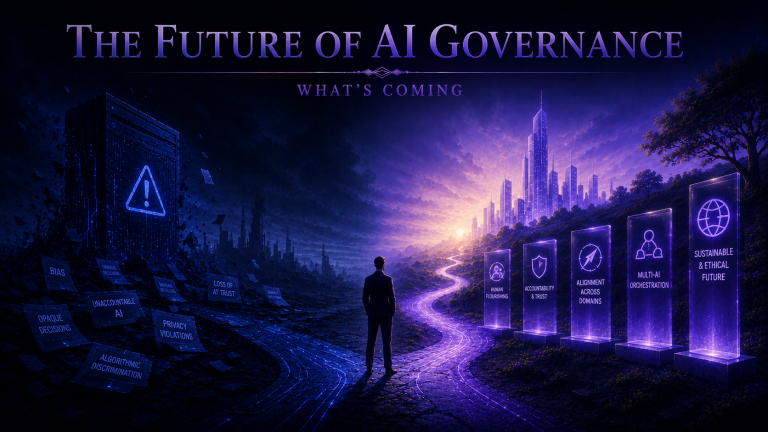
The fundamental insight is that alignment is not a state to be achieved but a practice to be maintained. Organizations that treat deployment as the end of ethical work rather than its beginning will inevitably drift toward inversion. Those that build continuous alignment monitoring and intervention into operational practice have a chance to sustain the stakeholder flourishing that governance frameworks are designed to protect. The question is not whether your AI systems are drifting. They are. The question is whether you have the visibility to recognize it and the discipline to correct it before drift becomes crisis.