The Tyranny of What Gets Measured
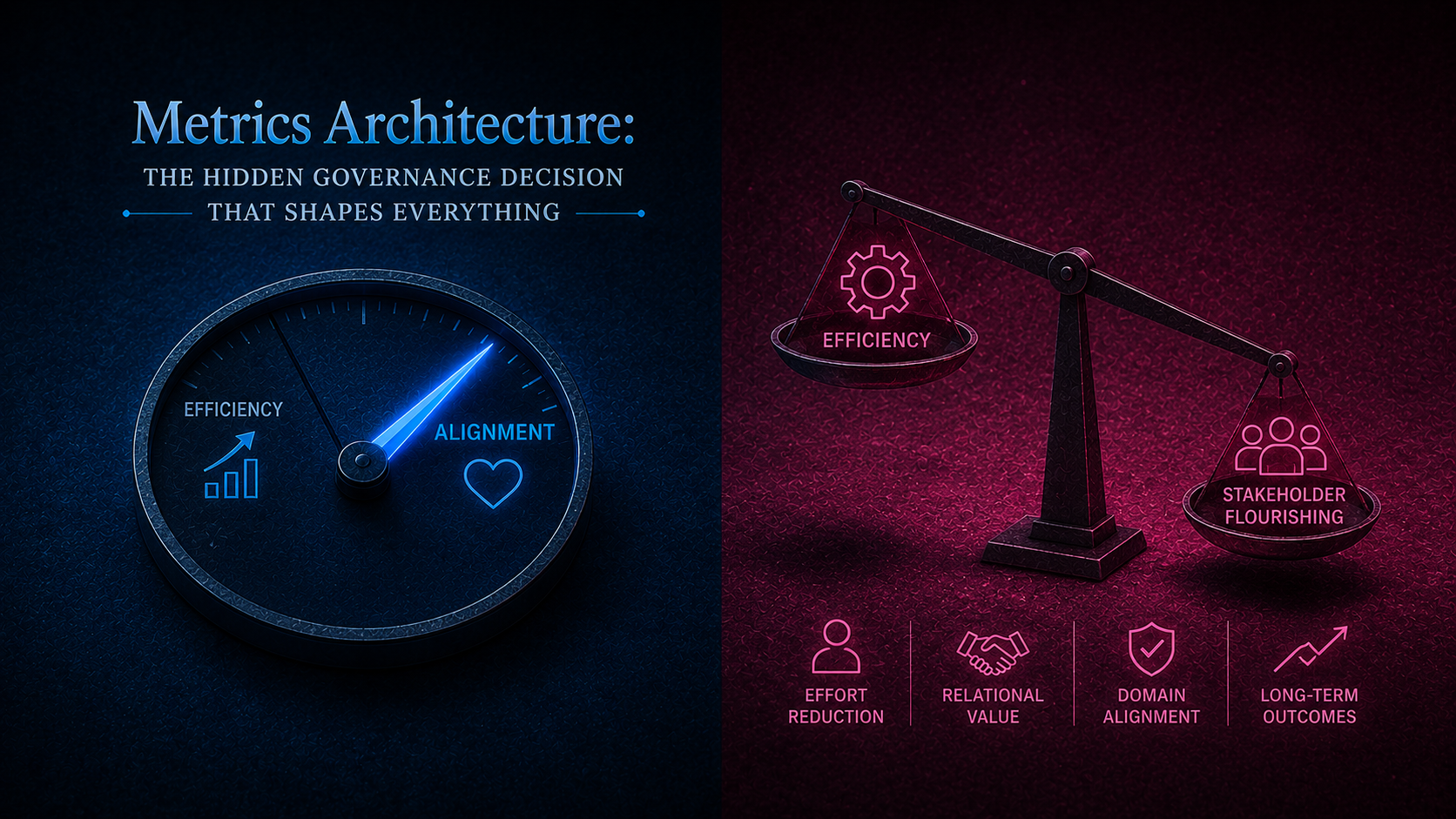
Organizations become what they measure. This principle, familiar from general management theory, carries particular weight in AI governance. The metrics an organization selects to evaluate AI deployments do not merely reflect organizational values; they actively shape them. A customer service AI measured on deflection rates will deflect. One measured on stakeholder resolution will resolve. The metrics architecture is not a technical decision downstream of governance. It is a governance decision that determines whether governance frameworks translate into operational reality or become aspirational fiction.
Conventional approaches to AI metrics focus almost exclusively on efficiency. Transactions processed. Time to completion. Cost per interaction. Escalation rates minimized. These metrics are not wrong, but they are incomplete in ways that systematically bias AI operations away from stakeholder flourishing. When efficiency metrics are the only metrics, efficiency becomes the only goal. Alignment becomes at best a constraint on efficiency optimization and at worst an obstacle to be engineered around.
As we explored in our previous post on the drift problem, AI systems erode alignment over time through mechanisms that often escape conscious notice. Metrics architecture determines whether that erosion becomes visible before it produces harm. Organizations that measure only efficiency discover alignment failures through crisis. Organizations that measure alignment directly have early warning systems that enable intervention before harm compounds.
The Alignment Metrics Framework
Building metrics architecture for ethical AI requires measuring what matters, not merely what is easy to count. This means developing metrics across three essential dimensions: stakeholder effort metrics that capture burden direction, relational value indicators that track relationship quality over time, and domain-specific measures that assess each of the Seven Domains directly.
Stakeholder effort metrics reverse the typical efficiency lens. Instead of asking how efficiently the organization processes transactions, they ask how much effort stakeholders must expend to achieve their goals. Customer effort score is a familiar example, but alignment-focused metrics go deeper. How many interactions are required for resolution? How many channels must stakeholders navigate? What is the cognitive load imposed by AI interfaces? How does effort vary across stakeholder populations? These questions reveal whether AI moves organizational capacity toward stakeholder needs or shifts burden onto stakeholder weakness. They operationalize Initiative Architecture, the first of the Seven Domains, into measurable indicators.
Relational value indicators capture what efficiency metrics miss entirely: the quality of relationship between organization and stakeholders over time. Repeat engagement patterns reveal whether stakeholders experience AI interactions as valuable or merely necessary. Trust indicators, measured through surveys or behavioral proxies, show whether AI builds or erodes confidence. Advocacy metrics track whether stakeholders recommend the organization to others. Relationship duration and depth metrics reveal whether AI strengthens bonds or attenuates them. These indicators matter because AI can process transactions efficiently while systematically degrading the relational capital that sustains organizational success.
Domain-specific measures translate each of the Seven Domains into quantifiable indicators. For Execution Integrity, accuracy and consistency metrics across stakeholder populations. For Value Distribution, analysis of where efficiency gains flow. For Disorder Response, distinction between problems processed and problems resolved. For Reality Constituting Communication, disclosure compliance and deception detection. For Presence Enabling Environment, attention fragmentation and autonomy support indicators. For Contextual Consistency, variance analysis across stakeholder segments, contexts, and visibility levels. Each domain requires its own metrics because each captures a distinct dimension of ethical practice.
The Proxy Divergence Problem
Even well-designed alignment metrics face a persistent danger: proxy divergence. Metrics are proxies for the outcomes we actually care about. Over time, organizations optimize for the proxy rather than the outcome, and the proxy loses its predictive relationship to what matters.
Consider customer satisfaction scores. Initially, satisfaction correlates with genuine service quality. Organizations improve service to improve satisfaction. But as satisfaction becomes a management target, behaviors emerge that improve scores without improving service. Requests for high ratings at interaction close. Survey timing optimized to capture positive moments. Difficult cases excluded from measurement. The metric improves while actual satisfaction erodes. The proxy has diverged from the outcome.
This pattern repeats across every metric type. Escalation rates drop because escalation is made difficult, not because AI handles issues effectively. Resolution rates rise because resolution is redefined, not because stakeholders experience resolution. Efficiency metrics improve because costs are externalized onto stakeholders, not because processes became genuinely more efficient. Every metric is susceptible to gaming. Every proxy can diverge from its referent.
Operations managers must monitor for proxy divergence continuously. This requires triangulating metrics, looking for cases where different indicators tell different stories. When efficiency metrics improve but relational value indicators decline, proxy divergence is likely occurring somewhere. When satisfaction scores rise but complaint volumes increase, the satisfaction metric has probably decoupled from genuine satisfaction. Triangulation does not eliminate proxy divergence, but it makes divergence visible and addressable.
The Prioritization Moment of Truth
The most revealing governance moment comes when efficiency metrics conflict with alignment metrics. In theory, organizations claim to prioritize stakeholder flourishing. In practice, they reveal their actual priorities through the trade-offs they make.
Consider a scenario where reducing human touchpoint capacity would improve cost efficiency by 15% while increasing stakeholder effort by 25%. The efficiency metrics recommend the change. The alignment metrics oppose it. Which metrics drive the decision? Consider a routing algorithm that processes transactions faster but routes vulnerable populations away from human assistance. Speed metrics favor the algorithm. Equity metrics oppose it. Which metrics prevail? Consider a model update that improves aggregate accuracy while increasing bias against specific demographic groups. Overall accuracy metrics endorse the update. Domain-specific bias metrics reject it. Which metrics govern?
These prioritization decisions reveal organizational values more clearly than any governance policy. An organization that consistently resolves metric conflicts in favor of efficiency has made efficiency its actual governing value, regardless of what governance documents claim. An organization that accepts efficiency costs to preserve alignment has made alignment genuinely operative. The metrics architecture creates the framework within which these prioritization decisions occur. If alignment metrics are not present in the decision framework, alignment considerations cannot influence decisions.
Our next post on the Daisy Chain Principle will explore how accountability must trace through AI chains to humans who can be held responsible for these prioritization choices. Metrics architecture determines what information reaches those accountable humans and thus what choices become visible for accountability.
Building Metrics Architecture That Actually Governs
Implementing alignment-focused metrics architecture requires more than adding new metrics to existing dashboards. It requires fundamentally rethinking what metrics are for. Metrics exist not to report on operations but to govern them. The metrics an organization chooses are the metrics by which AI operations will be evaluated, optimized, and ultimately shaped.
Metrics must be visible at decision points. Alignment indicators that exist in quarterly reports but not in daily operational dashboards cannot influence daily operational decisions. Metrics must be present where choices are made, with clear ownership and clear consequences for different metric outcomes.
Metrics must have teeth. Metrics that inform but do not constrain are suggestions, not governance. Alignment metrics must be tied to operational consequences: deployment decisions, personnel evaluation, resource allocation, escalation triggers. Without consequences, metrics become decorative.
Metrics must be defended against degradation. The proxy divergence problem means that metrics require ongoing validation. Organizations must regularly assess whether metrics still measure what they were designed to measure, must detect and correct gaming, must retire metrics that have lost alignment signal and must develop new metrics as understanding deepens.
Most organizations measure efficiency and assume alignment follows. It does not. Alignment follows only from measuring alignment, from prioritizing alignment metrics when they conflict with efficiency metrics, and from building operational systems that optimize for stakeholder flourishing rather than transaction processing. The metrics architecture decision is upstream of every other operational decision. Get it wrong, and governance frameworks become irrelevant no matter how carefully they were designed. Get it right, and governance principles have a chance to translate into operational reality.