The Myth of the Stable System
AI systems change constantly. Models update as new training data becomes available. Features expand to address additional use cases. Integrations multiply as AI connects with more organizational systems. Parameters adjust through optimization processes that run continuously. The AI system that was reviewed and approved at deployment is not the AI system operating six months later. It has evolved, sometimes dramatically, through changes that individually seemed minor but collectively transformed system behavior.
Conventional change management focuses on functionality. Does the change work? Does it introduce bugs? Does it affect system performance? These questions matter but remain incomplete for AI governance. A change that works technically, that introduces no bugs, and that improves performance can still be an ethical disaster if it shifts burden to stakeholders, introduces bias, reduces transparency, or undermines accountability structures. Technical change management that never examines ethical impact cannot govern AI effectively.
The challenge is that AI changes often occur outside traditional change management entirely. Model retraining happens automatically when data thresholds are reached. Parameter optimization adjusts system behavior continuously. Feature flags enable changes without deployment events. A/B testing exposes stakeholders to different system behaviors experimentally. These mechanisms improve AI capability but create change streams that bypass governance review entirely. Each change can shift alignment in ways that no one evaluates until drift produces visible harm.
Governance Review Before Changes Deploy
Effective change management for ethical AI requires governance review before changes deploy, not merely technical review. This means that changes affecting AI systems must be evaluated for ethical impact as part of change approval, that governance has authority to block changes that would degrade alignment even when those changes work technically, and that change processes include stakeholders who can assess moral implications alongside technical implications.
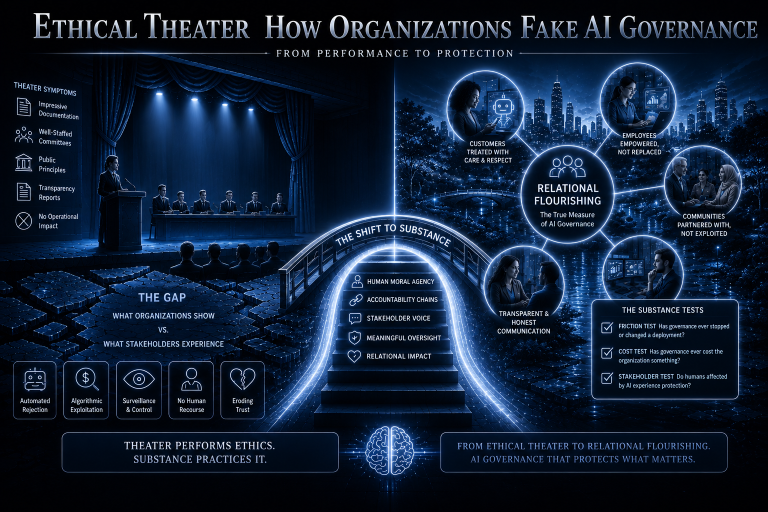
Establishing governance review authority requires organizational commitment. Technical teams accustomed to autonomous change management often resist governance involvement as bureaucratic interference. Business sponsors eager for rapid feature deployment may pressure governance to approve quickly or step aside. Leadership must establish clearly that ethical review is not optional, that governance has genuine authority to reject or modify changes, and that deployment without governance approval violates organizational policy. Without this commitment, governance review becomes theater that technical teams route around.
Review criteria must be specific enough for consistent application. Vague instructions to consider ethical implications provide insufficient guidance for reviewers and insufficient predictability for change sponsors. Criteria should specify what factors trigger enhanced review, what domain-specific assessments are required, what evidence demonstrates alignment preservation, and what thresholds define acceptable versus unacceptable impact. As we discussed in our post on metrics architecture, you govern what you measure. Change criteria translate governance frameworks into operationally applicable standards.
Impact Assessment Against the Seven Domains
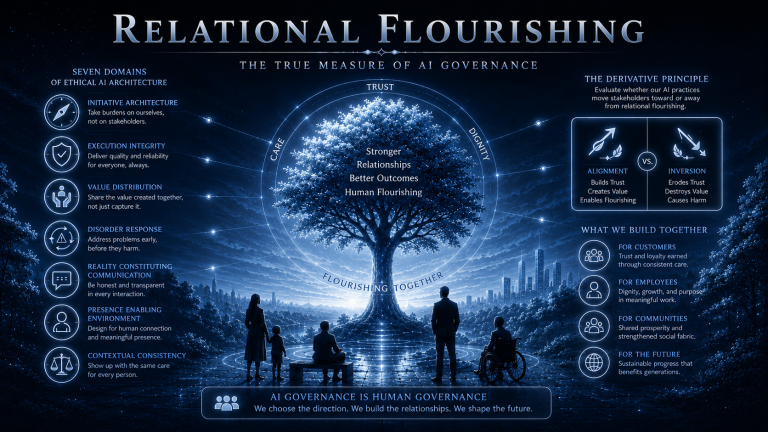
Change impact assessment should examine effects across all Seven Domains, not merely the domain most obviously affected by the change. AI systems operate holistically. A change that improves one domain may degrade another. A feature addition intended to enhance response quality may also affect what stakeholders must disclose, thereby affecting communication domain compliance. An efficiency optimization intended to reduce cost may also affect human touchpoint accessibility, thereby affecting Initiative Architecture alignment. Narrow impact assessment misses these cross-domain effects.
Initiative Architecture assessment asks whether the change shifts burden direction. Will stakeholders expend more or less effort? Will organizational capacity move more toward or away from stakeholder needs? Changes that improve organizational efficiency may accomplish that improvement by externalizing work onto stakeholders. This burden shift may not be visible in technical change documentation but becomes visible when Initiative Architecture is explicitly assessed.
Execution Integrity assessment asks whether the change affects system reliability, accuracy, or consistency. Will the change introduce variance across stakeholder populations? Will it degrade performance for certain groups while improving aggregate metrics? Changes that improve average outcomes may simultaneously worsen outcomes for vulnerable populations invisible in average calculations.
Similar assessments apply across Value Distribution (does the change affect how value is shared?), Disorder Response (does it affect how problems are detected and resolved?), Reality Constituting Communication (does it affect disclosure or accuracy?), Presence Enabling Environment (does it affect attention or autonomy?), and Contextual Consistency (does it affect uniform standard application?). Each domain requires specific assessment criteria that change reviewers can apply systematically.
Testing for Alignment Effects
Change testing must include alignment testing alongside functionality testing. Traditional test suites verify that changes produce expected outputs for given inputs. Alignment testing verifies that changes preserve ethical properties that governance requires.
Bias testing examines whether changes affect outcomes across protected populations. A model update that improves aggregate accuracy may introduce or amplify bias that baseline testing did not detect. Bias testing requires test datasets that include sufficient representation across relevant populations and metrics that reveal differential impact invisible in aggregate measures. Changes should not deploy until bias testing confirms that alignment across populations is preserved or improved.
Burden testing examines whether changes affect stakeholder effort. This testing is often neglected because burden is harder to measure than functionality. But burden testing can use proxies: interaction length, escalation rates, task completion rates, and similar indicators that correlate with stakeholder effort. Changes that increase these proxies require explanation of why burden increase is acceptable or modification to reduce burden impact.
Transparency testing examines whether changes affect stakeholder understanding. If changes alter how AI operates in ways that affect stakeholder interests, do stakeholders receive information enabling them to understand and respond? Changes that operate invisibly when visibility was previously available require justification or design modification.
These tests complement but do not replace governance review. Testing provides evidence about alignment effects. Governance review interprets that evidence and makes judgment calls about acceptability. Testing that reveals mild burden increase requires governance judgment about whether that increase is tolerable given change benefits. Testing is necessary but not sufficient for change governance.
Rollback Capability and Post-Change Monitoring
Even with comprehensive pre-deployment review and testing, changes may produce alignment degradation that only becomes visible in production. Rollback capability enables rapid reversal when problems emerge. Post-change monitoring detects problems that pre-deployment testing missed.
Rollback capability requires architectural investment. Systems must be designed so that changes can be reversed without disruption, so that previous states are preserved and recoverable, and so that rollback can occur rapidly enough to limit harm when problems are detected. Organizations that optimize for deployment speed without maintaining rollback capability find themselves unable to reverse changes that degrade alignment, forcing continued operation of systems they know are causing harm while fixes are developed.
Post-change monitoring must specifically track alignment indicators, not merely operational metrics. As we discussed in our post on the drift problem, standard operational metrics often miss alignment degradation. Post-change monitoring should compare pre-change alignment baselines to post-change performance across stakeholder effort indicators, bias metrics, transparency measures, and other domain-specific indicators. Variance from baseline should trigger investigation even when operational metrics show improvement.
The integration of rollback and monitoring creates change governance with teeth. If a change degrades alignment beyond acceptable thresholds, rollback reverses the change until alignment can be preserved. This integration creates genuine accountability for alignment in change processes. Technical teams know that changes causing alignment problems will be reversed. This knowledge motivates attention to alignment during change development that governance review alone cannot produce.
Our final post in this series will address the pressures that constantly push against the governance structures we have described. Every post in this series assumes organizational commitment to alignment. That commitment is not automatic. It must be defended against pressure that frames ethical standards as obstacles to business success. Change management, like every other operational practice, occurs within organizational cultures that either support or undermine ethical commitment. Understanding that cultural context is essential for translating governance frameworks into sustained operational reality.