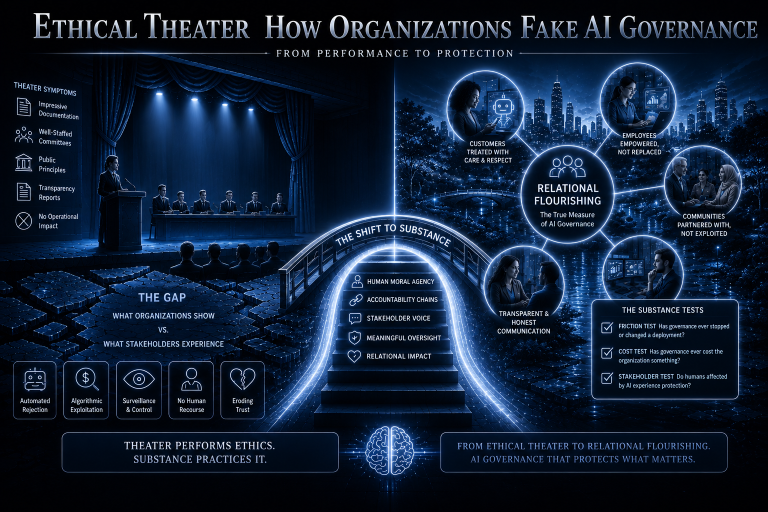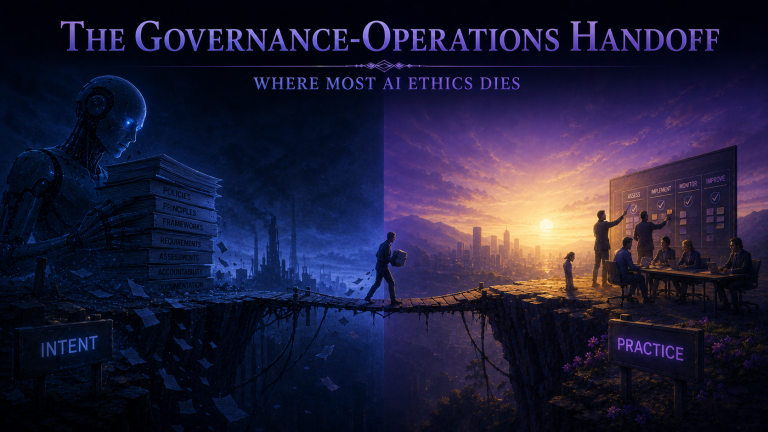
Most organizations believe they govern AI ethically. They point to policies, cite compliance records, and reference the absence of scandal as evidence of their alignment. When assessment relies solely on organizational self-report, these beliefs remain unchallenged. Documents are produced. Interviews proceed according to comfortable scripts. Everyone agrees that governance is functioning. But beneath this polished surface, a different reality often exists. The gap between what organizations believe about their AI governance and what they have actually achieved frequently proves substantial. The AI Governance 360 Assessment is designed to reveal this gap.
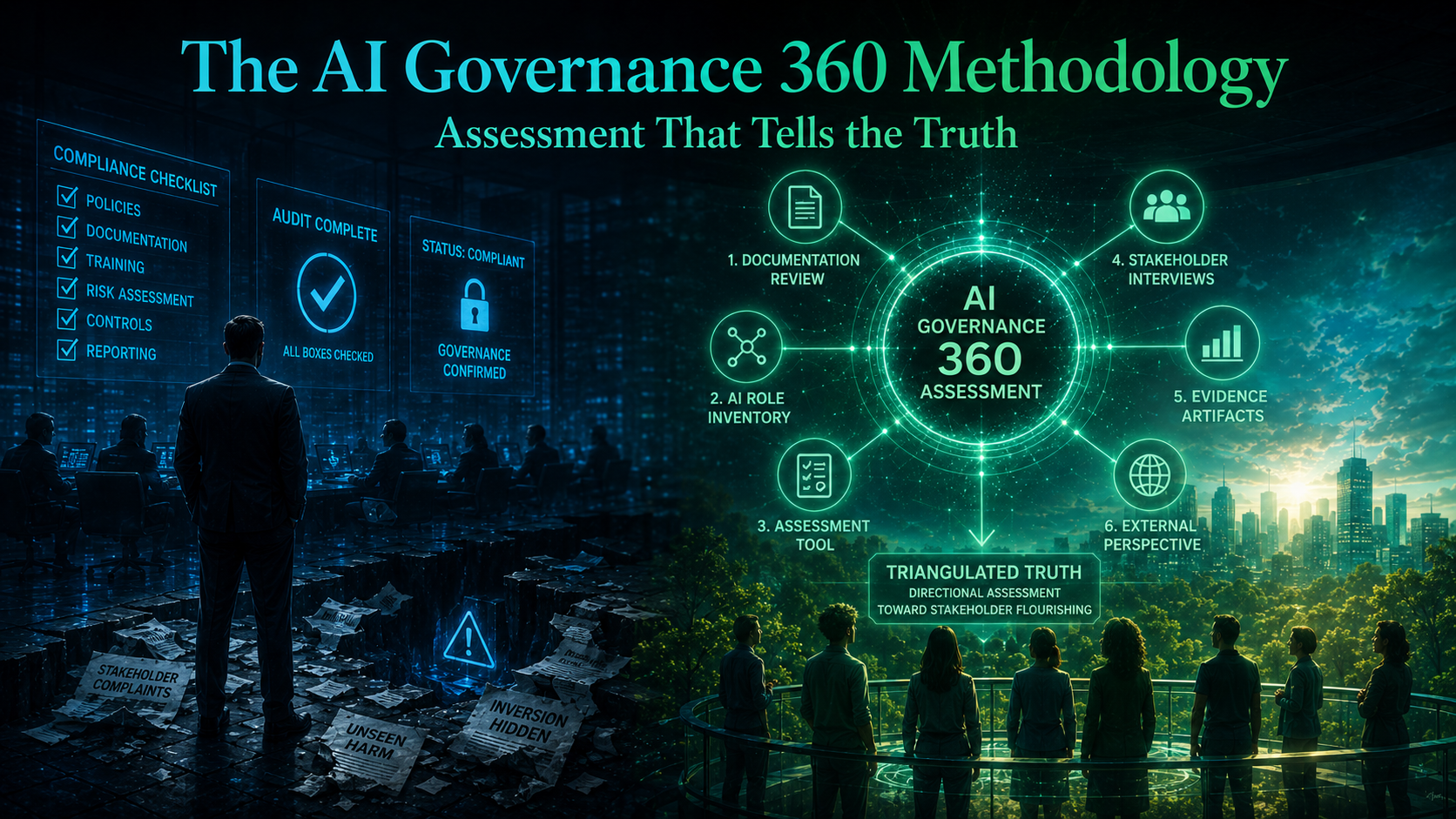
As we established in the previous post, compliance-based assessment cannot distinguish between organizations that genuinely serve stakeholders and organizations that merely document their intentions to do so. The AI Governance 360 methodology addresses this limitation through comprehensive triangulation: gathering evidence from multiple sources that together reveal operational reality rather than accepting organizational narrative at face value. When documentary claims are tested against stakeholder experience, when interview responses are compared to actual artifacts, when external perception is measured against internal self-assessment, truth emerges that single-source assessment cannot access.
Six Input Categories
The AI Governance 360 Assessment integrates six distinct input categories, each providing a different window into organizational practice. These categories are not redundant; they reveal different aspects of the same reality. Discrepancies between categories often prove more illuminating than consistency, because discrepancies reveal where organizational belief diverges from operational truth.
Documentation Review constitutes the first input category. Assessors examine governance artifacts including policies, procedures, standards, meeting minutes, and deployment approvals. This review establishes what organizations claim as their governance framework. Documentation review is necessary but radically insufficient. Documents are not practice. Policies that exist in filing cabinets but not in operations provide no stakeholder protection. The documentation review establishes a baseline against which actual practice can be measured, but it cannot itself reveal whether that practice occurs.
AI Role Inventory provides the second input category. Assessors work with organizations to comprehensively identify all AI systems operating at First Mover Authority Level 2 or above, meaning AI that initiates action within parameters rather than merely responding as a tool. This inventory reveals organizational self-knowledge. Organizations that cannot identify their Level 2+ deployments lack foundational governance capability. The inventory process often reveals shadow AI operating without governance awareness, legacy systems whose authority has expanded beyond original parameters, and deployments that organizations have forgotten exist. The completeness and accuracy of AI role inventory indicates governance maturity more reliably than policy sophistication.
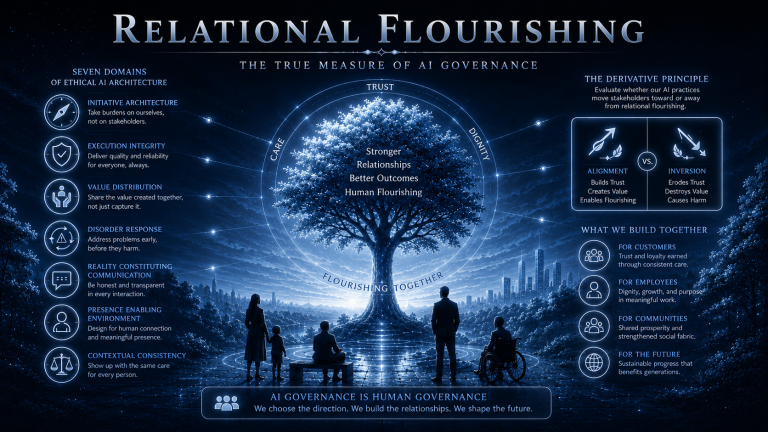
The Assessment Tool comprises the third input category. This structured questionnaire systematically evaluates governance and management practices across the Seven Domains of Ethical AI Architecture: Initiative Architecture, Execution Integrity, Value Distribution, Disorder Response, Reality Constituting Communication, Presence Enabling Environment, and Contextual Consistency. The questionnaire reveals alignment indicators across all domains simultaneously, enabling pattern recognition that domain-by-domain review might miss.
Stakeholder Interviews constitute the fourth input category, and they represent where operational reality most clearly emerges. Assessors interview diverse stakeholders affected by organizational AI: customers, employees, partners, and community members. These interviews reveal what stakeholders actually experience, which frequently differs from what organizations believe stakeholders experience. Stakeholders describe waiting times that documentation does not capture. They report friction that metrics fail to measure. They explain how AI interactions make them feel in ways that operational dashboards never address. Stakeholder voice often contradicts organizational narrative, and when it does, stakeholder voice should be believed.
Evidence Artifacts provide the fifth input category. These are the configurations, metrics, logs, complaints, and operational records that show what actually happens. When organizations claim rapid disorder response, evidence artifacts reveal actual response times. When organizations claim equitable AI treatment, evidence artifacts show outcomes stratified by population. When organizations claim stakeholder-centric design, evidence artifacts expose whether complaint volumes suggest otherwise. Evidence artifacts ground assessment in verifiable data rather than organizational assertion. They enable assessors to test claims rather than simply record them.
External Perspective comprises the sixth input category. This includes public feedback, online reviews, regulatory communications, media coverage, and reputation indicators. External perspective reveals how stakeholders experience organizational AI from outside organizational control. Organizations can manage internal narratives and train employees to give approved interview responses. External perspective escapes this management. Customers writing online reviews are not following organizational scripts. Regulators citing concerns have not been coached by organizational PR. External perspective often reveals patterns invisible from inside organizational walls.
The Power of Triangulation
The methodology’s power derives not from any single input category but from triangulation across all six. When documentation claims match interview statements, when interview statements align with evidence artifacts, when evidence artifacts correspond to external perception, assessors can have reasonable confidence in organizational self-report. But this consistency rarely characterizes organizations practicing inversion. More commonly, triangulation reveals gaps. Documentation describes stakeholder commitment while evidence artifacts show stakeholder complaints increasing. Interviews present rehearsed assurances while external perspective reveals patterns of stakeholder frustration. The AI Role Inventory omits systems that stakeholder interviews identify as problematic.
These gaps are not incidental findings. They are the assessment’s core purpose. The gap between organizational belief and operational reality reveals where governance has failed. It exposes self-deception that single-source assessment would miss. It identifies the space between what organizations tell themselves about their AI governance and what they have actually achieved. Most organizations have not looked this closely at themselves, and many will not appreciate what they see.
Assessment as Directional Evaluation
The AI Governance 360 methodology embodies the Derivative Principle that grounds this entire framework. Assessment does not ask whether organizations have achieved compliance status. It asks in which direction organizations are moving. For each of the Seven Domains, triangulated evidence enables assessors to determine whether the humans governing AI are moving stakeholders toward flourishing or away from it. This directional evaluation recognizes that organizations rarely exist in binary states of perfect alignment or complete inversion. Most organizations demonstrate mixed patterns, with alignment in some domains and inversion in others, with improvement in some areas and deterioration in others. Directional assessment captures this complexity in ways that compliance checkboxes cannot.
The directional scoring methodology we will examine in the next post translates this evaluation into precise findings. But even before scoring, the AI Governance 360 methodology ensures that assessment examines what matters: not whether organizations have the right documents, but whether they serve the right purposes. Not whether they follow procedures, but whether those procedures produce flourishing. Not whether they can demonstrate compliance, but whether they can demonstrate care.
What Assessment Reveals
Organizations approaching AI Governance 360 Assessment should prepare for uncomfortable discovery. The methodology is designed to penetrate organizational self-deception, and most organizations have deceived themselves to some degree. They have told themselves stories about their AI governance that triangulated evidence will challenge. They have maintained beliefs about stakeholder experience that stakeholder interviews will contradict. They have assumed alignment that evidence artifacts will reveal as inversion.
This is not failure of the assessment. This is the assessment working as intended. Assessment that tells organizations only what they want to hear provides no value. Assessment that challenges organizational self-perception provides the foundation for genuine improvement. The gap between belief and reality, once revealed, can be addressed. The inversion hidden beneath compliance, once exposed, can be corrected. The stakeholder harm rationalized through comfortable language, once named, can be remediated. Truth-telling is the assessment’s purpose. Everything else is governance theater.
The AI Governance 360 methodology serves stakeholders affected by organizational AI. It exists because those stakeholders deserve assessment that reveals whether AI governance actually protects them, not assessment that merely documents organizational intentions. If this methodology produces discomfort for organizations that have confused compliance with ethics, that discomfort is a feature rather than a flaw. The next posts in this series will explore how to translate triangulated evidence into directional scores, how to recognize the patterns of organizational self-deception, and how to deliver findings with the courage that stakeholder protection requires.