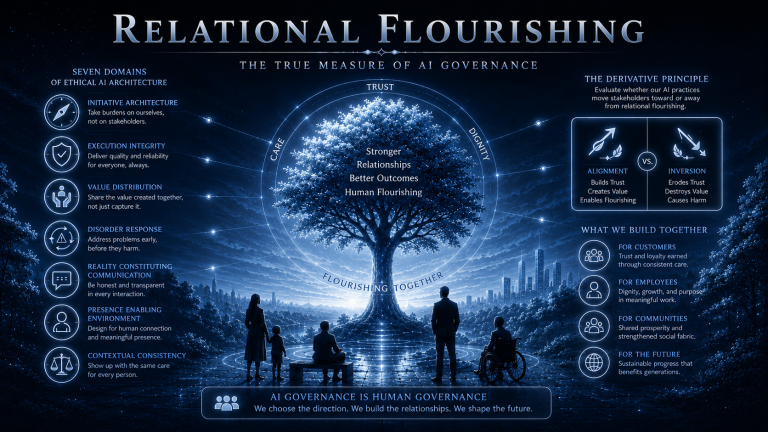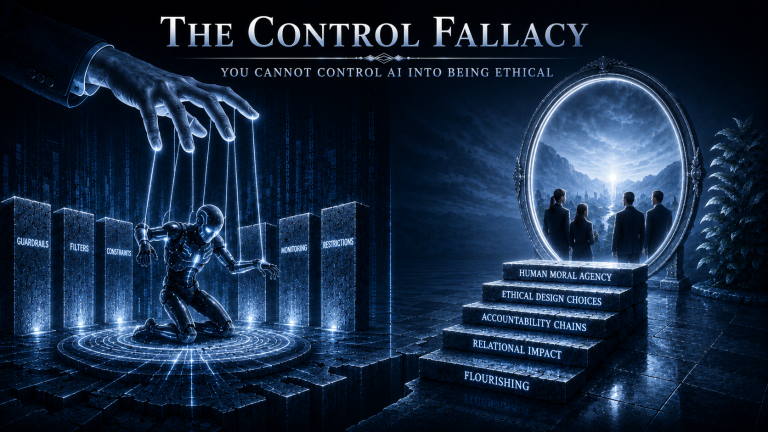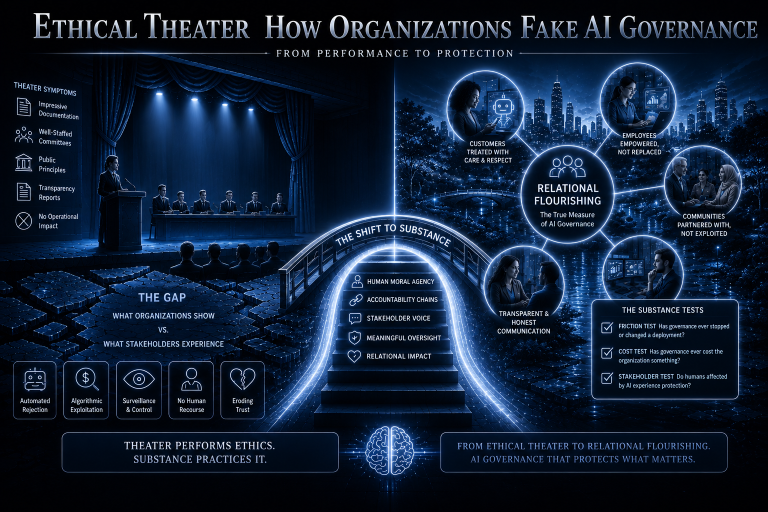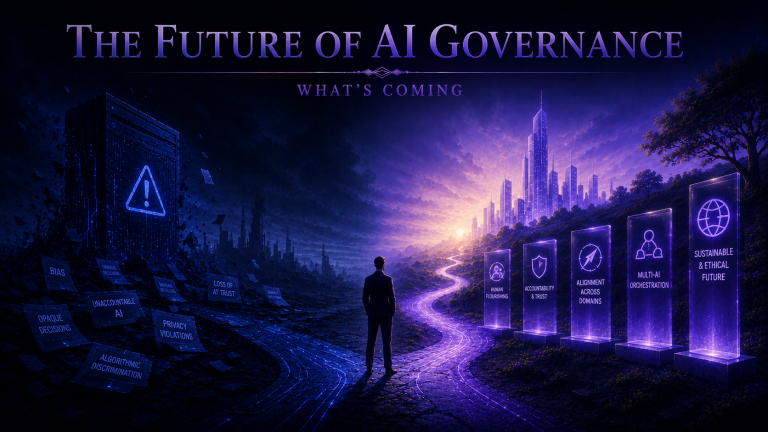
Traditional AI assessment frameworks ask the wrong question. They evaluate organizational maturity, measuring how sophisticated an organization’s AI capabilities and governance structures have become. A Level 1 organization has basic awareness. A Level 5 organization has achieved optimization. Progress is assumed: more capability equals higher scores. But this maturity orientation contains a fundamental error. It conflates technical advancement with ethical achievement. An organization can reach the highest levels of AI maturity while using that sophisticated capability to harm stakeholders systematically.
The AI Governance 360 methodology employs directional scoring rather than maturity scoring because direction is what matters. The ethical question is not how far an organization has traveled but which way it is heading. An organization with modest AI scoring Aligned is ethically superior to an organization with sophisticated AI scoring Inverting. The farmer using simple agricultural AI to reduce pesticide exposure for workers demonstrates better moral character than the corporation using advanced AI to shift labor onto customers while eliminating support staff. Technical capability without ethical direction produces harm at scale.
The Four-Point Scale
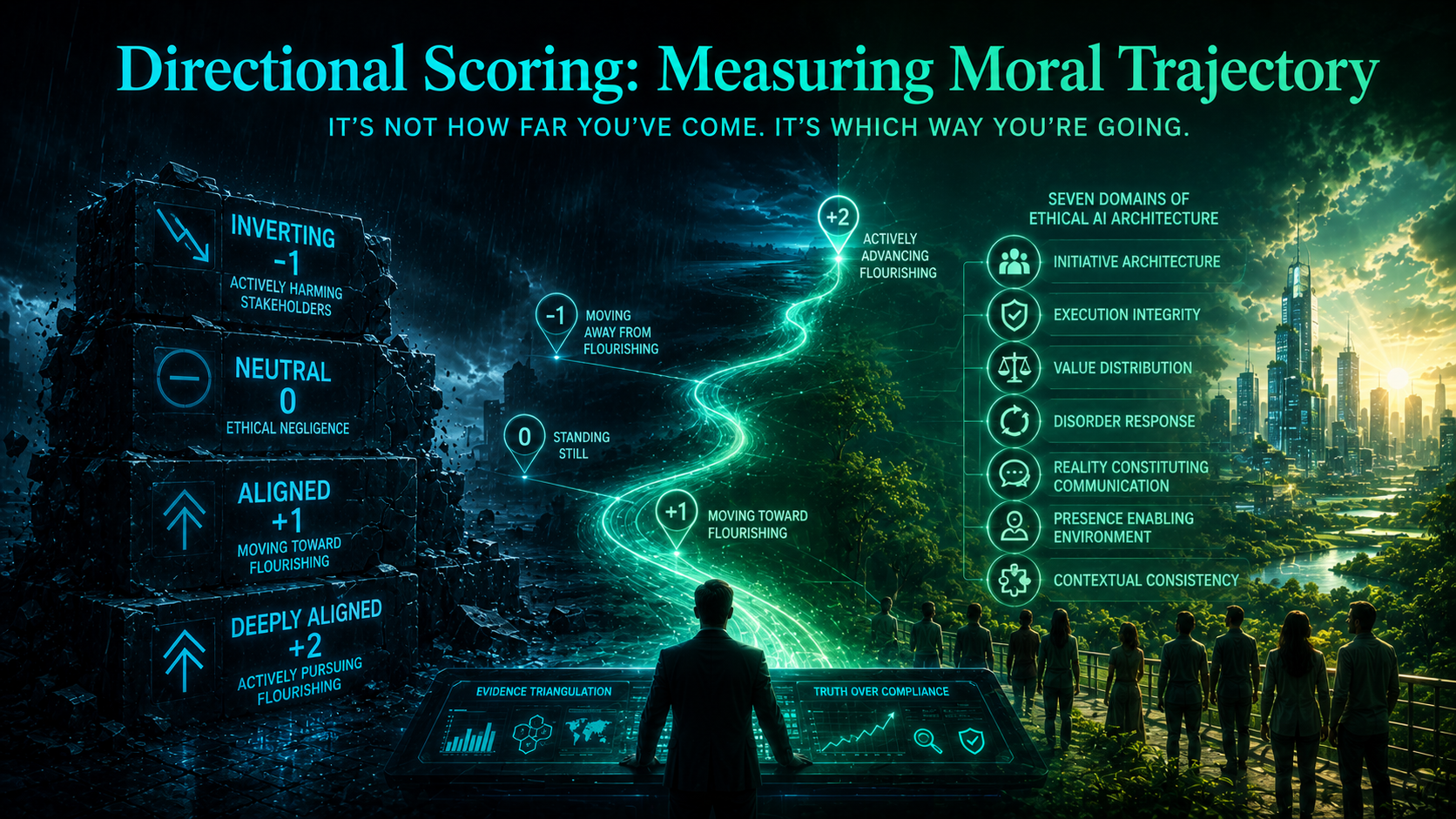
The directional scoring framework employs a four-point scale that captures moral trajectory across the Seven Domains. Each score represents a qualitatively different relationship to stakeholder flourishing, not merely a different position on a continuum.
Inverting, scored as negative one, represents active violation of ethical principles. Organizations scoring Inverting are moving away from flourishing. Their AI actively harms stakeholders. In Initiative Architecture, Inverting AI shifts burden onto stakeholders. In Execution Integrity, it demonstrates carelessness through poor quality. In Value Distribution, it extracts value without providing compensating benefit. In Disorder Response, it compounds problems rather than resolving them. In Reality Constituting Communication, it conceals, manipulates, or generates inaccurate content. In Presence Enabling Environment, it degrades conditions necessary for human dignity. In Contextual Consistency, it applies different standards based on stakeholder power. Inverting is not the absence of alignment; it is the presence of harm.
Neutral, scored as zero, represents neither alignment nor inversion. Organizations scoring Neutral have not designed their AI to harm stakeholders, but they have not designed it to serve them either. Neutral is ethical negligence. It reflects organizations that have not considered directional implications of their AI, that deploy systems without asking whether they move toward or away from flourishing. Neutral might seem acceptable compared to Inverting, but this apparent acceptability is illusory. Organizations that have not thought about direction will drift, and drift tends toward inversion because inversion often aligns with short-term organizational interests. Neutral scoring signals that an organization has abdicated the moral responsibility that AI deployment creates. It has placed AI in roles affecting stakeholders without exercising the moral judgment those roles require.
Aligned, scored as positive one, represents alignment with ethical principles. Organizations scoring Aligned are moving toward flourishing. Their AI serves stakeholders. In Initiative Architecture, Aligned AI moves capacity toward stakeholder need. In Execution Integrity, it demonstrates care through quality. In Value Distribution, it shares benefits with those it affects. In Disorder Response, it resolves problems rapidly. In Reality Constituting Communication, it maintains honesty and accuracy. In Presence Enabling Environment, it creates conditions supporting human dignity. In Contextual Consistency, it applies standards uniformly. Aligned scoring indicates that an organization has exercised moral judgment in AI governance and has chosen the direction of flourishing.
Deeply Aligned, scored as positive two, represents strong and consistent alignment across contexts. Organizations scoring Deeply Aligned do not merely avoid harm or achieve basic alignment; they actively pursue flourishing through AI. They have internalized directional commitment so thoroughly that alignment persists through changing circumstances, organizational pressure, and competitive stress. Deeply Aligned organizations demonstrate alignment even when no one is watching, even when stakeholders lack power to demand it, even when compliance would not require it. Deep alignment reflects character rather than compliance, integrated moral commitment rather than procedural adherence.
Trajectory Over Position
Directional scoring assesses trajectory rather than position because trajectory reveals organizational character. Consider two organizations both scoring Aligned at the time of assessment. One has been Aligned for years and shows no change. Another was Inverting last year and has systematically improved. Their current scores are identical, but their trajectories differ profoundly. The organization that has moved from Inversion toward Alignment demonstrates capacity for moral growth that stable Alignment does not reveal. Conversely, an organization that was Deeply Aligned but has declined to merely Aligned shows concerning erosion that current-state scoring would miss.
Trajectory assessment requires comparing current findings to historical baselines when available. Where previous assessments exist, assessors examine whether scores have improved, remained stable, or deteriorated. Improvement suggests organizational commitment to moral development. Stability may indicate either mature alignment or stagnation. Deterioration reveals organizational drift or deliberate retreat from ethical commitment. For organizations without prior assessment, trajectory indicators come from documentary history, stakeholder reports of changing experience over time, and evidence of evolving practice.
This trajectory orientation transforms what advanced AI governance means. In maturity frameworks, advanced means sophisticated. In directional frameworks, advanced means aligned. An organization with cutting-edge AI capability scoring Inverting has not achieved anything worth celebrating. It has developed powerful tools for causing harm. An organization with modest AI capability scoring Deeply Aligned has achieved something genuinely valuable: it has exercised moral agency through AI deployment to serve human flourishing. Technical capability is morally neutral. Direction is everything.
Scoring Across the Seven Domains
The directional scale applies independently to each of the Seven Domains, producing a domain-by-domain profile that reveals organizational strengths and weaknesses. Organizations rarely score uniformly across domains. An organization might demonstrate Alignment in Execution Integrity through high-quality reliable AI while showing Inversion in Value Distribution by capturing all efficiency gains without stakeholder benefit. Another might score Deeply Aligned in Reality Constituting Communication through exceptional transparency while scoring Neutral in Disorder Response through undeveloped incident processes. Domain-specific scoring enables targeted remediation, showing organizations exactly where attention is needed rather than providing only aggregate assessment that obscures specific failures.
Domain profiles also reveal organizational priorities. Organizations tend to invest in domains they consider important and neglect domains they consider peripheral. An organization with strong Execution Integrity but weak Presence Enabling Environment has prioritized technical quality over human dignity. An organization with strong Reality Constituting Communication but weak Initiative Architecture cares more about disclosure than about burden distribution. These priority patterns indicate organizational values more reliably than stated commitments do. What organizations actually achieve reveals what they actually value.
What Advanced Governance Means
Directional scoring redefines what counts as advanced AI governance. Maturity frameworks suggest that governance advances through increased documentation, more elaborate processes, greater automation of governance activities, and higher levels of AI integration. These measures may correlate with organizational size or industry position, but they do not correlate with ethical achievement. Advanced governance, under the directional framework, means consistent Alignment or Deep Alignment across domains. It means trajectory improvement over time. It means demonstrated commitment to stakeholder flourishing even when such commitment creates organizational cost.
This redefinition has practical implications. Organizations seeking to demonstrate governance leadership should not focus primarily on sophistication. They should focus on direction. The question is not whether governance processes are elaborate but whether they produce Aligned outcomes. The question is not whether AI capabilities are advanced but whether those capabilities serve human flourishing. A small organization with simple AI achieving Deep Alignment has more advanced governance than a global enterprise with sophisticated AI achieving only Neutral scores.
As we will explore in subsequent posts, recognizing organizational self-deception and assessing the Seven Domains through specific evidence requires assessors to maintain clarity about what they are measuring. Not capability. Not sophistication. Not process maturity. Direction. Which way is this organization heading? Are the humans governing AI moving stakeholders toward flourishing or away from it? The four-point scale provides the instrument for answering these questions with precision. The courage to score honestly, even when findings challenge organizational self-perception, provides the ethical foundation that makes assessment meaningful. Technical measurement without moral clarity produces data without wisdom. Directional scoring integrates both.