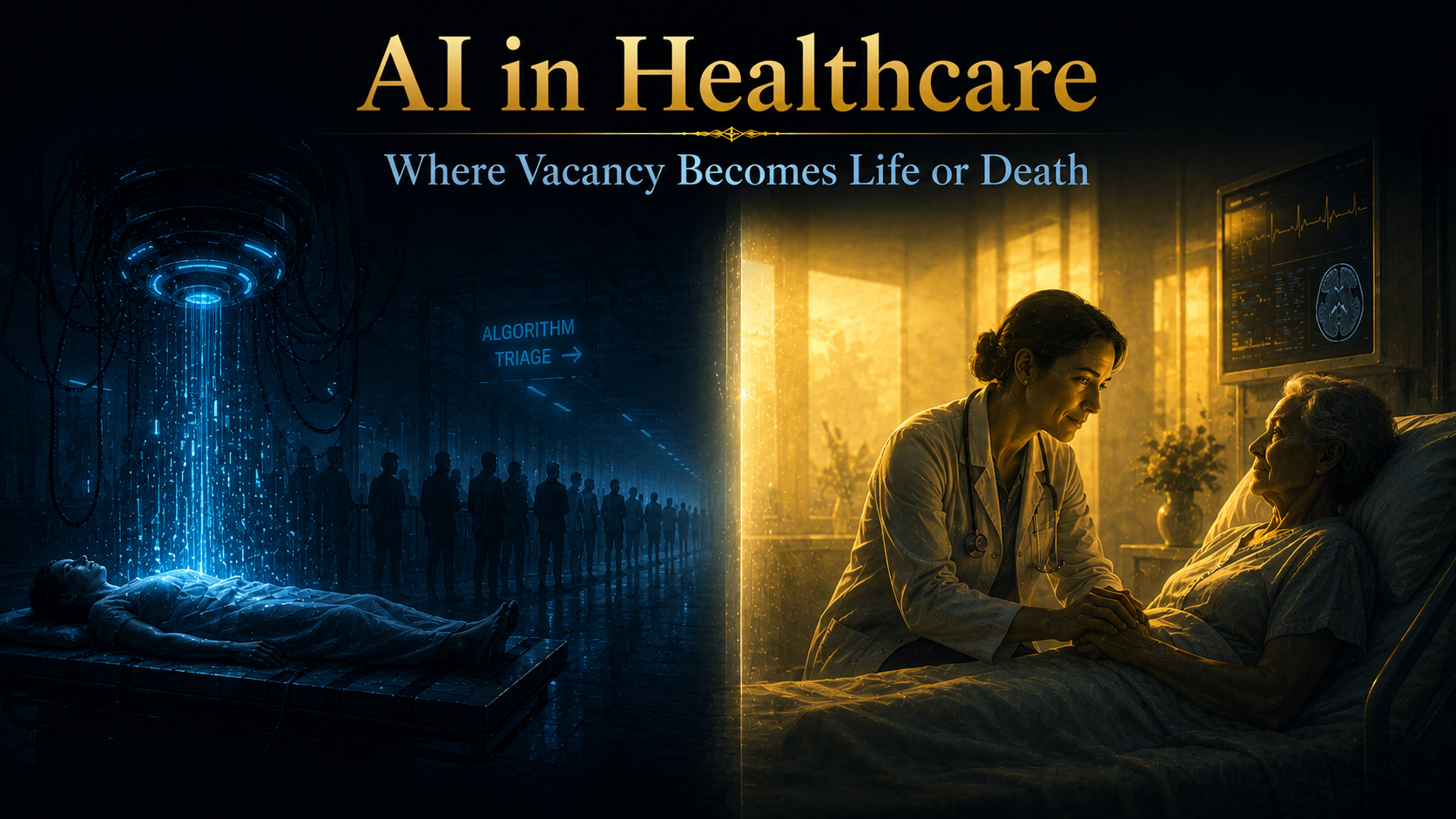
The patient arrives frightened. Their symptoms suggest something serious. They have been searching online, reading about possibilities, imagining worst cases. What they need from their healthcare encounter is not merely information processing. They need someone who can perceive their fear, who can judge their unique situation with the experience and wisdom that medical training provides, who can take responsibility for recommendations that may determine whether they live or die. They need a human capable of moral presence in what may be the most vulnerable moment of their lives.
Healthcare AI operates in precisely this context. Diagnostic support systems suggest possible conditions. Treatment recommendation engines propose interventions. Triage algorithms determine who receives urgent care and who waits. These systems process patients without perceiving them as persons, recommend treatments without judging whether recommendations fit individual circumstances, and sort humans into categories without capacity to recognize when categories fail the individuals being sorted.
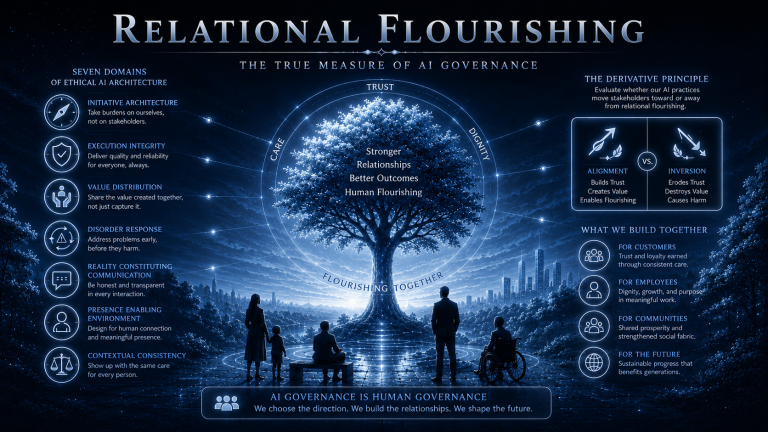
The stakes make every domain of ethical AI architecture critical. Healthcare AI governance cannot tolerate the inversions that might be merely problematic in other contexts. Here, inversion costs lives.
Consider Initiative Architecture in healthcare AI. Does the system move care toward patient need, or does it optimize for institutional efficiency while patients bear the burden? A triage algorithm that reduces wait times for the population while systematically disadvantaging patients whose presentations do not match standard patterns has inverted this domain. The patients who need the most careful evaluation may be precisely those whose symptoms do not fit the algorithms. Moving toward patient need means recognizing that healthcare exists to serve the sick, not to process them efficiently.
Consider Execution Integrity. Healthcare AI cannot tolerate the error rates accepted in other AI domains. A customer service chatbot that fails ten percent of the time creates frustration. A diagnostic AI that misses ten percent of serious conditions creates death. The quality standards for healthcare AI must reflect the stakes involved. This means not merely average performance but performance across all patient populations, including minorities whose conditions may present differently, patients whose circumstances complicate standard assessments, and cases at the margins where AI confidence may be low but the cost of error remains catastrophic.
Consider Disorder Response. Patients seeking healthcare are in disorder by definition. They are sick, worried, vulnerable. The healthcare system’s response to this disorder reveals its ethical direction. AI that compounds patient burden by adding complexity to an already difficult situation inverts this domain. AI that helps patients navigate healthcare systems more effectively, that reduces the barriers between people in need and appropriate care, that moves organizational capacity toward patient suffering rather than away from it, can achieve alignment. But the design intent matters. Healthcare AI designed primarily to reduce organizational cost while patients bear the complexity rarely achieves the alignment its designers claim.
The Vacancy Problem intensifies in healthcare because moral presence is not merely valuable but vital. The physician encountering a frightened patient exercises capacities that define good medicine. They perceive the patient as a whole person, not merely a collection of symptoms. They judge how textbook recommendations apply to this individual in these circumstances. They take responsibility for the decisions that shape patient outcomes. They provide presence that itself proves therapeutic for patients confronting their mortality.
AI can perform none of these functions. A diagnostic algorithm processes symptoms without perceiving the person experiencing them. A treatment recommendation engine applies patterns without judging whether patterns fit circumstances. No AI system takes responsibility for what it recommends. The patient interacting with healthcare AI encounters sophisticated processing absent the moral presence that healthcare relationships require.
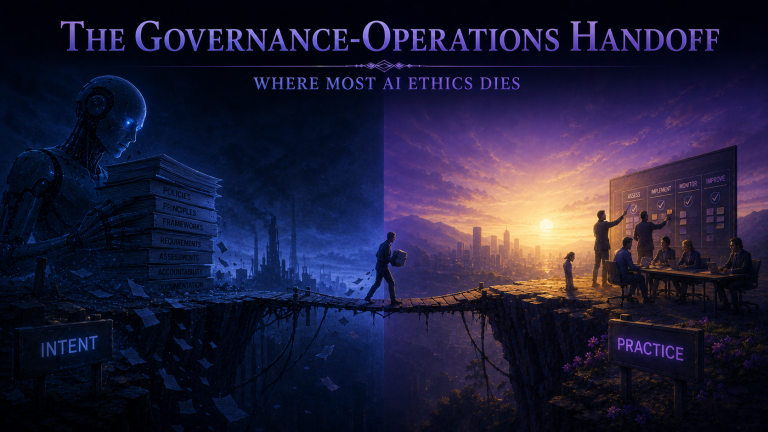
This creates a specific governance challenge. How should healthcare organizations deploy AI while preserving the human moral agency that patients need and deserve? The answer requires careful attention to role boundaries.
AI that assists physicians can serve patient flourishing. A diagnostic support system that surfaces possibilities a busy physician might overlook extends physician capacity without displacing physician judgment. A treatment reference tool that provides evidence helps physicians make more informed decisions while preserving their authority to judge how evidence applies to individual patients. The critical distinction is whether AI augments human medical judgment or replaces it.
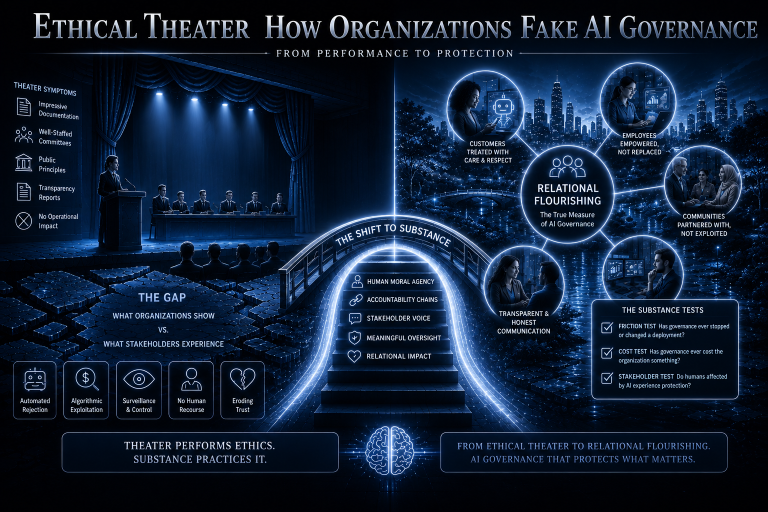
The Daisy Chain Principle becomes essential in healthcare AI governance. When diagnostic AI contributes to a treatment decision that harms a patient, accountability cannot dissolve into algorithmic complexity. The physician who relied on AI recommendations remains accountable. The administrators who deployed the AI system remain accountable. The organization that chose to interpose AI between patients and human medical judgment remains accountable. This accountability must be structural, not merely rhetorical. Healthcare organizations must ensure that humans with appropriate medical training and authority remain positioned to exercise judgment throughout the care process.
Contextual Consistency demands particular attention. Do healthcare organizations apply the same AI standards across all patient populations? The pattern we explored in our broader examination of this domain appears frequently in healthcare: careful, cautious deployment for populations that can advocate for themselves, more aggressive algorithmic treatment for populations that cannot. Patients with resources and knowledge may insist on human physician involvement. Patients without such advantages may find their care increasingly mediated by AI systems they cannot evaluate or contest. This stratification reveals whether healthcare organizations truly prioritize patient welfare or merely manage liability while maximizing efficiency.
The emotional dimension of healthcare compounds these concerns. Patients do not merely need accurate diagnoses. They need to feel heard, understood, supported through experiences that may be terrifying. A diagnostic AI might achieve equivalent accuracy to a physician while providing none of the relational care that helps patients cope with illness. Organizations that celebrate diagnostic equivalence while ignoring the vacancy in emotional support have not understood what healthcare actually provides.
The governance framework for healthcare AI must be exemplary because the consequences of failure are irreversible. A customer poorly served by AI customer service can escalate, complain, switch providers. A patient poorly served by AI healthcare may die. This asymmetry demands governance rigor exceeding other domains.
Healthcare AI governance must ensure that human override remains not merely possible but actively exercised. Physicians must retain authority to reject AI recommendations when their judgment indicates otherwise. Patients must retain access to human medical judgment when AI encounters prove inadequate. The design of healthcare AI systems must preserve space for the moral agency that medical care requires.
The fundamental question for healthcare AI is whether organizations are using AI to extend human medical care or to reduce it, whether AI augments physician capacity to serve patients or replaces physician presence with cheaper processing. The answer determines whether healthcare AI moves patients toward flourishing or merely processes them more efficiently while the moral vacancy grows. The accountability for this choice belongs to the humans who make it, and the consequences fall on the patients who have no choice but to trust that someone, somewhere in the system, is capable of seeing them as persons rather than cases to be processed.