Most organizations deploying AI today have little or no formal governance for that deployment. They adopted AI tools incrementally, each deployment seeming minor enough to proceed without special oversight. They treated AI as just another technology requiring the same governance as other software systems. They focused on technical functionality and business outcomes without establishing frameworks to evaluate whether AI deployment serves or undermines human flourishing. Now they find themselves with AI operating in role capacity across multiple functions, affecting customers, employees, and communities in consequential ways, all without the governance infrastructure this framework describes as essential.
Starting from zero is daunting but necessary. The framework this series has developed cannot be implemented overnight, but neither can organizations continue ungoverned deployment indefinitely. This piece examines how organizations without AI governance can begin building it, acknowledging both the urgency of action and the reality that governance maturity develops over time through sustained commitment, deliberate investment, and organizational learning that cannot be rushed.
Beginning with Honest Assessment
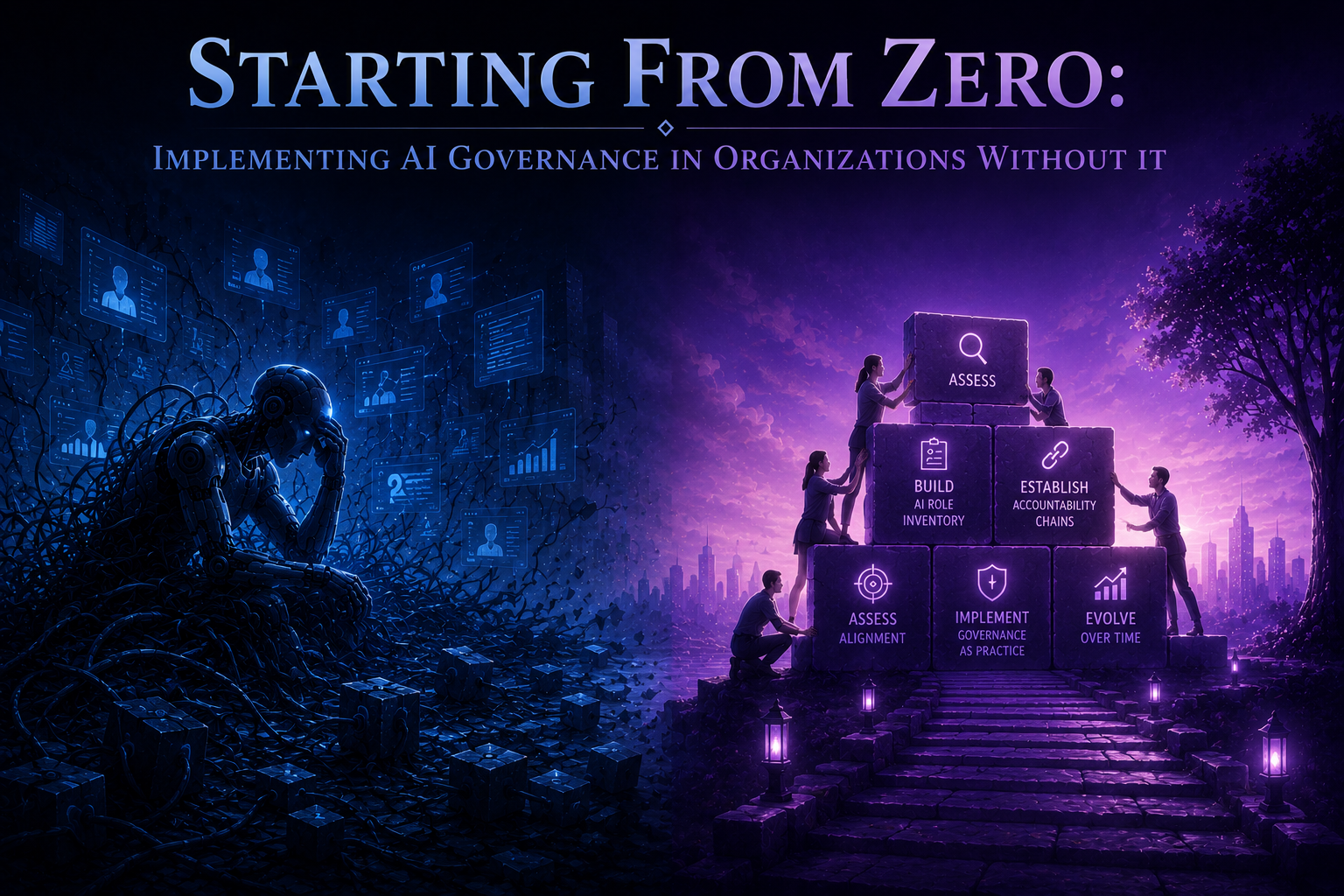
Organizations cannot govern what they do not understand. Before implementing governance frameworks, organizations must honestly assess their current AI deployment landscape. This assessment should identify all AI systems, where they are deployed, what functions they perform, and most importantly, which deployments involve AI occupying roles that require human judgment. This last determination, distinguishing AI as tool from AI in role, activates governance requirements as this framework has established throughout this series.
Many organizations resist this assessment because it reveals uncomfortable truths they would prefer not to confront. They discover AI making consequential decisions about hiring, lending, pricing, access, and other matters directly affecting human flourishing, all without governance oversight anyone established deliberately. They find the Vacancy Problem has occurred repeatedly across the organization: roles requiring human judgment have been vacated to AI systems without establishing the accountability structures and alignment assessments governance requires. Honest assessment reveals these gaps, which is precisely why honest assessment is essential and why it meets resistance. Organizations cannot address problems they refuse to acknowledge exist.
Building the AI Role Inventory
The AI Role Inventory catalogs all AI deployments where governance activates, specifically those deployments where AI occupies roles requiring human judgment. For each entry, the inventory documents what role the AI occupies, what decisions or actions it takes, who is affected by those decisions, and what accountability structures currently exist. Most organizations beginning from zero will discover that accountability structures are absent or unclear for many significant deployments. This discovery, while troubling, provides essential information for governance development and prioritization.
Building the inventory requires cross-functional collaboration that many organizations find challenging. IT teams know what AI systems are deployed technically but may not understand their business implications. Business teams understand what functions those systems perform operationally but may not recognize when AI has crossed from tool to role. Legal and compliance teams can help identify which deployments raise regulatory concerns. Human resources understands AI affecting employees. Customer-facing functions understand AI affecting customers. No single function has complete visibility into AI deployment across the organization, which is why building the inventory requires engagement across organizational boundaries that often do not communicate well.
Establishing Accountability Chains
With the inventory established, organizations can address accountability gaps systematically. For each AI system operating in role capacity, clear accountability chains must be established connecting AI outputs to responsible humans. The Daisy Chain Principle requires tracing responsibility from AI decisions through the system to accountable humans who can be held responsible when things go wrong. Someone must be responsible for the decisions each AI system makes, accountable for ensuring those decisions serve human flourishing rather than undermine it, and empowered to modify or discontinue deployment when problems emerge.
Establishing accountability is not merely assigning names to systems in documentation. True accountability requires that assigned individuals have authority to fulfill their responsibility, resources to monitor system behavior effectively, organizational support for raising concerns without career risk, and standing to halt deployment when necessary. Accountability without authority is theater that satisfies no one and protects nothing. Organizations starting from zero must ensure that accountability assignments come with the organizational backing that makes accountability real rather than nominal, which often requires more organizational change than organizations initially anticipate.
Assessing Current Alignment
With accountability established, organizations can assess whether existing deployments satisfy the second condition: directional alignment toward human flourishing. For each AI system in the inventory, assessment should examine impact across the Seven Domains this framework has established. This need not be exhaustive for every deployment immediately, but organizations should prioritize assessment for systems with greatest potential impact, those affecting the most people or affecting people in the most consequential ways.
Assessment may reveal deployments that cannot satisfy the alignment condition, creating difficult organizational choices. Organizations face hard decisions when assessment reveals existing AI deployment moving away from human flourishing rather than toward it. Discontinuing deployment may have operational and financial consequences that business leaders find unacceptable. Continuing deployment means knowingly maintaining systems that harm rather than serve stakeholders, which governance exists to prevent. Organizations with genuine commitment to AI governance will accept operational disruption rather than perpetuate known harm. This willingness to act on assessment findings, even when action is costly, is what distinguishes governance from theater.
Implementing Governance as Practice
Governance is practice, not project. Organizations cannot implement governance once and consider it complete, checking it off their list of initiatives. New AI systems require assessment before deployment. Existing systems require ongoing monitoring for alignment drift over time. Accountability structures require maintenance as people change roles. The cultural foundation our opening piece described requires continuous reinforcement that never concludes. Organizations starting from zero should understand they are beginning a permanent commitment, not a bounded initiative with defined completion.
This ongoing nature of governance requires dedicated resources that organizations must budget for indefinitely. Someone must own AI governance as their primary responsibility, not as one among many competing priorities that gets attention only when convenient. Governance functions require staff, budget, and organizational authority to be effective. Without dedicated resources, governance becomes something everyone assumes someone else is handling, which effectively means no one handles it. The three professional functions this framework has established, governance officers, management regulators, and assurance auditors, require investment that organizations starting from zero may not have anticipated but cannot avoid.
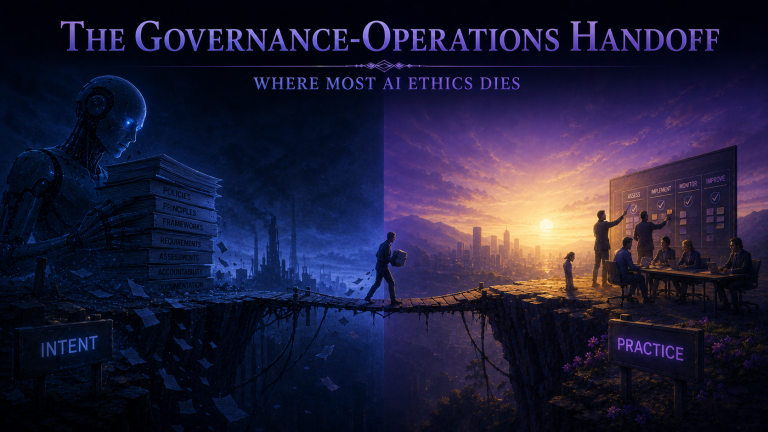
Organizations starting from zero face a significant gap between current state and governance maturity. Closing that gap requires sustained commitment over years, not months, and investment that may be uncomfortable. But the journey begins with honest assessment of current deployment, building the AI Role Inventory, establishing accountability chains, assessing current alignment, and committing to governance as ongoing practice. Our subsequent discussions examine the governance-operations handoff where implementation often fails, and the professional paths available to those who will do this essential work.