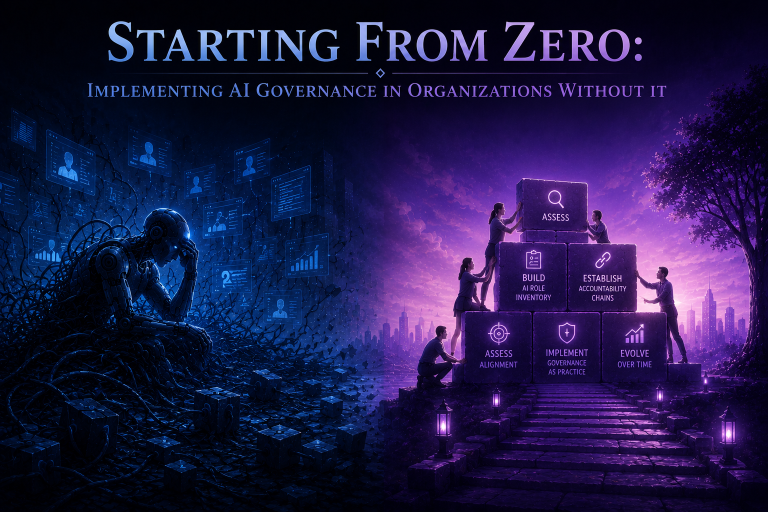
Every major technology company now publishes AI ethics principles. They convene ethics advisory boards. They issue transparency reports. They staff governance committees with impressive credentials. And their AI deployments continue exactly as they would have without any of this apparatus. This is ethical theater: the performance of moral commitment without its substance.
The proliferation of ethical theater represents one of the most significant failures in contemporary AI governance. Organizations have learned to produce the visible artifacts of ethical commitment while preserving complete operational freedom. The governance documents exist. The committees meet. The reports publish. But nothing actually changes in how AI affects the humans it touches. Understanding why this happens and how to identify it matters profoundly for anyone serious about AI governance.
The Anatomy of Performance
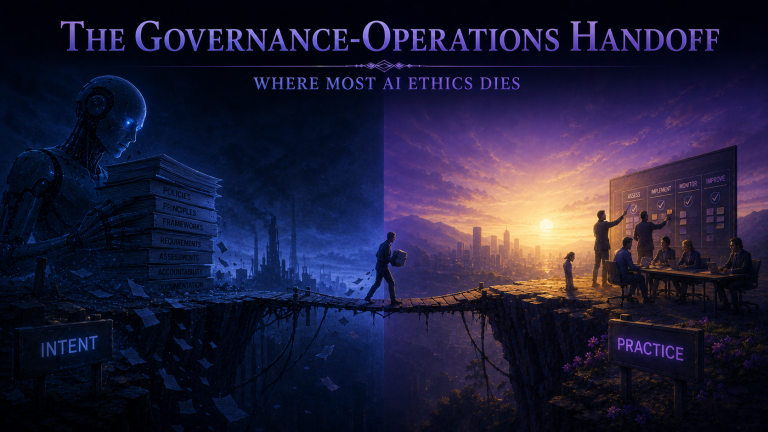
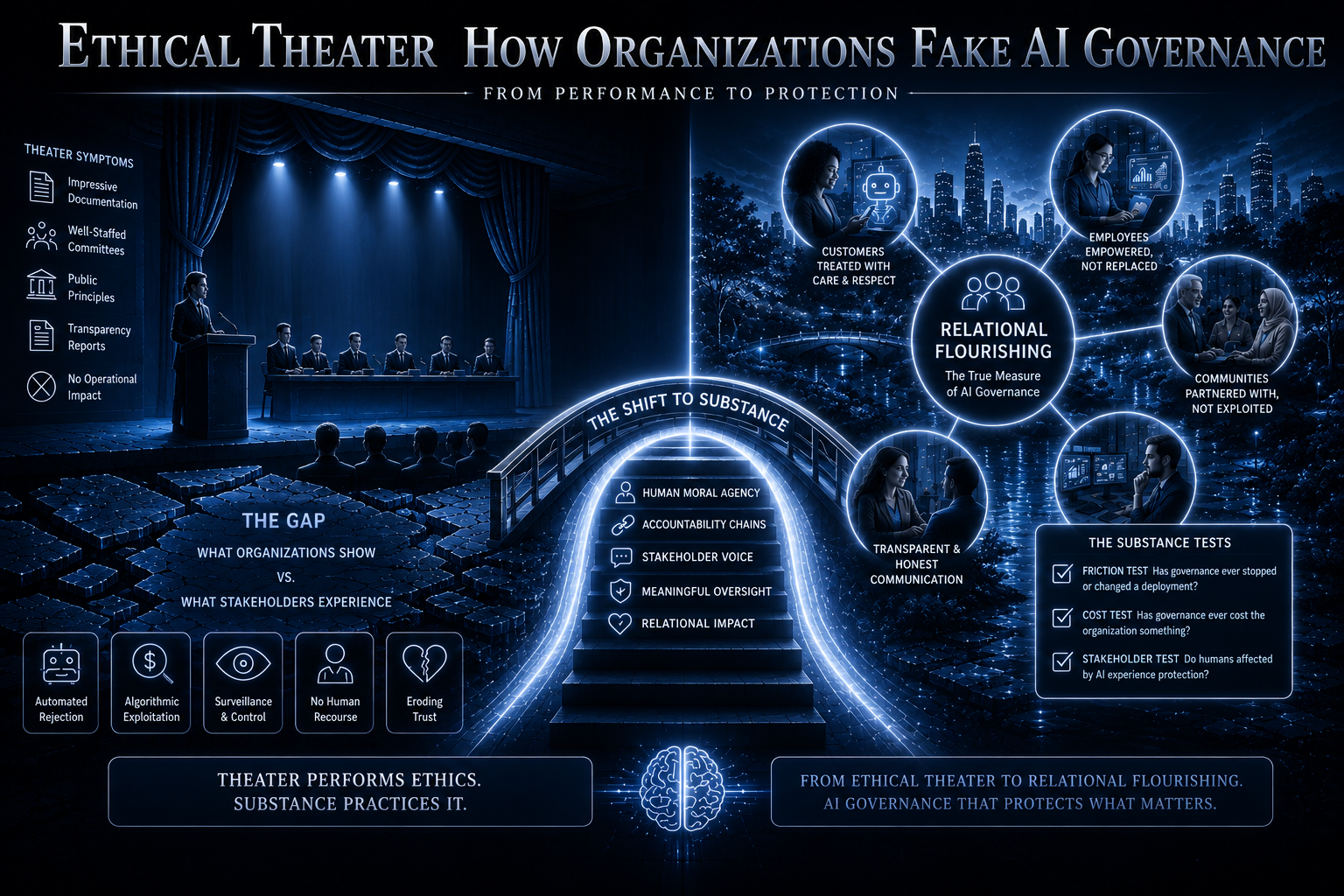
Ethical theater manifests in predictable patterns. The first pattern is governance documentation that never changes operations. Organizations produce elaborate AI ethics frameworks, responsible AI guidelines, and governance policy documents. These documents contain admirable language about human dignity, fairness, transparency, and accountability. They describe processes for ethical review and approval. They establish committees with oversight authority. But if you trace any actual AI deployment decision through this apparatus, you discover the documentation exists in a parallel universe from operational reality. Deployment teams know the governance documents exist. They may even reference them in approval requests. But the documents have never stopped a deployment, modified a design, or delayed a launch. They are compliance theater, not governance practice.
The second pattern is ethics committees that never block deployments. Organizations establish AI ethics boards staffed with academics, civil society representatives, and domain experts. These boards receive briefings on AI initiatives. They produce thoughtful recommendations. Their members genuinely care about ethical AI deployment. Yet somehow, no deployment they review ever fails approval. The committees function as legitimizing mechanisms, providing external validation that the organization takes ethics seriously while never actually constraining organizational behavior. When committees occasionally express concerns, those concerns are noted, appreciated, and filed where they cannot interfere with deployment timelines.
The third pattern is AI principles that never appear in product decisions. Organizations publish principles declaring commitment to beneficial AI, to avoiding harm, to transparency and accountability. These principles receive prominent placement on corporate websites and in annual reports. They are referenced in executive speeches and investor presentations. But when product teams make actual design decisions about how AI will interact with customers, employees, or communities, the principles are nowhere to be found. Design decisions optimize for engagement, conversion, efficiency, and cost reduction. The principles exist for public relations, not product development.
Why Theater Persists
Ethical theater persists because it serves organizational interests without requiring organizational sacrifice. Genuine governance creates friction. It stops deployments that would harm people even when those deployments would benefit the organization. It costs money, delays timelines, and sometimes eliminates competitive advantages. Organizations resist this friction, not because they are malicious, but because organizational incentives point toward efficiency and growth, not toward stakeholder protection when protection conflicts with performance.
Ethical theater provides the appearance of governance without its costs. Regulators see documentation and committees and conclude the organization takes ethics seriously. Boards of directors see governance frameworks and conclude risk is managed. Public relations teams cite principles and transparency reports when journalists ask difficult questions. Investors see responsible AI commitments and conclude reputational risk is contained. Everyone who needs reassurance receives it. Meanwhile, AI deployment continues optimizing for organizational objectives without meaningful constraint.
The framework I have developed throughout this series identifies why theater is so common: organizations confuse compliance with governance. As I argued in earlier posts on the Two Conditions of Ethical AI, genuine governance requires both structural accountability and directional alignment toward human flourishing. Compliance approaches satisfy neither condition. They produce documentation without ensuring humans exercise moral judgment over AI deployments. They create appearance of oversight without ensuring AI actually serves relational flourishing. Compliance is governance theater by design. It measures what organizations document, not what stakeholders experience.
The Tests That Reveal Theater
Distinguishing genuine governance from ethical theater requires examining impact rather than artifacts. The question is not whether governance exists but whether it matters. The friction test asks: has governance ever stopped or substantially changed an AI deployment? Has it ever delayed a launch because ethical requirements were not met? Has it ever required redesign that reduced efficiency or profitability? If governance has never produced friction, it is probably theater. Genuine governance creates tension between what organizations want to do and what they are permitted to do. Theater eliminates this tension by ensuring governance requirements are always already satisfied by whatever organizations want.
The cost test asks: has governance ever cost the organization money or competitive position? Has it ever required investment that did not produce business returns? Has it ever prevented the organization from pursuing opportunities competitors captured? Genuine governance sometimes costs. It requires investment in human touchpoints that AI could replace more cheaply. It foregoes efficiency gains that would harm stakeholders. It maintains oversight capacity that competitors may eliminate. If governance has never cost anything, it is probably theater.
The stakeholder test asks: do the humans affected by AI experience governance protections? Can customers reach human moral agents when AI fails them? Do employees have meaningful input into how AI affects their work? Do communities have voice in AI deployments that affect them? If governance exists entirely in corporate documents and committee meetings without manifesting in stakeholder experience, it is theater. Genuine governance appears in how stakeholders are treated, not in how organizations describe their commitments.
From Theater to Substance
Moving from ethical theater to substantive governance requires abandoning the compliance paradigm entirely. As I explored in my discussion of the Vacancy Problem, governance must address the fundamental issue that AI lacks moral agency. When organizations place AI in roles that affect human relationships, they create vacancies where human moral judgment should exist. Governance theater documents these vacancies. Substantive governance fills them with actual human presence and accountability.
The Daisy Chain Principle provides one test for substance over theater. This principle holds that accountability must trace through AI chains to humans who bear moral responsibility for outcomes. Theater creates accountability charts that look complete on paper but terminate in committees, processes, or documentation rather than in specific humans exercising moral judgment. Substantive governance ensures that when AI harms someone, a human being encounters that harm, takes responsibility for it, and has authority to address it. The chain of accountability connects AI outputs to human moral agents without gaps.
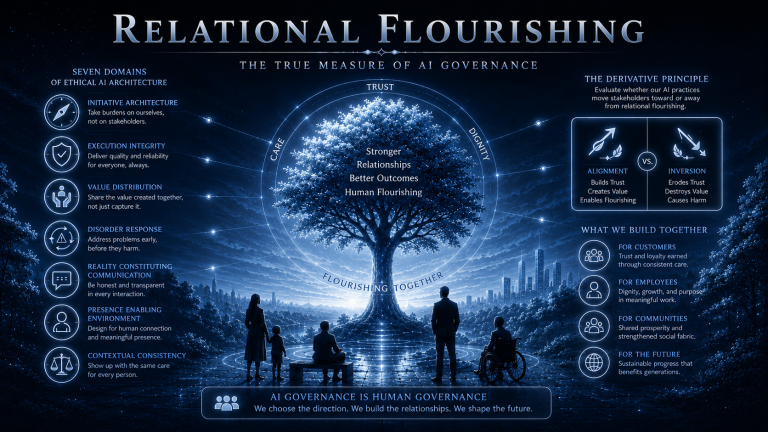
The Derivative Principle provides another test. This principle holds that AI governance must assess whether deployments move stakeholders toward or away from flourishing. Theater measures process compliance: were reviews conducted, were documents filed, were approvals obtained. Substance measures directional impact: are the humans touched by AI better off or worse off? Is relational value building or eroding? Are stakeholders experiencing care or extraction? These questions cannot be answered by examining governance artifacts. They require examining stakeholder reality.
Ethical theater satisfies no one who takes governance seriously. It fails stakeholders who receive performance instead of protection. It fails regulators who see compliance where substance is absent. It fails organizations themselves, which accumulate relational damage while believing governance shields them. In subsequent posts, I will explore how organizations can build governance that actually governs, beginning with the fundamental reframe that AI governance is not about controlling AI but about exercising human moral agency wisely. The path from theater to substance begins with recognizing what governance actually requires.