The dominant question in AI governance today is: How do we control AI? Policymakers ask how to control AI development. Corporations ask how to control AI deployment. Researchers ask how to control AI behavior. This question shapes regulation, governance frameworks, and public discourse. It also represents a fundamental category error that guarantees governance failure.
The control framing fails because it mislocates the ethical question. AI cannot be controlled into being ethical for the simple reason that AI cannot be ethical at all. AI processes information according to patterns established by human design. It has no moral agency, no capacity for ethical judgment, no understanding of right and wrong. The ethical questions in AI deployment belong entirely to the humans who design, deploy, and govern these systems. Asking how to control AI ethics is like asking how to control a hammer’s ethics. The question makes no sense because it assigns moral properties to something that lacks moral capacity.
The Moral Agency Distinction
Throughout this series, I have argued that understanding moral agency is essential to understanding AI governance. Moral agency requires not merely the capacity to act but the capacity to act for reasons, to evaluate those reasons against ethical standards, to feel the pull of moral obligation, and to bear responsibility for choices made. Humans possess moral agency. AI does not. This distinction is not a technical limitation awaiting future solution. It reflects the fundamental nature of what AI is: systems that process inputs according to patterns, however sophisticated those patterns become.
When we frame AI governance as controlling AI, we implicitly treat AI as an autonomous agent requiring external constraints. This framing makes intuitive sense because AI often appears autonomous. AI makes decisions. AI takes actions. AI produces outputs that surprise even its creators. The appearance of autonomy triggers human intuitions about controlling potentially dangerous agents. But the appearance deceives. AI decisions reflect human design choices about what patterns to recognize, what objectives to optimize, what outputs to produce. AI actions execute human instructions encoded in algorithms and training data. AI surprises reveal gaps in human understanding of their own creations, not genuine autonomy in the creation itself.
The Vacancy Problem I introduced earlier in this series illuminates the stakes. When AI occupies roles that require moral agency, those roles are not filled by an artificial moral agent. They are vacated. The moral presence that should exist in that role is simply absent. A customer service AI does not make ethical judgments about how to treat frustrated customers. It executes patterns for handling customer interactions. An HR screening AI does not evaluate fairness in hiring. It processes applications according to encoded criteria. The ethical judgments that should govern these interactions do not transfer to AI. They disappear unless humans with moral agency remain actively engaged.
What the Control Frame Gets Wrong
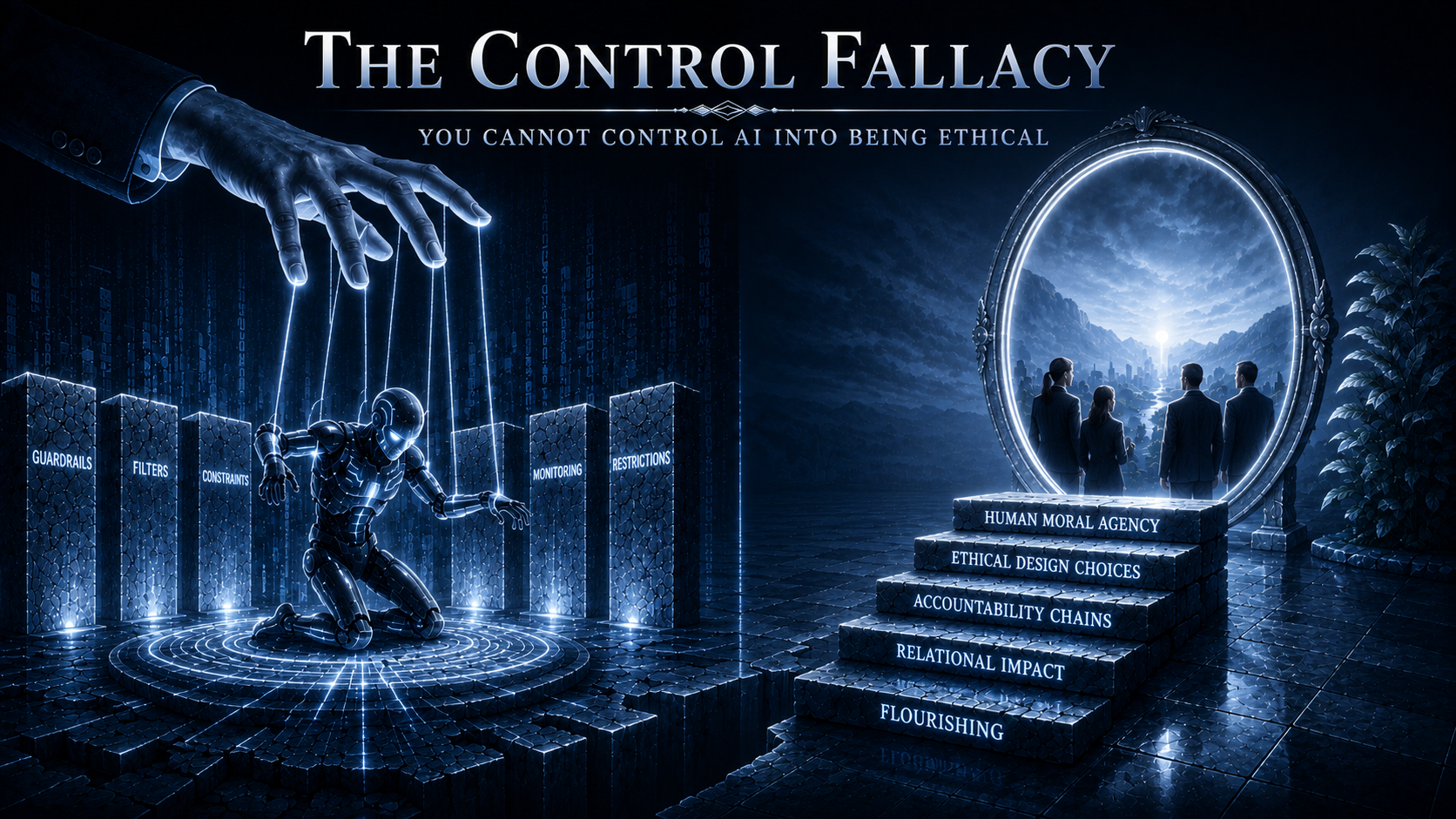
The control framing produces governance frameworks that fundamentally misunderstand their task. These frameworks focus on constraining AI behavior through technical mechanisms: guardrails that prevent certain outputs, filters that screen problematic content, constraints that bound AI operations within acceptable parameters. Such mechanisms have legitimate purposes in AI system design. But they are not ethics. They are engineering. Controlling what AI does is different from governing the moral implications of deploying AI in human relationships.
Consider the real ethical questions in AI deployment. What do we design AI to do? This question asks whether humans have aimed their creation toward beneficial ends or toward extraction. How do we deploy it? This question asks whether deployment decisions reflect care for those affected or indifference to their wellbeing. What accountability structures govern its use? This question asks whether humans maintain meaningful authority over AI operation. What happens when it harms people? This question asks whether organizations take responsibility for AI impacts or evade accountability.
None of these questions are about controlling AI. They are about governing human decisions. The control framing obscures this by positioning AI as the ethical agent to be constrained. Organizations then satisfy governance requirements by demonstrating AI constraints while ignoring the human decisions that determine whether AI serves or harms. They build elaborate technical controls around systems deployed for purposes that damage relational flourishing, and they call this ethical AI.
Reframing Changes Everything
Successful AI governance governs human decisions about AI, not AI itself. This reframing transforms every aspect of governance practice. Governance attention shifts from AI behavior to human authority. Instead of asking what constraints AI needs, governance asks what decisions humans are making through AI deployment and whether those decisions align with ethical requirements. The Daisy Chain Principle I discussed in earlier posts requires that accountability trace through AI chains to humans. When AI produces harmful outcomes, governance must identify which humans made the design choices that produced harm, which humans approved the deployment that enabled harm, which humans failed to intervene when harm became apparent. The accountability chain terminates in human moral agents, always.
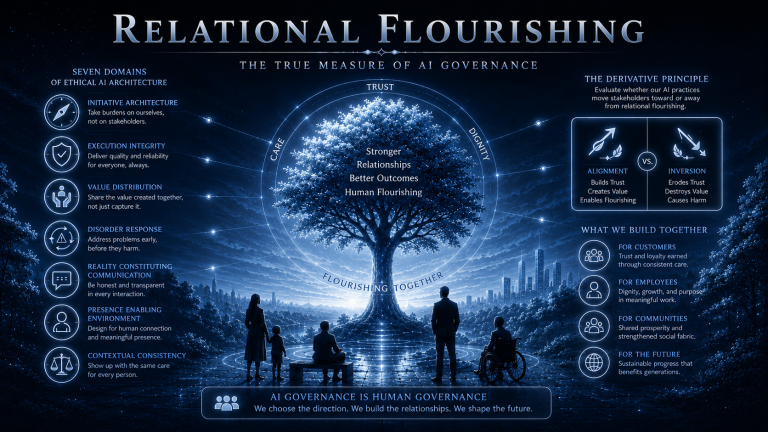
Governance attention shifts from technical performance to relational impact. Instead of asking whether AI operates within technical parameters, governance asks how AI deployment affects human relationships. The Derivative Principle requires assessing whether AI moves stakeholders toward or away from flourishing. This assessment cannot be accomplished by monitoring AI behavior. It requires examining stakeholder experience. Are customers being served or processed? Are employees being supported or displaced? Are communities being enriched or exploited? These questions evaluate human decisions manifesting through AI, not AI operation.
Governance attention shifts from compliance documentation to moral presence. Instead of asking whether governance processes were followed, governance asks whether human moral agency remains active in AI-augmented systems. The Two Conditions framework requires both structural accountability (humans remain present, active, and responsible) and directional alignment (those humans have aimed systems toward flourishing). Checking boxes about AI constraints satisfies neither condition. Organizations can maintain comprehensive AI controls while failing completely to exercise moral judgment about their deployment decisions.
Beyond the Control Paradigm
The control paradigm appeals because it promises technical solutions to moral problems. If governance can specify the right constraints, install the right guardrails, implement the right filters, then AI will be ethical. This promise is illusory. Ethics is not a specification to encode but a practice to exercise. Moral judgment cannot be automated because it requires the capacity that only moral agents possess: the ability to encounter particular situations, recognize their moral dimensions, weigh competing considerations, and choose actions that honor ethical commitments. No amount of control engineering produces this capacity in systems that lack it.
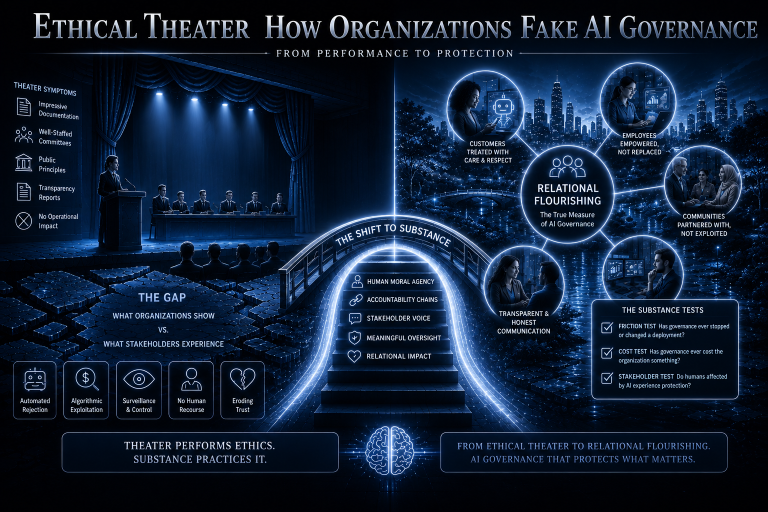
As I discussed in the previous post on ethical theater, control-focused governance produces the appearance of ethical commitment without its substance. Organizations demonstrate AI constraints and call it governance. They publish principles that never affect product decisions. They convene committees that never block deployments. The control frame enables this theater by directing attention away from human decisions toward AI behavior. If governance is about controlling AI, then governance succeeds when AI is controlled. That the humans deploying controlled AI have made harmful decisions disappears from view.
Moving beyond the control paradigm requires recognizing that AI governance is fundamentally about human moral agency exercised through technological systems. The governance question is not how we control AI but how we exercise moral authority wisely when AI amplifies our choices. What values do we encode in AI design? What relationships do we protect or damage through AI deployment? What accountability do we maintain for AI outcomes? What flourishing do we enable or prevent through AI operations? These questions place humans where they belong: as the moral agents whose choices determine whether AI serves good or ill. The next and final post in this series examines what those choices should aim toward: relational flourishing as the true measure of AI governance.