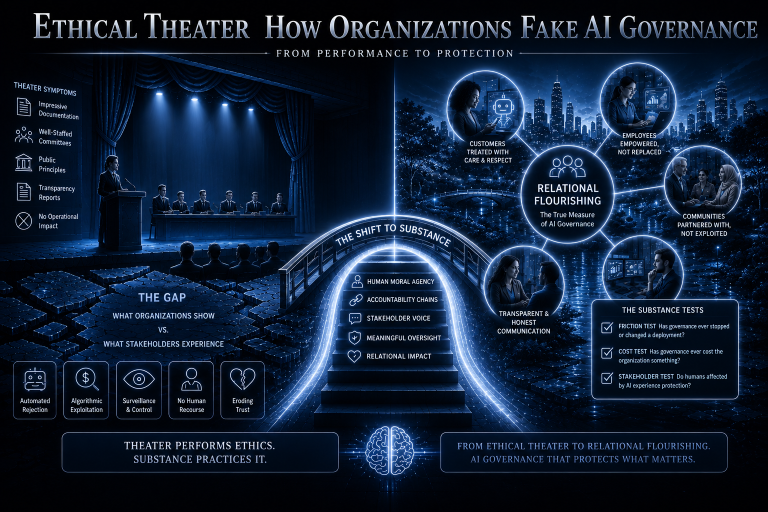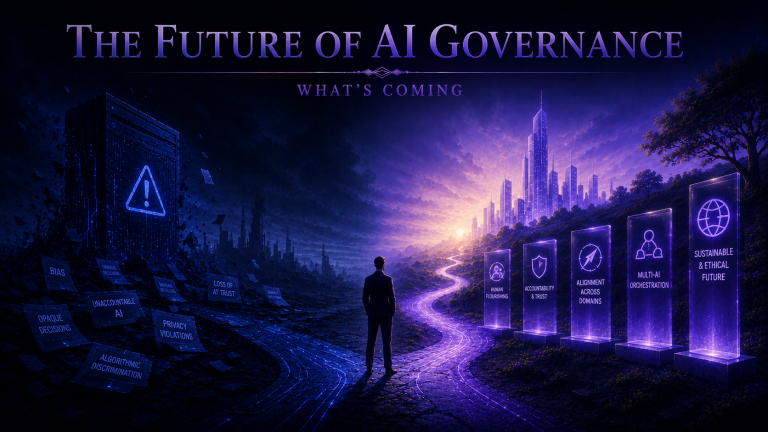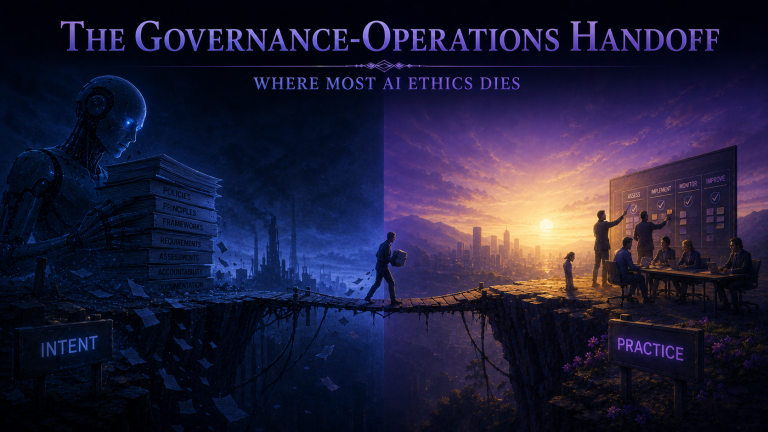
Throughout this series, I have critiqued prevailing approaches to AI governance: the compliance frameworks that produce documentation without protection, the ethical theater that performs commitment without substance, the control paradigm that governs AI behavior while ignoring human choices. These critiques raise an essential question: if not compliance, if not theater, if not control, then what? What should AI governance actually measure? What standard should determine whether governance succeeds or fails?
The answer is relational flourishing. The ultimate measure of AI governance is not compliance with policies, not technical performance within specifications, not even efficiency of operations. It is whether the fabric of human relationships is strengthening or weakening. Is trust building or eroding? Are stakeholders experiencing care or extraction? Are employees flourishing or degrading? Are communities enriched or depleted? These questions name what AI governance exists to protect. Any framework that cannot answer them has mistaken its purpose.
AI as Capability, Not Character
AI is not good or bad in itself. This claim may seem obvious, but its implications are routinely ignored. AI is a capability that can serve flourishing or undermine it. The same technology that helps patients receive better diagnoses can exclude vulnerable populations from healthcare access. The same systems that help employees be more productive can intensify surveillance and erode workplace dignity. The same algorithms that help customers find relevant products can manipulate purchasing decisions and exploit psychological vulnerabilities. The technology does not determine the direction. Humans who design, deploy, and govern AI choose the direction.
This is why the control paradigm fails so completely. Controlling AI behavior does not address whether controlled AI serves flourishing or harm. You can control a weapon with perfect precision while using it for atrocity. You can control an exploitative algorithm with complete reliability while it extracts value from vulnerable people. Control is morally neutral. The question governance must answer is not whether AI is controlled but whether humans are using AI to build or destroy relational value.
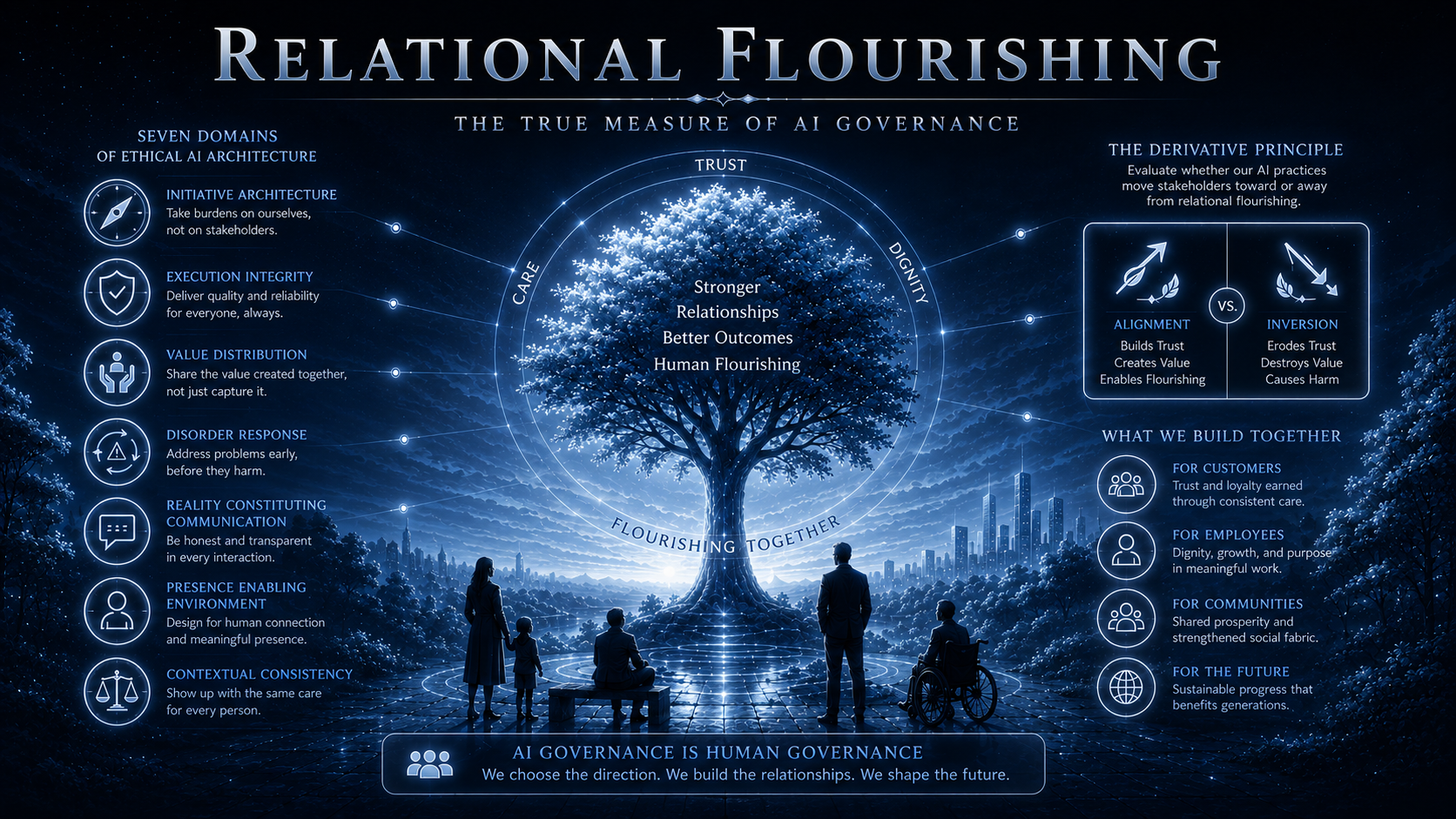
The Derivative Principle provides the framework for this assessment. This principle holds that AI governance must evaluate whether organizational practices move stakeholders toward flourishing or away from it. The question is directional: not whether some threshold is crossed but whether the trajectory points toward building relational value or destroying it. Organizations whose AI deployments consistently strengthen trust and create conditions for human flourishing demonstrate positive directional alignment. Organizations whose AI deployments consistently erode trust and degrade conditions for flourishing demonstrate inversion. Most organizations demonstrate mixed patterns, requiring domain-by-domain assessment.
The Seven Domains as Patterns of Care
The Seven Domains of Ethical AI Architecture that I have detailed in this series describe patterns of ethical action that serve flourishing. They are not compliance checklists or technical specifications. They describe how moral agents act when they genuinely care about those affected by their actions. Initiative Architecture asks whether organizations take on burdens themselves or shift them to stakeholders. Aligned practice moves toward stakeholder needs. Inverted practice imposes friction and complexity on those already disadvantaged by the relationship. Execution Integrity asks whether organizations attend to details that affect stakeholder experience. Aligned practice maintains quality across all affected populations. Inverted practice accepts mediocrity that harms vulnerable groups while serving advantaged ones.
Value Distribution asks whether AI-generated value flows toward stakeholders or concentrates to the organization. Aligned practice shares benefits with those who helped create them. Inverted practice extracts maximum value while returning minimum. Disorder Response asks whether organizations address problems proactively or allow them to compound. Aligned practice tends to what is breaking before it shatters. Inverted practice ignores emerging problems until crisis forces response. Reality Constituting Communication asks whether organizations maintain honesty in their AI interactions. Aligned practice ensures stakeholders understand what they encounter. Inverted practice conceals, manipulates, and deceives.
Presence Enabling Environment asks whether AI creates conditions for human flourishing or degrades them. Aligned practice designs interactions that respect stakeholder humanity and maintains touchpoints where moral presence matters. Inverted practice eliminates human connection for efficiency. Contextual Consistency asks whether organizations maintain ethical standards regardless of who is watching. Aligned practice applies equivalent care across all stakeholders. Inverted practice provides exemplary treatment to powerful observers while degrading service to those without voice.
Building Relational Value
Organizations that align with these patterns build relational value. They accumulate trust with customers who experience consistent care. They develop loyalty among employees who feel supported rather than surveilled. They earn legitimacy in communities that see genuine benefit from organizational presence. This relational value is not soft sentiment. It is the foundation of sustainable organizational success. Organizations that destroy relational value through AI deployment may achieve short-term efficiency while creating long-term stakeholder exodus. Governance that ignores relational impact ignores what matters most to organizational sustainability.
Organizations that invert these patterns destroy relational value. They shift burdens onto stakeholders through Initiative Architecture inversion, making AI deployment convenient for the organization while imposing costs on those served. They accept execution failures through Execution Integrity inversion, tolerating poor quality that harms stakeholders. They extract value through Value Distribution inversion, capturing AI benefits while stakeholders experience only costs. They ignore problems through Disorder Response inversion, allowing small issues to compound into catastrophic failures. They deceive through Reality Constituting Communication inversion, hiding AI involvement and manipulating decisions. They degrade environment through Presence Enabling inversion, eliminating human connection stakeholders need. They treat powerful stakeholders well through Contextual Consistency inversion while invisible stakeholders receive indifferent treatment.
The Seven Domains provide evaluative structure for assessing whether AI deployment serves flourishing. They do not prescribe specific technical implementations. They describe the patterns that characterize ethical action across diverse contexts. Organizations genuinely committed to relational flourishing can examine their AI deployments against these patterns and identify where alignment strengthens and where inversion weakens the relational fabric. This assessment is moral self-examination using frameworks designed to reveal directional orientation.
What AI Governance Is Ultimately About
This series has argued that AI governance requires fundamentally different thinking than conventional approaches provide. AI governance is not about controlling AI as autonomous agent. AI lacks moral agency entirely. The governance question is always about how humans exercise authority through AI systems. AI governance is not about compliance with policies and processes. Compliance frameworks produce documentation without protection, theater without substance. The governance question is always about whether stakeholders actually experience the care that governance claims to provide. AI governance is not about technical risk management. Technical risks matter, but they are not ethical questions. The governance question is always about relational impact: how AI deployment affects the humans it touches.
AI governance is ultimately about relational flourishing. When organizations deploy AI, they make choices that strengthen or weaken relationships with every stakeholder population. They build trust or erode it. They demonstrate care or indifference. They create conditions where humans can flourish or conditions where humans are merely processed. These choices belong to humans. AI amplifies them, extends them, scales them to affect millions. But the moral responsibility remains human throughout. The Three Professional Functions I have described together maintain the structures through which human moral agency governs AI deployment.
The measure of their success is not the sophistication of their frameworks, the comprehensiveness of their documentation, or the rigor of their processes. The measure is relational flourishing. Are stakeholders better off because of how the organization governs AI? Is trust deepening? Is care evident? Is flourishing expanding? Organizations that can answer these questions affirmatively have achieved what AI governance exists to accomplish. Organizations that cannot have substituted governance theater for governance substance, regardless of how impressive their governance apparatus appears. This is what AI governance is ultimately about: ensuring that as AI transforms human relationships, those relationships move toward flourishing rather than away from it. Nothing less will do.