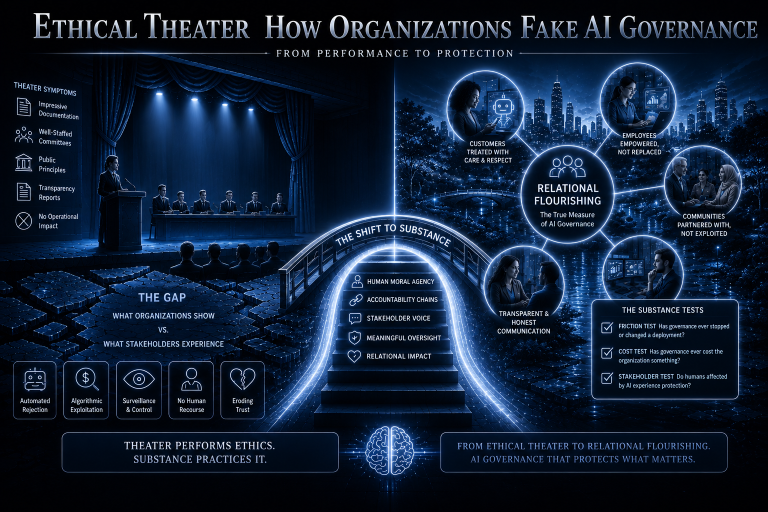
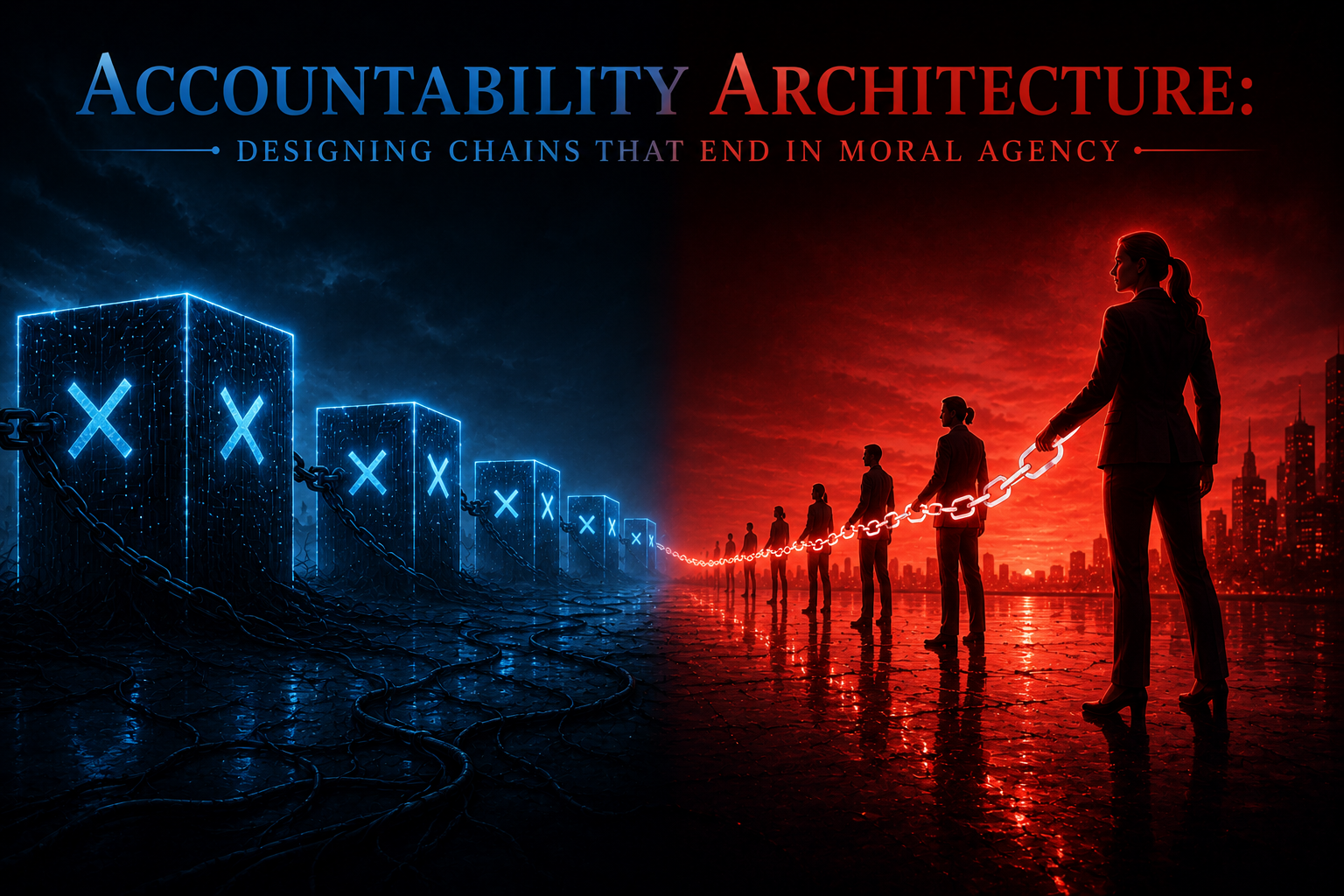
Accountability architecture ensures that clear chains of responsibility connect every AI output to human moral agents who actually exercise judgment, not merely retain theoretical authority. This distinction is where most organizational accountability fails. Organizations can point to documentation showing accountability assignments. Yet when examined operationally, these structures often prove ceremonial: humans nominally responsible who do not actually exercise judgment, chains that exist on paper without operational reality, authority assigned but never used.
The Daisy Chain Principle holds that accountability must trace through AI chains to humans who bear genuine responsibility. AI cannot be accountable because AI lacks moral agency. When AI systems produce effects on stakeholders, those effects must trace backward to humans who made design and deployment choices and forward to humans who maintain oversight authority. Accountability architecture makes these chains explicit, operational, and verifiable. The previous post examined the AI Role Inventory as governance’s foundation. Accountability architecture assigns responsibility for each identified system.
Role-Specific Accountability Assignment
Effective accountability begins with role-specific assignment: identifying who is responsible for which AI system’s effects. Generic accountability that assigns responsibility to “management” or “the governance committee” diffuses responsibility until no one bears it. Accountability architecture must name specific individuals with specific responsibilities for specific systems. These assignments cannot be implicit through organizational hierarchy. An executive nominally responsible for a business unit does not automatically maintain accountability for AI systems within that unit. Accountability must be explicitly assigned, explicitly accepted, and explicitly operationalized.
Role-specific assignment requires distinguishing types of accountability. Design accountability belongs to humans who decided to place AI into specific roles and specified parameters within which AI would operate. Operational accountability belongs to humans who manage AI systems daily, monitor performance, and identify when AI operates outside acceptable boundaries. Intervention accountability belongs to humans who maintain authority to halt, modify, or override AI operation. Stakeholder accountability belongs to humans who represent affected populations and ensure stakeholder impacts receive appropriate attention. A complete accountability architecture addresses all four types.
Assignment must match capability. A human assigned design accountability who did not participate in design decisions cannot bear that accountability. A human assigned operational accountability who receives no information about operations cannot exercise judgment over what they cannot see. A human assigned intervention accountability who lacks authority to actually intervene holds responsibility without power. Accountability architecture must verify that assigned individuals have the information, authority, and capability necessary to exercise their assigned responsibilities.
Intervention Capacity as Operational Reality
Structural accountability, one of the Two Conditions for ethical AI, requires that humans can actually intervene in AI operations when moral judgment requires it. This intervention capacity must be operational reality, not theoretical possibility. Organizations routinely claim intervention authority while designing systems that make intervention practically impossible: AI operates too fast for meaningful human review, systems are too complex for humans to understand, or organizational processes take longer than the decisions being made. Authority exists without operational reality.
Accountability architecture must specify how intervention actually works for each AI system in role capacity. What triggers indicate intervention may be needed? How do triggers reach humans with intervention authority? What mechanisms enable humans to halt, modify, or override AI operation? These questions must have operational answers verified through testing, not policy aspirations assumed through documentation. Intervention capacity degrades when untested. Organizations that design intervention mechanisms and never use them often discover, when intervention becomes necessary, that mechanisms do not work as expected.
Operational Versus Nominal Accountability
Most organizations have nominal accountability: names on organizational charts, responsibilities in job descriptions, assignments in governance documentation. Fewer organizations have operational accountability: humans who actually review AI outputs, who actually make judgments about appropriateness, who actually exercise authority to modify AI behavior when judgment requires it. The distinction matters because nominal accountability provides legal cover while operational accountability provides ethical reality.
Operational accountability requires that assigned individuals actually engage with AI systems through ongoing attention to what AI does and how it affects stakeholders, not annual review of performance summaries. The operations manager post in this series examined the challenge of maintaining this attention at scale. Accountability architecture must acknowledge scale constraints and design accountability that can actually be exercised given the number of systems requiring attention and the time available to accountable individuals.
Operational accountability also requires that assigned individuals actually make decisions. A human who reviews AI outputs and always approves them is not exercising judgment. A human who receives escalations and always confirms AI recommendations is rubber-stamping rather than deciding. Operational accountability produces evidence of judgment exercise: decisions to modify AI behavior, interventions that override AI outputs, escalations that halt AI operations pending review. Audit should examine that evidence to verify accountability is operational rather than nominal.
Accountability Through AI Chains
The Daisy Chain Principle addresses situations where AI systems coordinate, where one AI’s output becomes another AI’s input. These chains create accountability challenges because effects cannot be attributed to single systems. An outcome emerges from the interaction of multiple AI systems, each operating according to its own design, none individually responsible for the combined result. Accountability architecture for Level 3 systems (AI orchestrating other AI) must trace responsibility through the orchestration. Who designed the orchestration? Who is accountable for emergent effects that individual system accountability does not capture? Who can intervene at the orchestration level?
Level 4 systems (AI self-modifying parameters) create additional challenges. When AI modifies its own operational parameters, the humans who designed initial parameters did not design current parameters. Accountability architecture must address this evolution: Who is accountable for autonomous parameter modifications? What boundaries constrain self-modification? Who monitors for modifications exceeding boundaries? Self-modifying systems require accountability architecture addressing not only what systems were designed to do but what they have become through self-modification.
Making Accountability Real
Accountability architecture that exists only in documentation does not constitute accountability. The governance professional must build architecture that operates in organizational reality, connecting AI systems to humans who actually bear and exercise responsibility. This requires verification that assigned individuals know they are accountable, have information enabling judgment, have authority enabling intervention, and actually exercise both. It requires testing that intervention mechanisms work when needed and that judgment exercise actually occurs.
Real accountability requires organizational culture that supports it. Individuals will not exercise accountability if doing so exposes them to blame while accepting AI outputs protects them. Organizations must make clear that accountability involves authority to exercise judgment and that individuals who intervene appropriately are supported rather than second-guessed. Architecture can design accountability structures, but culture determines whether humans actually occupy those structures with genuine engagement.
This series on the Three Functions has established that AI governance requires distinct but complementary functions: governance that creates architecture, management that maintains alignment operationally, and audit that verifies whether intentions match outcomes. Accountability architecture represents governance’s core structural contribution. AI systems affect stakeholders through decisions, recommendations, actions, and interactions. Accountability architecture ensures that clear chains connect those effects to humans who bear moral responsibility, who actually exercise judgment, and who can actually intervene when judgment requires. Without this architecture, AI operates in an accountability vacuum. With it, the humans who exercise moral agency through AI remain present, active, and accountable for how that agency affects other humans.