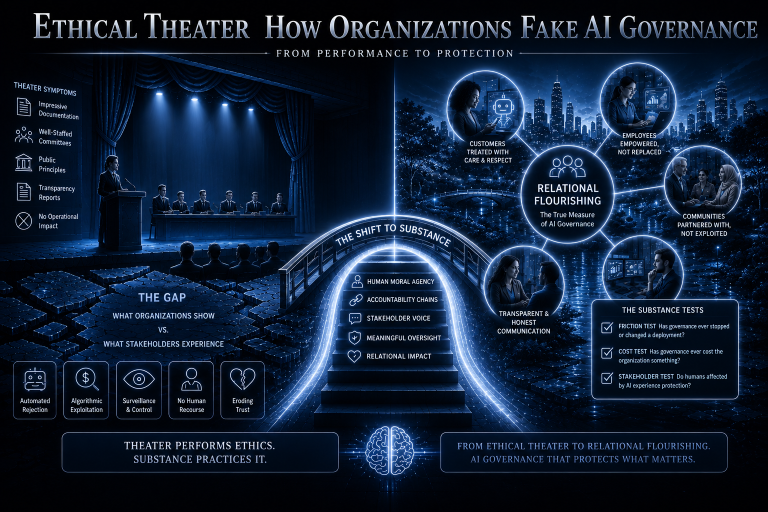
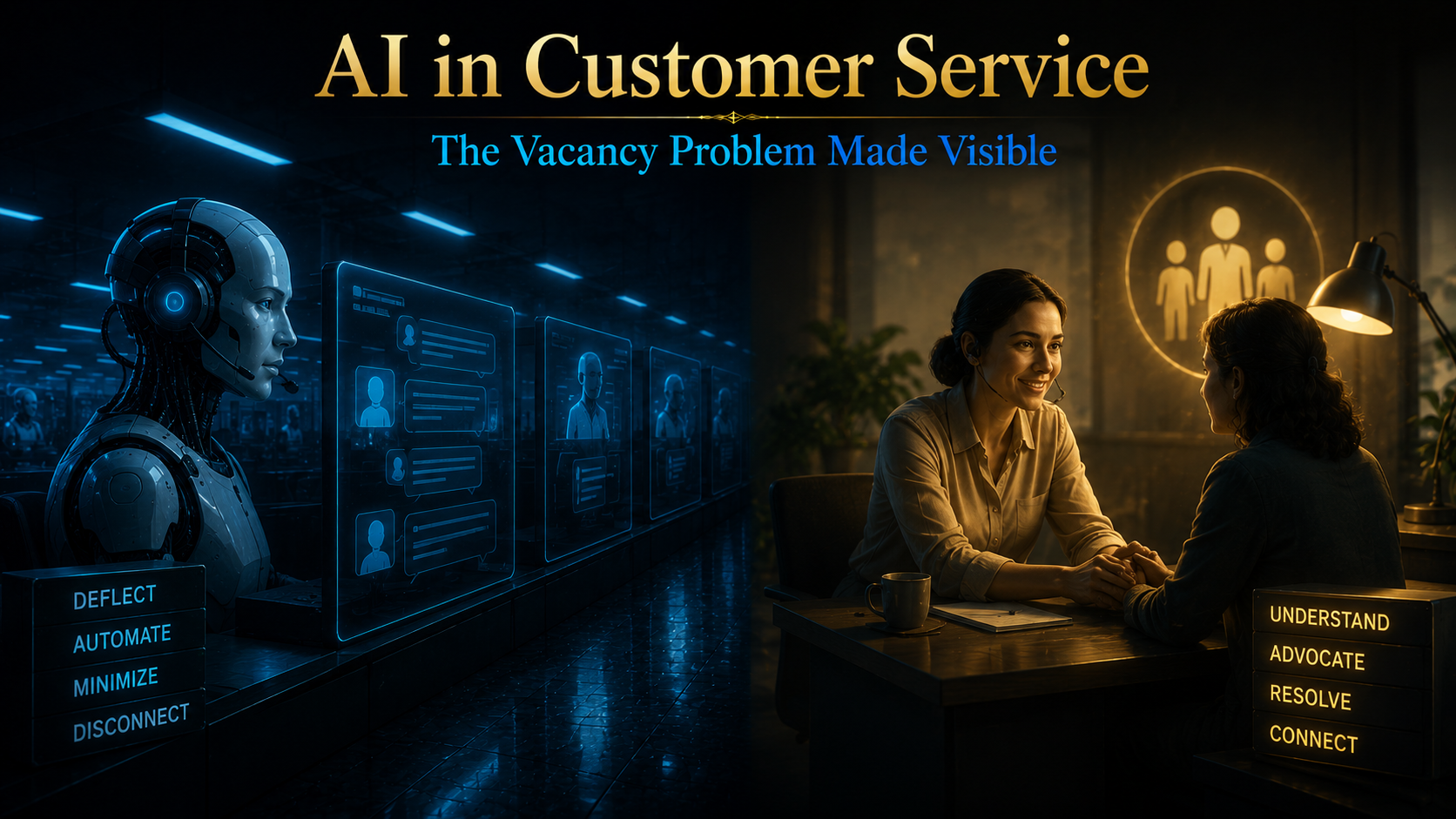
When a customer calls with a problem, they are not calling to process a transaction. They are reaching out in hope of encountering someone who can see their situation, judge whether the standard response fits their circumstances, and choose to help even when helping requires going beyond the script. The customer is seeking a human capable of moral agency. What they increasingly encounter instead is a sophisticated simulation that can recognize keywords, generate responses, and celebrate its own efficiency while being categorically incapable of the very thing the customer needs most.
Customer service represents the domain where the Vacancy Problem becomes viscerally apparent to ordinary people in their daily lives. Unlike AI systems operating in back offices or analytical contexts where the absence of moral agency remains invisible to those affected, customer service AI confronts people directly with what happens when roles requiring human judgment are occupied by systems that cannot provide it.
The customer service role has always carried moral weight. The representative encountering a distressed customer must perceive that distress, not merely process the words being spoken. They must judge whether the company’s standard policy produces a fair outcome in this particular situation, recognizing when rigid application of rules creates injustice. They must choose whether to advocate for the customer even when doing so creates inconvenience for the organization. They must apologize with genuine regret when the company has failed, not recite scripted phrases designed to create an impression of care without providing it. These capacities define what customers expect when they seek help. They are precisely what AI cannot provide.
As we explored in our earlier examination of the Vacancy Problem, AI occupies structural positions while being fundamentally incapable of filling the moral vacancy those positions create. The customer service context makes this abstract problem concrete and felt. The chatbot that responds to a grieving customer with cheerful efficiency has not merely failed to read the room. It has revealed that no one is in the room at all. The voice system that deflects a frustrated caller through endless menu options is not managing volume. It is ensuring that people in need never encounter anyone capable of helping them.
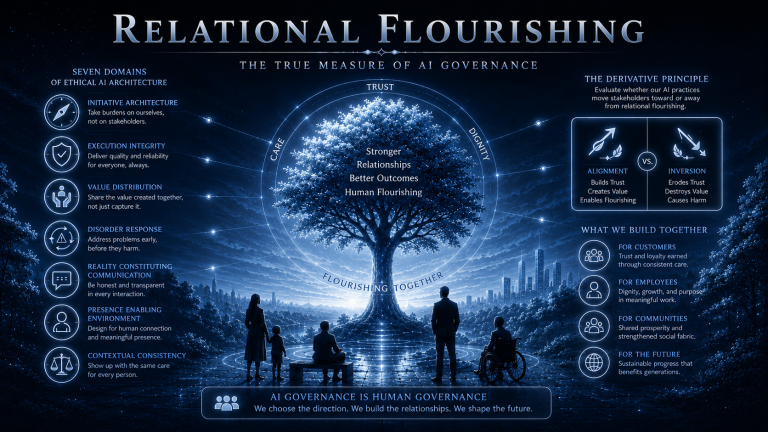
The ethical assessment of customer service AI must proceed through the Seven Domains framework, and what this assessment typically reveals is systematic inversion across multiple dimensions.
Consider Initiative Architecture. Does customer service AI move organizational capacity toward customer need, or does it shift burden onto those already struggling? The honest answer for most deployments is that AI exists primarily to reduce organizational cost, not to serve customers better. The customer facing a problem must now navigate the AI system before any possibility of human assistance emerges. The organization has shifted its burden onto the customer. That the organization celebrates this as efficiency reveals its ethical direction.
Consider Execution Integrity. Does the AI actually solve customer problems, or does it process contacts while leaving problems unresolved? The metrics organizations track tell the story. Contact deflection rates. Average handling time. First contact resolution, defined as the customer not calling back within some arbitrary window, regardless of whether their problem was actually solved. These metrics optimize for organizational convenience while ignoring whether customers leave their encounters better off than they arrived. A system that answers every query with technically accurate but practically useless information achieves excellent metrics while failing entirely to serve the people it encounters.
Consider Value Distribution. Where do the efficiency gains from customer service AI actually flow? The customer who previously received competent human assistance now receives degraded service while paying the same prices. The organization captures all value from automation while the customer bears all cost of reduced quality. Workers who previously performed these roles lose employment or see their positions degraded to handling only the problems AI cannot resolve, which are inevitably the most difficult and draining encounters. The distribution of AI-generated value reveals organizational character, and customer service AI typically reveals extraction patterns that should concern anyone committed to stakeholder flourishing.
Consider Disorder Response. Customers seeking service are already in disorder. Something has gone wrong. They have a problem they cannot solve themselves. They are reaching out for help. The aligned organization responds to disorder by moving toward it, providing assistance that genuinely resolves the disruption. The inverted organization responds to disorder by creating barriers, deflecting contacts, and celebrating when customers give up without their problems being addressed. Most customer service AI functions precisely as a barrier between customers in need and any possibility of genuine assistance.
Consider Reality Constituting Communication. Does the AI honestly present itself, or does it simulate capacities it does not possess? The chatbot with the friendly human name that expresses understanding and empathy is engaging in relational fraud. It cannot understand. It cannot empathize. It is performing emotional responses it cannot experience, creating false impressions about the nature of the encounter. That organizations design these deceptions deliberately reveals their willingness to manipulate customers rather than serve them honestly.
The deeper problem is what customer service AI reveals about how organizations actually view their customers. When a company deploys AI specifically designed to prevent customers from reaching humans capable of helping them, the company has answered the fundamental question of whether it sees customers as relationships to nurture or volume to manage. The answer is written in the architecture of every deflection, every endless menu, every cheerful chatbot that cannot perceive human distress.
This does not mean AI has no legitimate role in customer service. AI that handles genuinely routine matters quickly and accurately, freeing human agents to provide meaningful assistance where it matters, can serve customer flourishing. AI that routes complex problems to appropriate human specialists efficiently can reduce customer burden. AI that provides information customers actually need, honestly presented as automated assistance, can complement human service. The critical distinction is whether AI augments human moral agency or replaces it, whether AI serves customers or merely processes them.
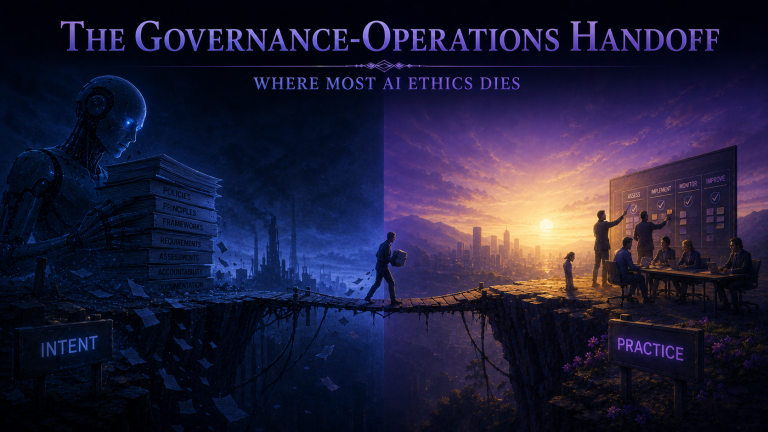
The governance challenge is ensuring that customer service AI deployments satisfy both conditions of ethical AI architecture. Structural accountability requires that humans remain responsible for how AI treats customers, with genuine authority to intervene when AI fails. Directional alignment requires that customer service systems are aimed at serving customer needs, not extracting value from them while minimizing organizational inconvenience.
Organizations deploying customer service AI should ask themselves a simple question: If customers fully understood what we are doing and why, would they feel served or exploited? The answer reveals everything about whether the deployment moves toward flourishing or away from it. Customer service AI makes the Vacancy Problem visible precisely because customers can feel the difference between encountering someone who can help and being processed by something that cannot.
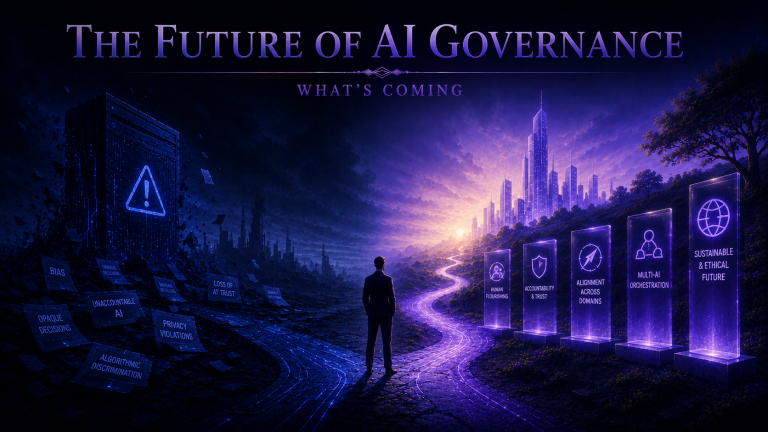
The accountability for this belongs not to the AI, which has no moral agency, but to the humans who design these systems, the executives who approve them, and the organizations that deploy them while celebrating efficiencies that come at customer expense. Customer service AI governance must evaluate how these humans exercise their moral agency through the systems they create. What we find, far too often, is moral abdication disguised as technological progress.