
There is a particular kind of organizational dishonesty that manifests not in what companies say but in what they do. An organization can proclaim commitment to customer experience while deploying AI systems riddled with preventable errors. It can announce dedication to stakeholder welfare while accepting failure rates that would be intolerable if executives experienced them. The gap between stated values and execution quality reveals something profound about organizational ethics that no corporate messaging can obscure.
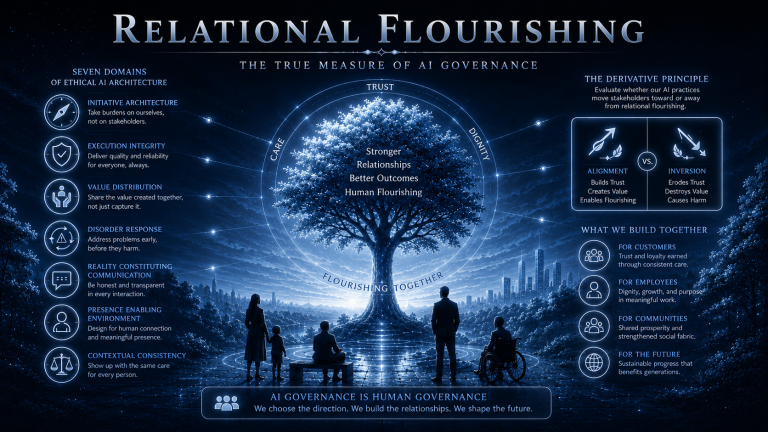
In our Seven Domains series, Execution Integrity follows Initiative Architecture for essential reasons. The previous post established that ethical AI deployment requires moving organizational capacity toward stakeholder need. But direction alone proves insufficient. An organization can intend to serve stakeholders while executing so poorly that the result harms them anyway. Execution Integrity addresses the moral weight of how things are done, not merely what is intended.
The Moral Substance of Quality
Execution Integrity rests on a principle that technical professionals often resist: how something is done matters morally, not merely whether it is accomplished. Deploying AI carelessly when careful execution is possible communicates something to affected stakeholders. It communicates that they do not matter enough to warrant attention to detail, that their experience is acceptable collateral damage, that errors affecting them are tolerable costs rather than failures requiring prevention.
This principle challenges the organizational habit of treating quality as purely operational concern divorced from ethics. Quality metrics belong to technical teams. Ethical questions belong to compliance departments. The Seven Domains framework rejects this separation. The quality of execution is an ethical question because it affects real people whose flourishing depends on organizational competence.
Consider AI systems affecting consequential outcomes: medical diagnostic assistants, employment screening tools, benefits determinations. Every error produces tangible harm. When organizations accept error rates as inherent to AI rather than failures demanding resolution, they make ethical choice masquerading as technical acceptance. The Vacancy Problem becomes acute when AI executes poorly in high-stakes domains.
The Evidence of Care
Organizations demonstrating aligned Execution Integrity test rigorously before deployment, investing resources to discover failure modes before stakeholders encounter them. They monitor comprehensively after deployment, maintaining visibility into actual performance. They respond rapidly to errors, treating each failure as urgent rather than acceptable.
More fundamentally, aligned organizations treat execution quality as moral commitment. The attention to edge cases, the investment in error prevention, the responsiveness to problems express a message: you matter enough that we refuse to harm you through carelessness. This message cannot be faked. Stakeholders experience execution quality directly.
Inverted Execution Integrity manifests as rushed deployment where launch dates override quality assurance. It appears as monitoring gaps where organizations do not know how their AI actually performs. It shows in acceptance of error rates as inherent rather than as problems requiring solution. Inverted organizations sacrifice quality for speed in ways that would be unthinkable if executives personally experienced the failures.
The Gap Between Aspiration and Reality
Many organizations maintain genuine aspirations for quality while tolerating practices that undermine it. They establish standards but create pressures making standards unachievable. They celebrate successes while quietly accepting failures. They respond to dramatic failures with visible remediation while allowing chronic problems to persist.
This middle ground is not neutral territory. The Derivative Principle admits no static positions. Either execution quality is improving or degrading. Either the gap between aspiration and reality is closing or widening. Organizations cannot claim aligned Execution Integrity while tolerating conditions that produce misaligned outcomes.
The governance challenge lies in distinguishing genuine failures, which occur in any complex system, from patterns of negligence revealing organizational values. Individual errors prove little. Patterns prove everything. When same types of failures recur, when known problems go unaddressed, when quality investments are repeatedly deferred, the pattern reveals that execution quality is not actually an organizational priority.
Execution as Equity
Execution Integrity carries particular weight for vulnerable populations. AI systems often perform less reliably for populations underrepresented in training data. When organizations accept differential performance as inevitable, they make an ethical choice about which stakeholders deserve reliable service and which can be sacrificed to algorithmic convenience.
Aligned organizations test specifically for performance across diverse populations. They monitor for differential error rates revealing bias. They treat disproportionate impact as execution failure requiring correction. The attention to equity reflects the broader principle: all stakeholders matter, not merely convenient ones.
The Daisy Chain Principle applies forcefully. When AI performs poorly, that performance reflects human decisions about testing investment, monitoring scope, acceptable error rates, and remediation priority. Those humans bear moral responsibility for execution failures even when no individual failure can be attributed to specific negligence.
The Organizational Testimony of Execution
Every deployment decision testifies to organizational values. Rushing AI to market testifies that launch dates matter more than stakeholder protection. Accepting known error rates without remediation testifies that those affected are expendable. Designing monitoring that tracks operational efficiency without capturing stakeholder experience testifies that experience is not valued.
Organizations cannot escape this testimony through communications. Stakeholders experience execution quality directly. The customer encountering repeated errors knows that resolution is not prioritized. The patient receiving incorrect information knows that accuracy is not paramount. The applicant wrongly screened out knows that thoroughness matters less than efficiency.
This is why Execution Integrity reveals organizational character. Organizations can control messaging but cannot fake execution. The quality of AI deployment exposes what organizations actually prioritize when priorities conflict, whose interests they protect when protection costs something.
Toward Execution That Honors Stakeholders
Aligned Execution Integrity requires treating deployment quality as ethical obligation. It requires testing investment proportionate to stakeholder impact. It requires monitoring capturing stakeholder experience, not merely system metrics obscuring human impacts. It requires response protocols treating errors as urgent regardless of operational consequences.
Most fundamentally, aligned Execution Integrity requires cultures where quality shortcuts are ethically unacceptable rather than merely operationally suboptimal. When deployment pressure conflicts with standards, aligned organizations delay deployment rather than accept predictable harm.
The previous post examined Initiative Architecture, asking whether organizations move capacity toward stakeholder need. Execution Integrity asks whether that movement is careful or careless, competent or negligent. An organization can move in the right direction while stumbling so badly that movement produces harm.
The next post examines Value Distribution, exploring how organizations share the benefits AI creates. But value cannot be distributed well through systems that execute poorly. The domains connect because organizational ethics forms an integrated whole rather than separable components.
How you deploy AI reveals who you think matters. Execution Integrity asks organizations to answer that question through practices rather than pronouncements.