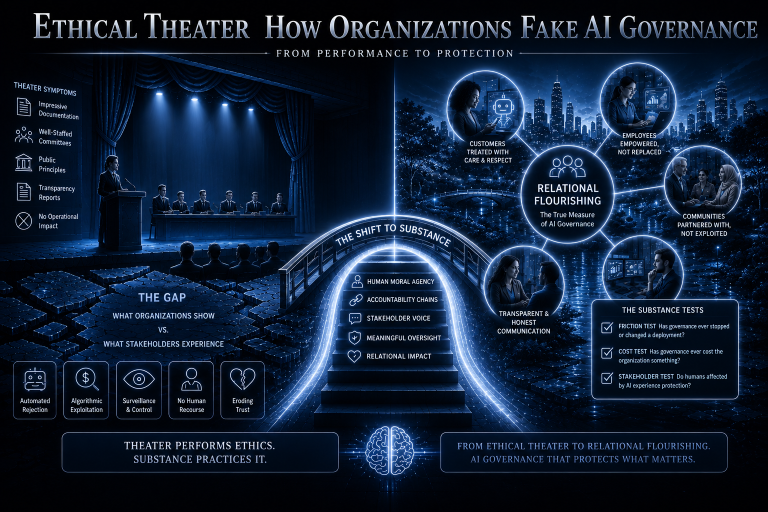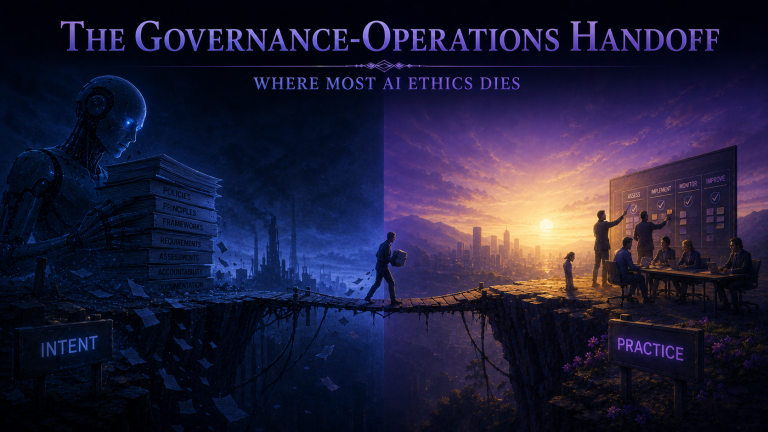
The governance theater that dominates most organizations follows a predictable script. Leadership announces an AI governance initiative. Consultants produce frameworks. Policies appear in document repositories. The organization declares itself governed. Then nothing changes in how AI actually operates, affects stakeholders, or produces outcomes. The policies exist; the governance does not.
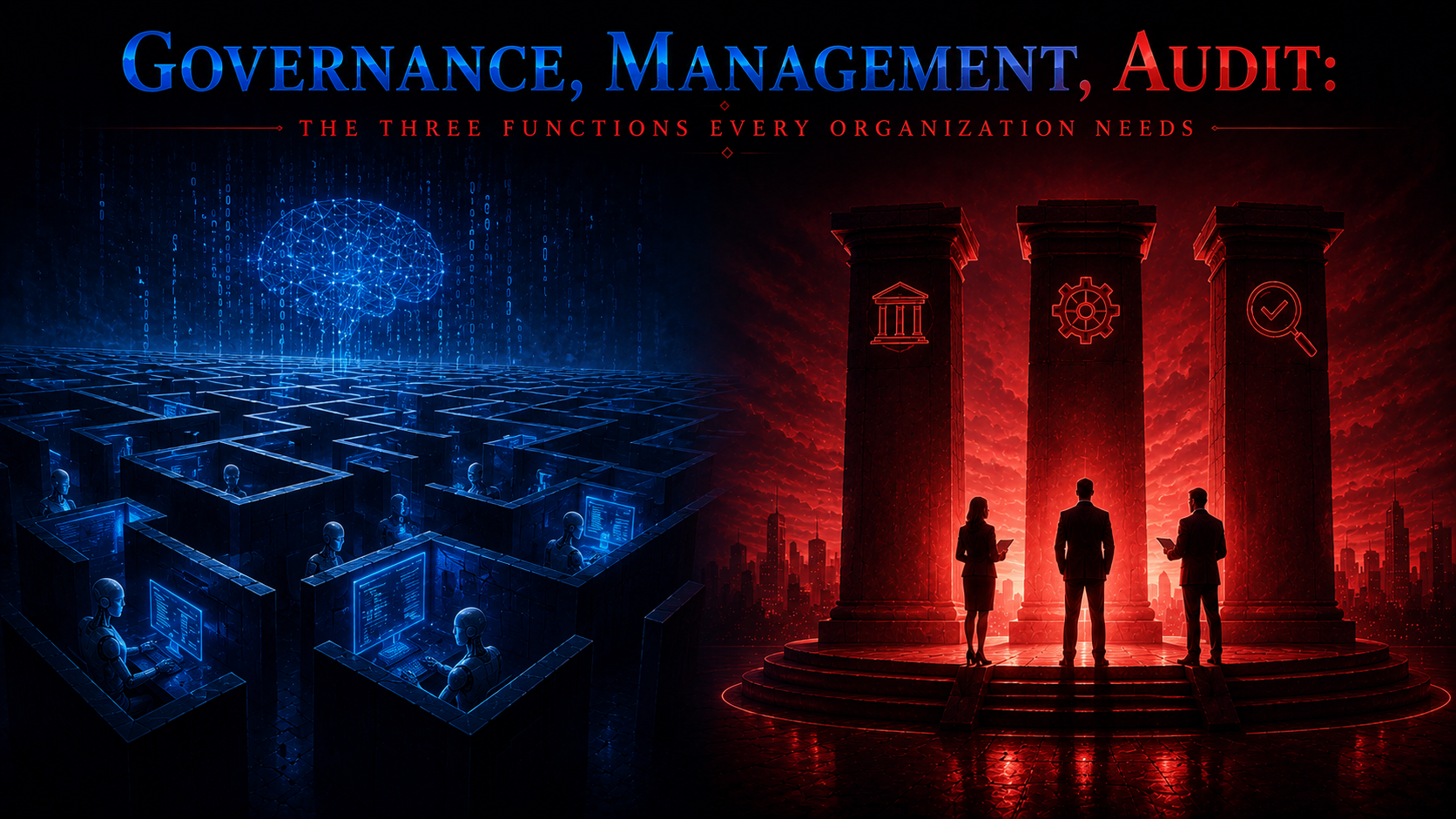
This failure is structural. Organizations treat AI governance as a single function when it actually requires three distinct functions operating in coordination. Governance establishes what must exist before AI can ethically occupy roles. Management maintains alignment in daily practice. Audit verifies whether intentions match outcomes. Most organizations have governance on paper but lack management infrastructure that makes policies operational and audit that tells them whether any of it works.
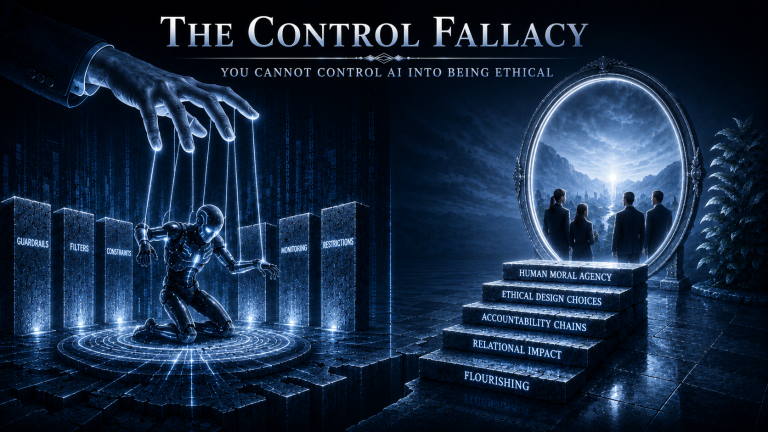
Understanding why three functions are necessary begins with understanding what AI governance evaluates. As established throughout this series, AI governance addresses how humans exercise moral agency through AI systems. AI lacks moral agency entirely. When AI occupies roles affecting stakeholders, it creates the Vacancy Problem: positions requiring human judgment now filled by systems incapable of providing it. Governance must ensure humans remain present, accountable, and properly directed. This requires structures before deployment, attention during operation, and verification that both achieve their purposes.
The Three Functions as Peer Disciplines
The governance function, performed by the Certified AI Governance Officer (CAIGO), establishes architectural requirements for ethical AI deployment. Governance asks: what must exist before AI can ethically occupy roles? The answer involves frameworks, policies, and accountability structures. Governance identifies which roles AI may occupy and which must remain human. It establishes how accountability chains connect AI outputs to human moral agents. It specifies what oversight mechanisms must exist at each First Mover Authority level.
Architecture alone produces nothing. The management function, performed by the Certified AI Management Regulator (CAIMR), operationalizes governance in daily practice. Management asks: how do we maintain alignment day to day? AI systems drift from original parameters. Metrics that once measured what mattered begin measuring what is easy. The humans who work with AI face constant decisions about balancing governance requirements against operational demands. Management transforms governance intent into reality by maintaining vigilance and ensuring that humans exercising moral agency through AI actually exercise it well.
Even perfect governance and diligent management cannot verify their own success. The audit function, performed by the Certified AI Assurance Auditor (CAIAA), assesses whether governance and management achieve objectives. Audit asks: have we actually achieved alignment or just claimed it? This requires independence from both other functions, methodology for assessing whether structural accountability and directional alignment exist, and willingness to deliver findings that challenge organizational self-perception.
These functions operate as peers, not hierarchy. Each has distinct responsibilities requiring different expertise and organizational positioning. Governance requires policy development capability and executive connection. Management requires operational expertise and daily engagement with AI systems. Audit requires independence and assessment methodology. Collapsing these functions or subordinating one to another undermines the checks and balances that make the system work.
What Happens When Functions Are Missing
Governance without management produces policies that sit on shelves. The organization can point to impressive documentation, but that documentation has no operational manifestation. Policies require human touchpoints, but no one monitors whether stakeholders can reach humans. Policies require accountability chains, but no one verifies that designated humans exercise oversight. Meanwhile, operational reality follows its own logic, optimizing for efficiency without regard for governance requirements that exist only on paper.
Management without governance operates without standards. Operations managers making daily decisions have no framework telling them what ethical operation requires. When they face trade-offs between stakeholder wellbeing and efficiency, they have no principled basis for decision-making. Without governance standards, each manager becomes their own ethics committee, producing inconsistent outcomes that reflect individual judgment rather than organizational commitment.
Either function without audit cannot verify intentions match outcomes. This creates organizational confidence without organizational knowledge. Leadership believes AI deployment is ethical because governance frameworks exist and management claims to implement them. But no one has independently verified whether implementation occurs, whether structures exist operationally, whether designated humans actually exercise accountability. Organizations in this configuration often discover governance failures only when external events force recognition: investigations, scandals, or undeniable stakeholder harm.
The Two Conditions Across Three Functions
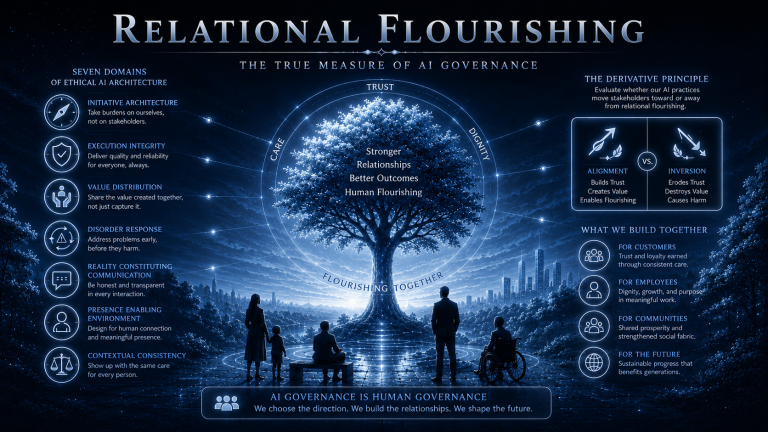
The framework established in earlier posts specifies two conditions for ethical AI: structural accountability and directional alignment. Structural accountability ensures humans with moral agency remain present, active, and responsible within AI-augmented systems. Directional alignment ensures those humans have aimed systems toward relational flourishing. The three functions distribute responsibility for these conditions.
Governance defines what structural accountability requires. What oversight mechanisms must exist? What intervention capabilities must humans retain? What access must stakeholders have to human moral agents? Governance also establishes directional requirements: acceptable purposes, permissible optimization targets, stakeholder impacts warranting attention. Management implements these requirements operationally. Audit verifies both: do accountability structures actually function, and do deployments actually move stakeholders toward flourishing?
The Derivative Principle provides methodology for directional assessment across all three functions. Governance uses it to establish acceptable directions. Management uses it to evaluate whether operations maintain direction. Audit uses it to assess whether alignment has actually been achieved. The principle asks whether AI deployments move stakeholders toward or away from flourishing, applicable at every level.
Building the Three-Function Infrastructure
Organizations that take AI governance seriously must build infrastructure supporting all three functions. This begins with organizational positioning. Governance requires executive authority connection. Management requires integration with operational units. Audit requires independence, typically through reporting to board or audit committee rather than operational executives.
The functions require coordination mechanisms that preserve independence while enabling collaboration. Governance must communicate policies to management in implementable form. Management must provide operational feedback about what works. Audit must share findings with both while maintaining independence. These information flows require structured processes: coordination meetings, handoff protocols, escalation pathways.
Most importantly, organizations must staff all three functions with professionals who understand both their specific responsibilities and how their function relates to others. A governance officer who ignores operational constraints produces unimplementable policies. A management regulator who ignores governance intent implements letter while violating spirit. An auditor who misunderstands both assesses compliance with documentation rather than achievement of purpose. Subsequent posts will examine each function in depth, exploring what each role requires and how professionals can excel at their distinctive responsibilities.
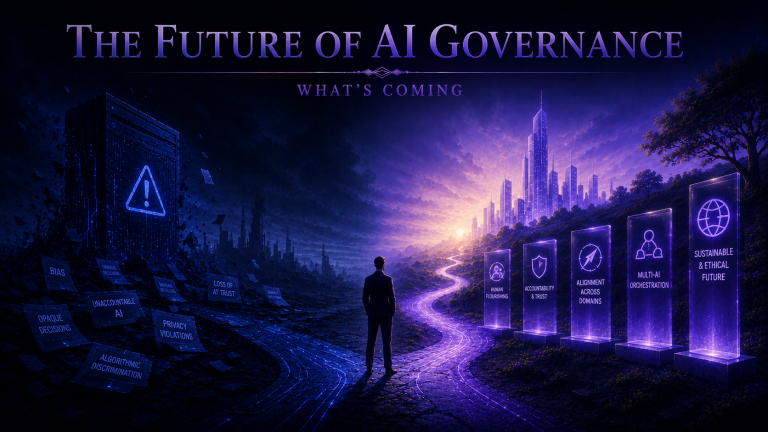
Organizations that will govern AI effectively recognize governance, management, and audit as essential functions requiring dedicated attention, distinct expertise, and coordinated operation. Those attempting AI governance through documentation alone, operational effort alone, or periodic assessment alone will find themselves performing governance theater while their AI systems affect stakeholders in ways the organization neither controls nor understands.