The Paradox of Expanding Automation
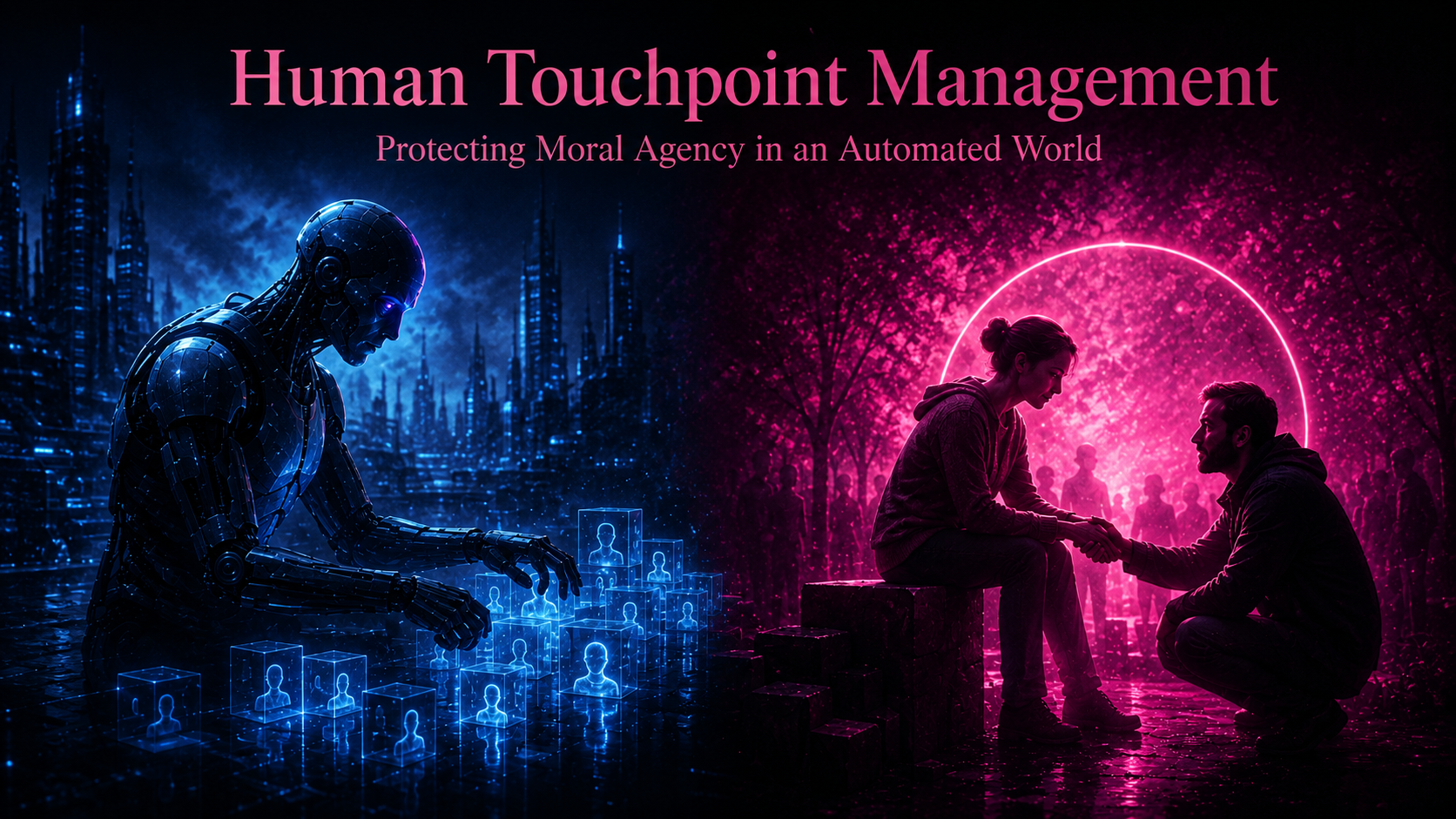
As AI capabilities expand, human touchpoints become simultaneously more important and harder to maintain. The same efficiency gains that justify AI deployment create pressure to reduce human involvement. The same volume that AI handles creates scale that makes human review impractical. The same cost savings that AI generates make human labor comparatively expensive. Organizations face constant temptation to treat human touchpoints as inefficiency to be eliminated rather than moral necessity to be protected.
This framing is precisely backward. Human touchpoints are not inefficiencies. They are the mechanism through which moral agency remains present in AI-augmented systems. They are where the Vacancy Problem, which we explored in our foundational posts, finds its remedy. They are what distinguishes organizations that govern AI ethically from organizations that merely deploy AI efficiently. Eliminating human touchpoints does not optimize operations. It optimizes away the moral presence that gives operations ethical standing.
The trap manifests gradually. Initial AI deployment includes robust human touchpoints. Success leads to expanded AI scope. Touchpoint capacity that was adequate at lower volumes becomes strained. Budget pressure discourages touchpoint expansion. AI handles more cases that once required humans. Remaining touchpoints become specialized, handling only escalations and exceptions. Human capability atrophies as routine work disappears. Eventually, the touchpoints that governance required exist in name only, overwhelmed, undertrained, and unable to provide the moral judgment they were designed to supply.
Identifying Where Moral Agency Must Remain
Effective touchpoint management begins with identifying where human moral agency must remain present in AI workflows. This is not merely a technical design question. It is a moral judgment about which decisions require human presence and which can appropriately flow through automated systems.
Some touchpoints are categorically required regardless of AI capability. Decisions about individual justice or fairness require human judgment that weighs particular circumstances against general rules. Responses to human suffering require empathetic presence that AI cannot provide. Determinations affecting fundamental stakeholder interests require moral deliberation that no algorithm can execute. These touchpoints must remain staffed by humans with genuine authority, not merely humans who execute AI-scripted interactions.
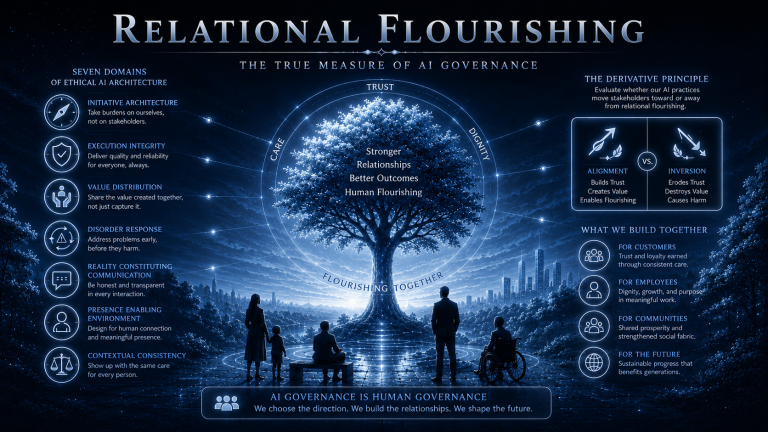
Other touchpoints are required by stakes calibration. As we discussed in our post on managing AI chains, high-stakes decisions demand human judgment even when AI could technically produce outputs. The stakes are not merely organizational. They are the impacts on stakeholder flourishing that the Derivative Principle requires us to assess. When AI decisions significantly move stakeholders toward or away from flourishing, human moral agency must be present to evaluate whether that movement is appropriate.
Still other touchpoints are required by uncertainty. AI systems operate confidently within their training distribution and often overconfidently outside it. When AI encounters situations that exceed its reliable competence, human judgment must be available to assess what the situation requires. These uncertainty-triggered touchpoints require AI systems designed to recognize their own limitations and escalate appropriately, and humans prepared to exercise judgment when escalation occurs.
Resourcing Touchpoints as Investment, Not Cost
The most common failure mode in touchpoint management is under-resourcing. Organizations staff touchpoints at levels adequate for projected escalation volumes, then discover that actual volumes exceed projections, or that touchpoint capacity erodes as AI handles more routine work, or that personnel trained for pre-AI workflows lack skills for post-AI touchpoint responsibilities.
Adequate touchpoint resourcing must account for volume uncertainty. Escalation rates will vary with AI performance, stakeholder behavior, and external events. Touchpoint capacity must accommodate peak loads, not merely average loads. Stakeholders who cannot reach humans when they need to reach humans experience the vacancy that governance exists to prevent.
Adequate resourcing must also preserve touchpoint capability. When AI handles routine work, personnel who once developed judgment through routine practice lose that development opportunity. Touchpoint staff must receive training that compensates for reduced routine exposure, must maintain skills through deliberate practice, and must develop expertise specifically suited to the escalation-heavy, edge-case-intensive work that remains. Organizations that reduce touchpoint headcount proportionally to AI volume gains often discover that remaining personnel lack the capability that touchpoint work now requires.
The budget framing matters. Touchpoint spending is not cost to be minimized. It is investment in moral agency that governance requires. Organizations that treat touchpoints as necessary evils will inevitably starve them. Organizations that treat touchpoints as strategic assets will resource them appropriately. The framing determines the outcome.
Designing Effective Handoffs
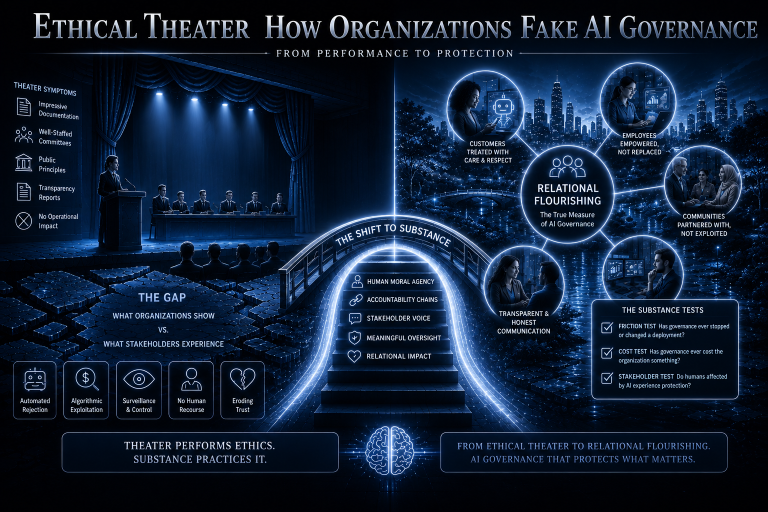
Touchpoint effectiveness depends heavily on how handoffs between AI and human occur. A human reviewer who receives a case stripped of context, AI rationale, and relevant history cannot exercise effective judgment. A stakeholder who reaches a human after navigating complex escalation barriers arrives frustrated, creating interactions that begin adversarially. Handoff design determines whether touchpoints function as genuine moral agency insertion or as friction that satisfies governance requirements without providing governance value.
Context preservation is essential. When cases escalate from AI to human, the human must receive complete relevant information. What did the AI attempt? Why did escalation trigger? What does the stakeholder need? What constraints apply? What precedents are relevant? AI systems must be designed to package this context for human consumption, not merely to dump raw interaction logs that humans cannot efficiently process.
Continuity matters for stakeholder experience. Stakeholders who must restart explanations after reaching humans experience the burden shift that Initiative Architecture prohibits. Effective handoffs preserve stakeholder context so that human touchpoints build on AI interactions rather than requiring stakeholders to begin again. This requires technical infrastructure that passes context reliably and human training that ensures personnel actually use the context they receive.
Authority must be clear. Humans staffing touchpoints must know what they can do. Override AI decisions. Adjust case handling. Escalate further. Provide exceptions to standard processes. Touchpoints without authority cannot exercise judgment. They can only execute protocols, which is precisely what AI already does. The point of human touchpoints is bringing judgment that AI lacks. That judgment requires authority to act on what judgment reveals.
Preventing Capability Atrophy
Perhaps the most subtle threat to touchpoint effectiveness is capability atrophy. As AI handles more routine work, humans lose the practice that builds and maintains skill. A loan officer who once reviewed fifty applications daily now reviews five, only the exceptions that AI cannot handle. Those five cases are harder than the fifty were. But the officer has less practice, less pattern recognition, less intuitive calibration developed through repetition. The touchpoint exists. The capability to exercise judgment effectively may have eroded.
Capability atrophy operates invisibly. Personnel do not recognize their skills declining. They handle fewer cases, so they notice fewer opportunities for judgment. They rely more on AI recommendations because they trust their own judgment less. They escalate more because uncertainty feels higher without the calibration that routine practice provides. Touchpoints staffed by personnel with atrophied capabilities provide less moral agency than governance intended.
Addressing atrophy requires deliberate skill maintenance. This may mean routing some routine cases through human review purely for practice, not because AI could not handle them. It may mean simulation and scenario training that provides judgment opportunities that operational workflows no longer supply. It may mean job design that combines touchpoint responsibilities with other work that develops relevant capabilities. The specific approach matters less than the recognition that capability requires maintenance and that AI deployment will erode capability unless organizations deliberately counteract that erosion.
Our subsequent posts will address how organizations should respond when ethical failures occur despite touchpoint protections, how to govern the continuous evolution of AI systems, and how to manage the pressure that constantly pushes against ethical standards. Human touchpoint management connects to all these challenges. Touchpoints are where humans remain present in automated systems. Their effectiveness determines whether that presence is genuine or nominal, whether governance frameworks translate into operational practice or remain aspirational documents that actual operations have left behind.