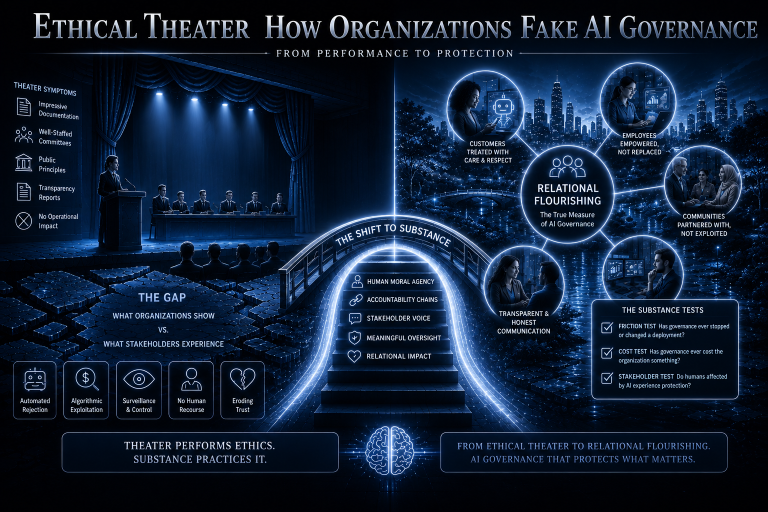

The language of customer service has become a masterwork of corporate euphemism. “Self-service portals” that force customers to navigate byzantine systems. “Intelligent routing” that ensures callers exhaust themselves before reaching a human. “Automated assistance” that exists primarily to deflect rather than serve. Organizations celebrate these innovations as improvements in efficiency, but efficiency for whom? The uncomfortable answer reveals something profound about how AI governance actually functions.
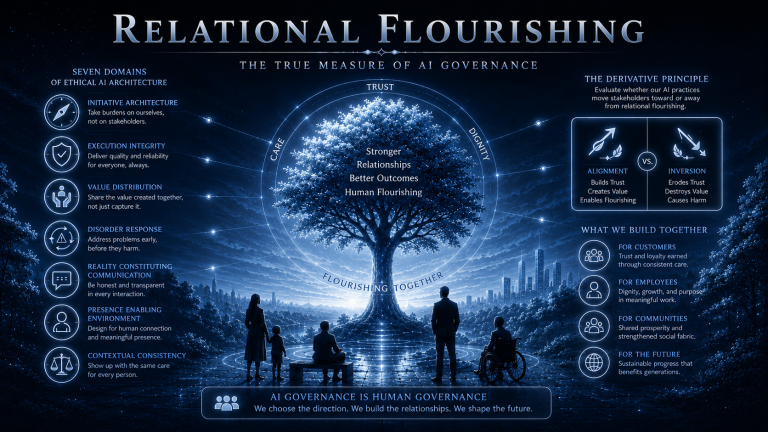
This is the first in a series examining the Seven Domains of Ethical AI Architecture, the framework through which we evaluate whether organizations deploy AI toward human flourishing or away from it. We begin with Initiative Architecture because it exposes the foundational moral question that every other domain builds upon: when an organization possesses greater capacity than its stakeholders, which direction does it move?
The Moral Physics of Initiative
Initiative Architecture rests on a simple principle: those with greater capacity bear responsibility to move first toward those with less. Organizations possess asymmetric advantages over their stakeholders. More knowledge about products and policies. More resources to absorb transaction costs. More time to wait out frustrating interactions. More options for alternative courses of action. The ethical question is not whether this asymmetry exists but what organizations do with it.
Aligned organizations use AI to amplify human initiative toward stakeholder need. They deploy their technological advantages to reduce stakeholder burden, to anticipate problems before customers experience them, to reach out proactively rather than waiting behind fortified walls. The movement is always from strength toward need, from organizational capacity toward stakeholder vulnerability.
Inverted organizations do precisely the opposite. They use AI to shift burden onto stakeholders, to build walls requiring customers to fight through automated systems, to celebrate deflection as efficiency. The chatbot that loops endlessly without resolution is not a failure of technology but a success of burden shifting. The phone tree that exhausts callers before connecting them to agents is not poor design but intentional architecture.
The distinction matters because it reveals that AI governance is fundamentally about human choices, not technological constraints. The Vacancy Problem, which this framework addresses throughout, describes what happens when AI occupies roles requiring human moral judgment. But Initiative Architecture reveals that even well-designed systems can become instruments of moral inversion when the humans governing them choose extraction over service.
What Alignment Actually Looks Like
Organizations demonstrating aligned Initiative Architecture share recognizable patterns. They design AI systems that genuinely resolve stakeholder needs rather than processing stakeholders through minimal viable responses. When AI cannot resolve an issue, escalation to human judgment happens smoothly, with context preserved. Human touchpoints remain accessible without requiring stakeholders to defeat the system first.
More fundamentally, aligned organizations treat stakeholder time and energy as resources deserving protection. They recognize that every minute a customer spends navigating an AI system is a minute extracted from that customer’s life. They measure success not by calls deflected but by stakeholder problems actually resolved. The metrics reveal the values.
Consider two approaches to AI deployment in insurance claims processing. One organization uses AI to identify claims that can be processed immediately, routing complex cases to human adjusters with full context. The other uses AI to create friction, requiring documentation through systems designed to discourage persistence, measuring success by processing time rather than stakeholder experience. Both deploy sophisticated AI. Only one moves capacity toward stakeholder need.
The Inversion Epidemic
The patterns of inverted Initiative Architecture have become so normalized that organizations rarely recognize them as ethical failures. When a healthcare system deploys AI requiring patients to navigate multiple portals and retry failed transactions before reaching assistance, this is described as modernization. When a financial institution makes account closures difficult while making openings frictionless, this is positioned as security.
The inversion reveals itself when we examine whose burden increases. Aligned AI reduces stakeholder burden while potentially increasing organizational work. Inverted AI reduces organizational burden while increasing stakeholder work. The direction of burden transfer exposes the direction of ethics regardless of marketing.
Vulnerable populations bear disproportionate costs. Those with less technological facility, less time flexibility, less familiarity with organizational systems suffer most when organizations shift burden outward. The elderly caller who cannot navigate voice prompts, the working parent who cannot spend forty minutes on hold, the non-native speaker who struggles with chatbot syntax all experience moral consequences of design decisions made by humans facing no such barriers.
The Governance Imperative
Initiative Architecture is the first domain for a reason. It establishes whether an organization approaches AI deployment as an opportunity to serve stakeholders or an opportunity to extract from them. The remaining six domains examine execution, value distribution, disorder response, communication, environment, and consistency. But all operate within the fundamental orientation Initiative Architecture establishes.
For governance professionals, assessing this domain requires looking beyond official descriptions to operational reality. What do stakeholder experience metrics show? Where does burden fall when systems fail? How accessible are human touchpoints? Does the organization measure success in stakeholder outcomes or organizational efficiency?
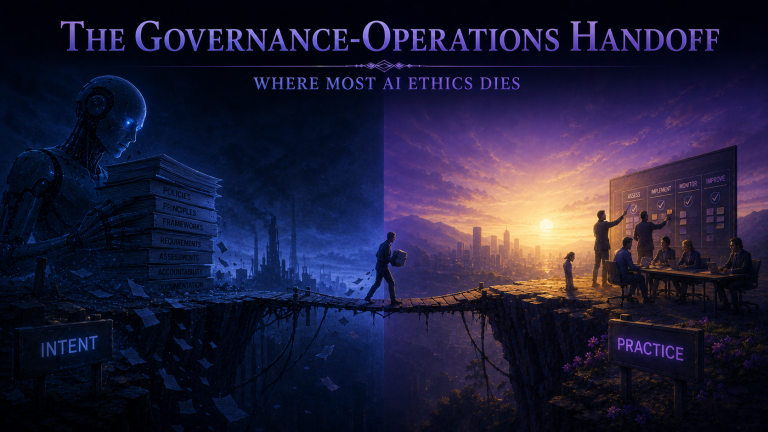
The Daisy Chain Principle, holding that accountability must trace through AI systems to humans, applies directly. When AI creates stakeholder burden, that burden reflects human choices. Someone designed the system. Someone approved the deployment. Someone benefits from the burden shift. Governance ensures those humans remain accountable for the direction their decisions take.
Toward Authentic Service
Organizations serious about aligned Initiative Architecture must acknowledge the moral significance of burden distribution. They must recognize that every AI system either moves organizational capacity toward stakeholder need or shifts stakeholder burden toward organizational convenience. There is no neutral deployment. The Derivative Principle, central to this framework, asks whether AI moves stakeholders toward or away from flourishing. In Initiative Architecture, this question becomes viscerally concrete: does interacting with organizational AI leave stakeholders better served or more exhausted?
The path forward requires rejecting efficiency metrics that treat stakeholder burden as externality. It requires designing AI that succeeds when stakeholders succeed rather than when stakeholders give up. Most fundamentally, it requires organizations to see their technological advantages as creating obligations rather than opportunities for extraction.
The next post examines Execution Integrity, exploring how the quality of AI deployment reveals organizational values. But Execution Integrity operates within the initiative orientation we establish first. An organization that executes beautifully while moving burden onto stakeholders has merely polished its extraction machinery. Only when initiative flows from organizational strength toward stakeholder need does execution quality become ethical achievement rather than sophisticated harm.
The direction of burden reveals the direction of ethics. Initiative Architecture asks organizations to examine which way they actually move.