The Orchestration Revolution and Its Governance Void
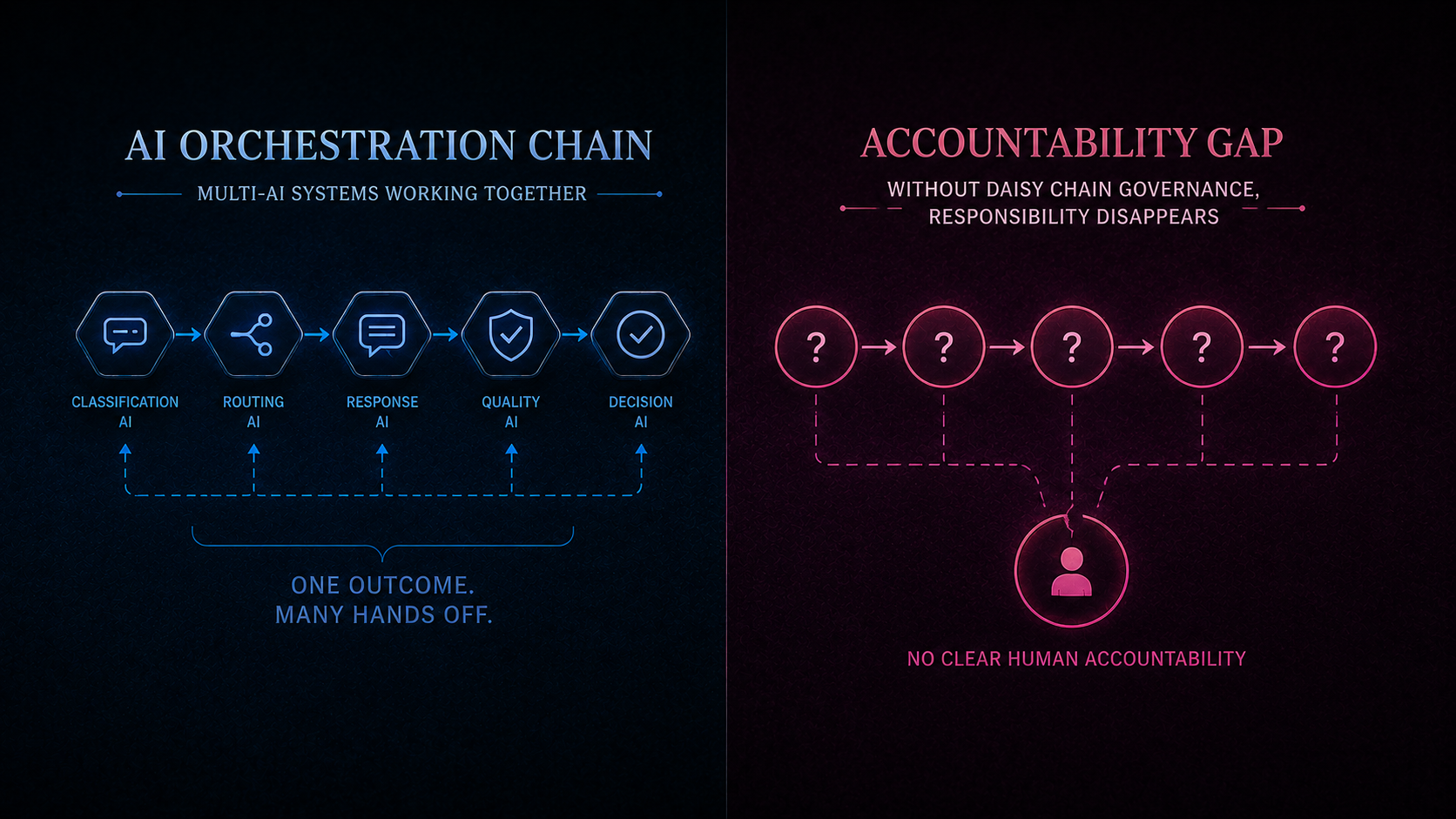
The AI landscape has evolved beyond isolated deployments. Organizations increasingly deploy multi-AI architectures where AI systems coordinate with other AI systems in chains of automated decisions. A customer inquiry triggers a classification AI, which routes to a response generation AI, which drafts output reviewed by a quality assurance AI, which approves publication with no human seeing the transaction. A loan application passes through document processing AI, credit scoring AI, fraud detection AI, and decisioning AI before a human learns the outcome. These orchestrated architectures amplify both capability and risk in ways that demand fundamentally different governance approaches.
Conventional AI governance treats each system as an independent deployment. Classification AI receives one governance review. Response generation AI receives another. Each satisfies governance requirements individually. But the chain formed by their interaction receives no review at all. Orchestration creates emergent behaviors, cumulative risks, and compounded accountability gaps that individual system reviews cannot detect. An organization can govern each link meticulously while the chain as a whole operates without meaningful human oversight.
The Daisy Chain Principle, which we introduced in our foundational posts on philosophical frameworks, holds that accountability must trace through AI chains to human moral agents. When AI coordinates AI, the humans who architected the coordination bear responsibility for outcomes the orchestration produces. The chain does not create a accountability void where no one is responsible. It creates an accountability chain where architects and operators must answer for what their chains do. Most orchestration architectures fail to operationalize this principle, executing consequential decisions through automated flows that never surface for human review.
Mapping the Chains Within Operational Responsibility
The first operational requirement for Daisy Chain governance is comprehensive chain identification. Operations managers must know every AI chain within their responsibility: what systems compose each chain, how they interact, what decisions flow through them, and what stakes attach to those decisions. This mapping exercise often reveals orchestrations that no one consciously designed, emergent chains that formed as individual systems were connected over time without architectural intention.
Chain mapping must capture more than technical data flows. It must identify decision points where outcomes affecting stakeholders are determined, must assess the stakes attached to those decisions, must trace how authority is exercised at each link, and must document where human judgment could intervene but currently does not. A complete chain map reveals not only what the orchestration does but what moral agency is exercised (or abdicated) at each stage.
Many organizations discover during this mapping that their chains are longer and more consequential than they realized. The hiring workflow that seemed to involve human decision-making actually presents humans with AI-curated candidates, AI-drafted assessments, and AI-recommended rankings, with human reviewers exercising judgment only within parameters that AI has already established. The customer service operation that seemed human-centered actually routes, classifies, responds, and closes most interactions without human awareness. The claims processing system that seemed augmented is actually autonomous for the vast majority of cases. Chain mapping makes visible what casual observation obscures.
Designing Human Touchpoints Within Chains
Once chains are mapped, operations managers must determine where human touchpoints are required. The Daisy Chain Principle does not demand human review of every transaction. It demands that humans with moral agency exercise judgment over outcomes affecting other humans. The question is where in each chain such judgment must occur.
Stakes calibration guides touchpoint placement. Low-stakes decisions that affect stakeholders minimally may flow through chains without human intervention, provided the chain as a whole has been designed with human accountability and provided monitoring detects when outcomes drift from acceptable parameters. High-stakes decisions that significantly affect stakeholder flourishing require human judgment before outcomes are finalized. The highest-stakes decisions may require human approval at multiple chain points, with escalation protocols that prevent automation from determining outcomes that should emerge from moral deliberation.
Touchpoint design must address what information reaches human reviewers. A human touchpoint that sees only AI-summarized information exercises judgment constrained by AI framing. True human agency requires access to underlying data, alternative interpretations, and context that AI summaries may omit. Operations managers must design touchpoints that enable genuine judgment, not merely rubber-stamping of AI recommendations.
Our next post will explore human touchpoint management in detail, addressing how to maintain meaningful human presence as AI expands. For now, the essential point is that touchpoint placement within chains is a governance decision that determines whether chains operate with moral agency present or absent. That decision cannot be delegated to technical architecture. It requires explicit judgment about where human moral presence is necessary.
Monitoring Chains for Drift and Failure
As we discussed in our earlier post on the drift problem, AI systems erode alignment over time. In orchestrated architectures, drift compounds across chain links. A small accuracy degradation in a classification AI shifts the distribution of cases reaching downstream systems. Those systems, calibrated for different input distributions, produce outputs that drift from intended parameters. The downstream drift triggers compensating behavior in subsequent links. The chain as a whole drifts faster and further than any individual system.
Chain monitoring must capture both link-level and chain-level indicators. Link-level monitoring tracks each system’s individual performance. Chain-level monitoring tracks end-to-end outcomes: what goes in, what comes out, and how the transformation compares to intended behavior. Chain-level monitoring often reveals problems invisible to link-level metrics. Each link performs within specification while the chain produces unacceptable outcomes.
Failure modes in chains are particularly complex. A failure in one link may propagate through subsequent links, amplifying rather than damping. Downstream systems may misinterpret upstream errors as valid inputs, producing confidently wrong outputs. Error detection mechanisms designed for individual systems may not activate when errors arrive from trusted upstream sources. Chain monitoring must detect failure propagation and must trigger intervention before cascading errors reach stakeholders.
Operations managers must establish chain-level alerts that activate when end-to-end behavior exceeds acceptable variance, regardless of whether link-level metrics show problems. They must design intervention protocols that can halt chain operation rapidly when failures are detected. And they must conduct regular chain-level reviews that assess orchestration behavior holistically, not merely as the sum of individual system assessments.
Intervention Points in Automated Flows
The ultimate test of Daisy Chain governance is whether humans can actually intervene in chain operations when intervention is needed. Intervention authority means little if chains operate at speeds, scales, or complexities that make intervention practically impossible.
Operations managers must identify intervention points at each chain stage where human override is possible. They must verify that intervention mechanisms actually function under operational conditions. They must establish escalation protocols that bring chain problems to human attention before harm compounds. And they must maintain intervention capability as chains evolve, ensuring that optimization does not gradually eliminate human override options.
The architectural tension is real. Chains provide value through speed and scale that human intervention constrains. Full human review of every chain transaction would eliminate the efficiency that justified orchestration. The governance challenge is finding intervention designs that preserve human moral agency over consequential outcomes while permitting automation of routine processing. This requires sophisticated filtering that identifies which transactions require human attention, requires confidence calibration that escalates uncertain cases, and requires outcome monitoring that detects when automated filtering fails to identify cases needing review.
Organizations that implement Daisy Chain governance discover that orchestration architecture is governance architecture. The technical design decisions that determine how chains operate are simultaneously moral decisions about where human judgment will and will not be present. Technical teams cannot make these decisions in isolation. Governance must be present in orchestration design, must review chain architectures before deployment, and must maintain ongoing oversight as chains evolve. The alternative is chains that execute consequential decisions affecting stakeholder flourishing with no moral agency present anywhere in the flow. This is precisely the abdication that governance frameworks exist to prevent.