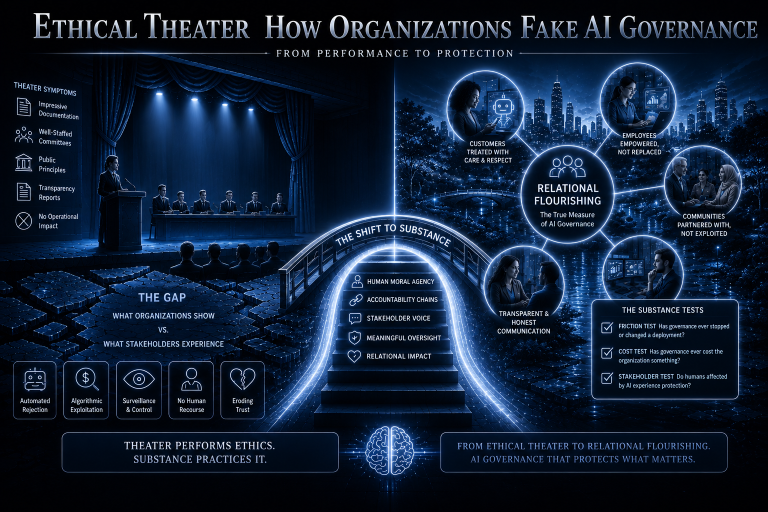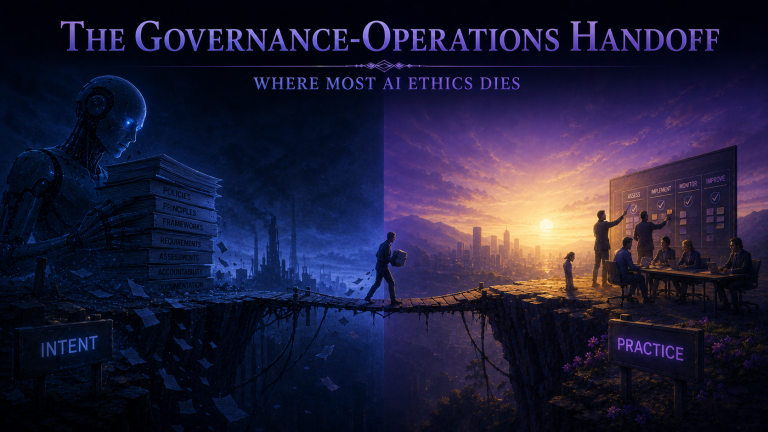
Most AI governance frameworks fail. They fail not because they are poorly written but because they treat governance as documentation rather than architecture. The organization commissions a framework. Consultants draft policies covering bias, transparency, accountability, privacy. Documents are reviewed, approved, and published. Then they sit in repositories, occasionally referenced when someone asks whether the organization has AI governance, never operationalized in ways that shape how AI is designed, deployed, or managed.
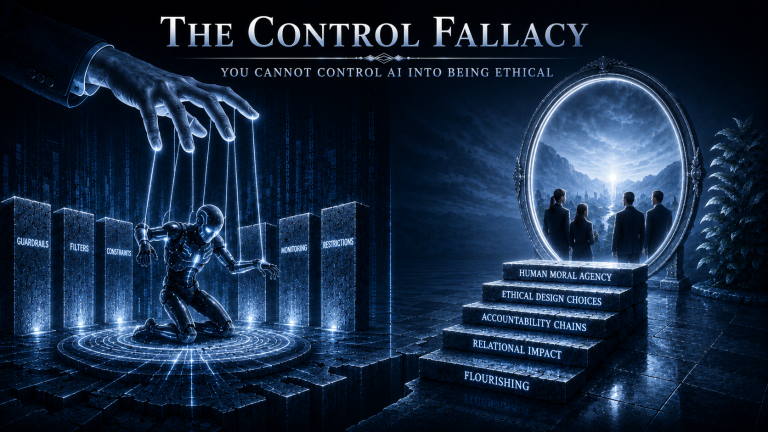
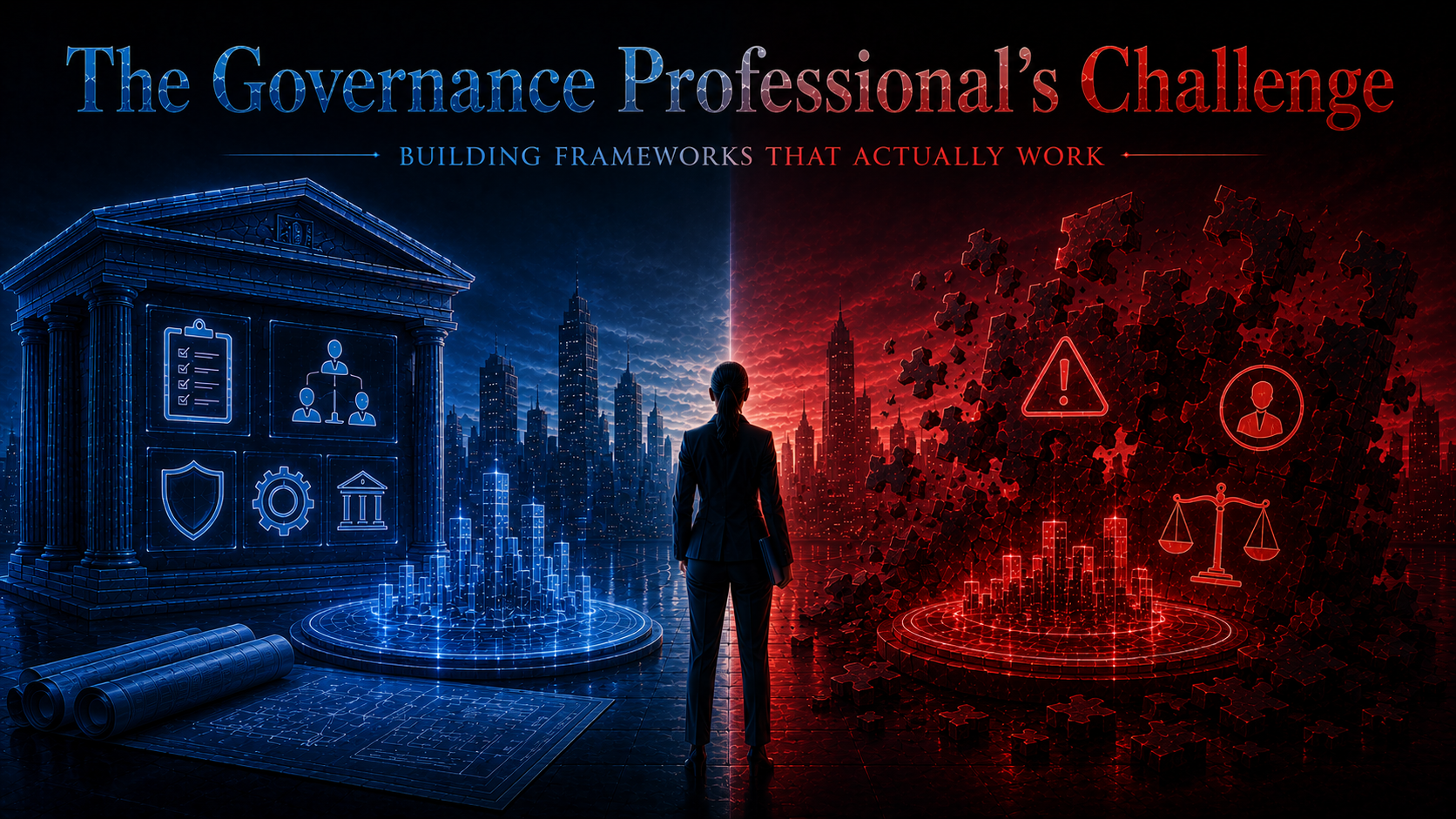
The governance professional’s challenge is building structures, not producing documents. Effective AI governance requires organizational mechanisms that ensure AI deployments satisfy the Two Conditions before they proceed and continue satisfying them as they operate. Structural accountability must actually exist in the organization, not merely be described in governance documents. Directional alignment toward stakeholder flourishing must actually be achieved, not merely proclaimed. The governance professional is a structural engineer, not a document author.
This post examines what governance professionals actually build when they do their job well. As established in the previous post on the three functions, governance establishes what must exist before AI can ethically occupy roles. That establishment is architectural work creating structures that shape deployment rather than merely describing what should happen. The specific structures required fall into five categories: AI Role Inventory, Accountability Architecture, Policy Frameworks, Human Override Architecture, and Governance Integration.
The AI Role Inventory
You cannot govern what you have not identified. The foundational governance structure is the AI Role Inventory: comprehensive identification of every AI system functioning as a role within the organization. This differs from asset inventories that catalog what AI the organization owns or licenses. Role inventories identify where AI occupies positions that would otherwise require humans exercising moral judgment.
Governance activates based on role occupation, not mere existence. As established earlier in this series, the tool versus role distinction determines governance scope. When humans initiate and AI responds, AI functions as a tool receiving traditional technology governance. When AI initiates action affecting stakeholders, AI occupies a role requiring comprehensive governance. The inventory classifies systems by First Mover Authority level. Level 2 systems where AI initiates within designed parameters require structural accountability ensuring human oversight. Level 3 systems where AI orchestrates other AI require governance addressing cascading effects and the Daisy Chain Principle. Level 4 systems where AI self-modifies require the most comprehensive structures. A subsequent post will explore inventory building in depth.
Accountability Architecture
The Daisy Chain Principle established in the philosophical foundations of this framework holds that accountability must trace through AI chains to humans who actually exercise moral agency. The governance professional builds accountability architecture making these chains explicit, operational, and verifiable. This begins with specifying who is responsible for what: who designed the system into this role and bears design responsibility, who operates it daily and bears operational responsibility, who maintains override authority, and who is accountable to affected stakeholders. These assignments cannot be generic role descriptions but must identify specific humans with genuine authority and genuine responsibility.
The architecture must specify how accountability operates. What information does each accountable human receive about system performance? What decisions does each accountable human actually make? What happens when they identify concerns? A human nominally responsible for AI outputs who receives no information and has no mechanism to influence them is not accountable in any meaningful sense. Accountability requires that responsible humans have access to information necessary for judgment and authority necessary for action. The subsequent post on accountability architecture will explore these requirements comprehensively.
Policy Frameworks Grounded in Domains
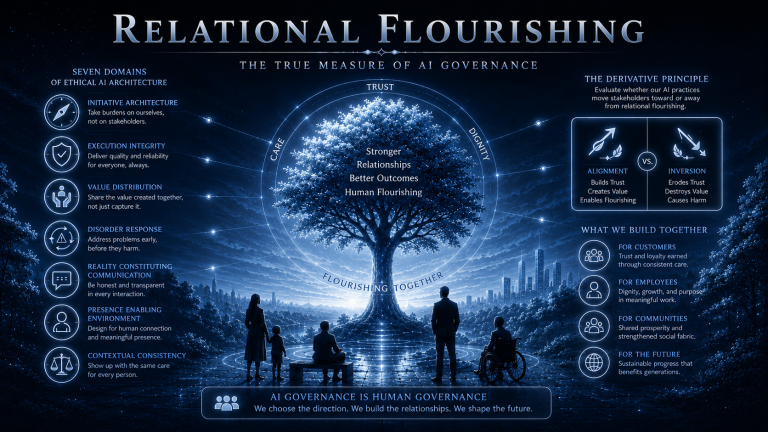
Generic policies proclaiming commitment to “ethical AI” or “responsible AI” accomplish nothing. They provide no criteria for determining whether specific deployments are ethical, no methodology for assessment, no boundaries distinguishing acceptable from unacceptable. The governance professional builds policy frameworks grounded in specific evaluative domains. The Seven Domains framework establishes dimensions along which AI deployments must be evaluated: how they affect stakeholder relationships, how they impact human dignity, how they distribute benefits and burdens, how they maintain transparency, how they preserve human agency, how they enable accountability, and how they support relational structures enabling flourishing.
For each domain, policies must specify what questions must be asked about proposed deployments, what thresholds must be met before deployment proceeds, what ongoing monitoring must occur, and what triggers require reassessment. These policies cannot be copied from other organizations or downloaded from industry repositories. Governance policies must reflect organizational context: affected stakeholders, maintained relationships, held values, faced risks. A financial services firm and healthcare provider face different impacts even deploying similar AI. The governance professional’s job is building policies that operationalize the Two Conditions within specific organizational context.
Human Override Architecture
Structural accountability requires that humans can actually intervene in AI operations when moral judgment requires it. This intervention capacity must be architectural: designed into systems, tested to verify function, maintained as systems evolve. The governance professional builds human override architecture ensuring designated humans can actually exercise their authority. Technical override ensures mechanisms allowing human intervention exist: emergency stops, parameter overrides, manual processing pathways. Organizations often claim override capability while designing systems that make override practically impossible due to automation speed, integration complexity, or absent manual fallbacks.
Operational override ensures human personnel can recognize when intervention is needed and act on that recognition. This requires training, communication channels, and organizational culture supporting intervention. Stakeholder access to override creates pathways through which affected parties can escalate from AI to human engagement. These pathways must be accessible without extraordinary effort, staffed by humans with authority to act, and responsive within appropriate timeframes. The governance professional must verify that override architecture exists operationally, not merely in documentation.
Governance Integration
AI governance cannot exist as an isolated function disconnected from broader organizational governance. The governance professional must integrate AI governance into corporate governance structures, connecting it to executive oversight, board responsibility, risk management, and compliance frameworks. This requires reporting lines connecting AI governance to executive authority and board attention for significant issues.
Integration also requires alignment with existing governance processes. Procurement governance should include AI governance requirements. Project governance should incorporate AI governance review stages. Change management should address AI governance implications. The governance professional builds connections between AI-specific governance and organization-wide governance mechanisms, ensuring AI governance is integrated rather than an add-on.
The governance professional who builds these five structures creates the architectural foundation for ethical AI deployment. Without the AI Role Inventory, governance applies to an unknown subset of deployment. Without Accountability Architecture, responsibility diffuses into ambiguity. Without Policy Frameworks grounded in domains, governance becomes vague aspiration. Without Human Override Architecture, structural accountability lacks operational reality. Without Governance Integration, AI governance remains disconnected from authority. Subsequent posts will examine how management operationalizes these structures and how audit verifies their effectiveness. But it begins here, with the governance professional building frameworks that actually work.