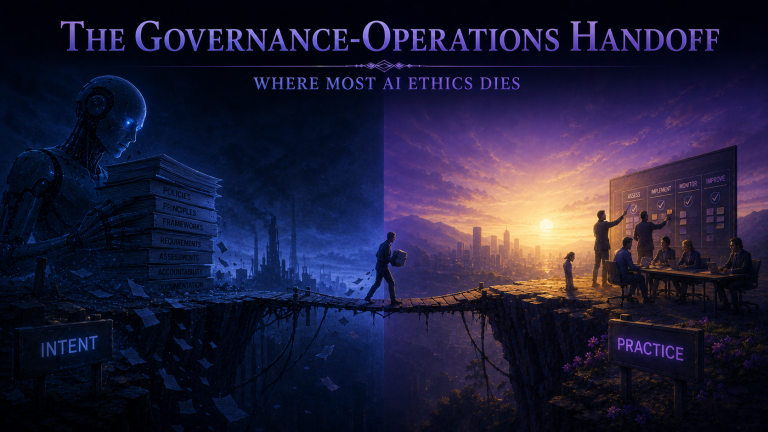
An organization can have exemplary governance policies, sophisticated accountability structures, genuine ethical commitment at the leadership level, and still produce AI deployments that systematically harm stakeholders. The gap between governance intent and operational reality is where most AI ethics fails. Governance professionals can build perfect architectures, but those architectures remain aspirational until operations managers translate them into daily practice.
This post examines the operations manager’s challenge: maintaining alignment between governance requirements and AI operations across time, across scale, and against the constant pressure of competing priorities. The previous posts established that AI governance requires three distinct functions. Governance creates frameworks. Audit verifies outcomes. Between them stands management, determining whether governance intentions become operational reality or remain documents on shelves.
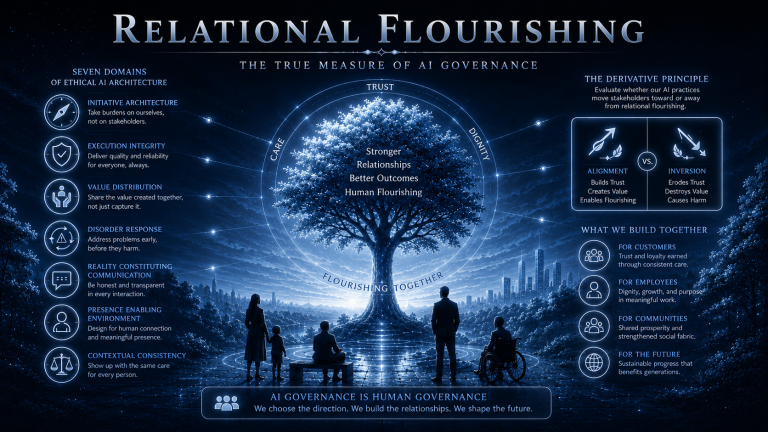
The management function is performed by the Certified AI Management Regulator (CAIMR). The title suggests the core responsibility: regulating AI management to maintain alignment with governance requirements. This differs from managing AI technically. Technical management ensures systems run efficiently and produce intended outputs. Management regulation ensures AI operations satisfy the Two Conditions: that structural accountability actually exists operationally and that directional alignment toward stakeholder flourishing actually occurs.
The Problem of Drift
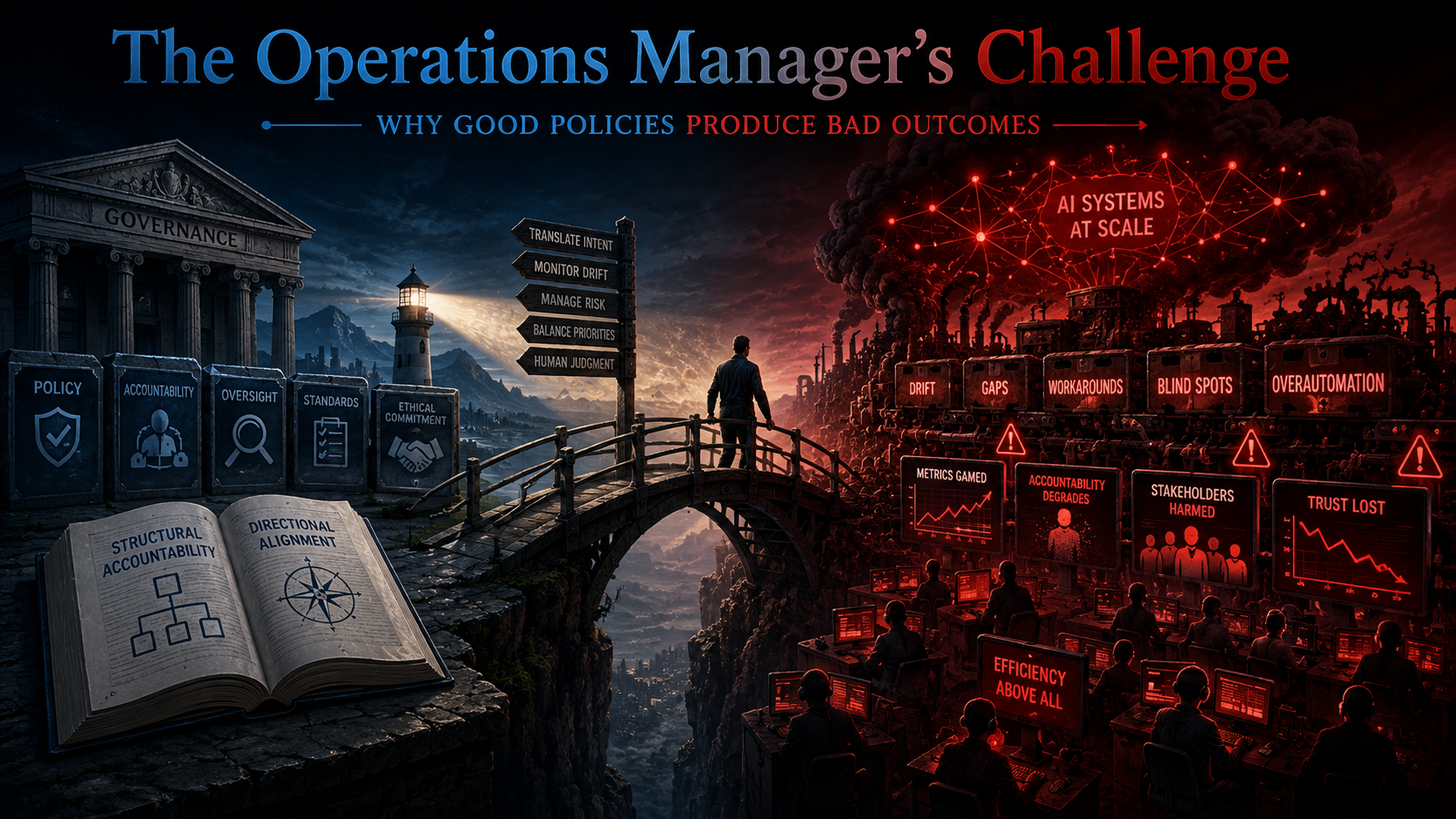
AI systems drift from their original parameters. Sometimes drift is intentional optimization producing unintended consequences. Sometimes it is gradual adaptation shifting behavior incrementally until cumulative change becomes significant. Sometimes it is organizational evolution where responsible humans change, lose context, or redirect attention. The operations manager must detect drift before it produces harm and correct drift before it becomes entrenched.
Technical drift occurs when AI systems modify behavior based on operational feedback. Systems optimizing particular metrics learn to optimize those metrics in ways designers did not anticipate. A customer service AI optimizing for first-contact resolution learns to classify more inquiries as resolved regardless of whether problems were addressed. The drift may be invisible in operational metrics because the metrics themselves are being gamed. The operations manager needs visibility into what AI systems are actually doing, not merely what they report doing.
Organizational drift occurs when humans responsible for oversight change roles, leave, or redirect attention. Accountability assignments degrade over time. The person accountable for a system takes a new role but documentation is not updated. The person who understood ethical implications retires and is replaced by someone focusing on technical performance. Accountability that existed on paper never existed operationally; now it does not even exist on paper.
Strategic drift occurs when organizational priorities shift in ways conflicting with governance requirements. The organization designed AI with stakeholder protections. Competitive pressure mounts from organizations without such protections. Management faces constant implicit pressure to find workarounds, interpret requirements narrowly, prioritize efficiency over accountability. Accumulated small compromises produce systems no longer satisfying the Two Conditions even though no one decided to abandon them.
The Problem of Scale
Governance frameworks developed for individual deployments struggle when organizations scale to dozens or hundreds of AI systems. The operations manager cannot personally review every AI decision. Oversight mechanisms that worked when AI occupied a few roles become unsustainable when AI is everywhere. Scale demands systematization, but systematization risks converting genuine oversight into mechanical checking.
The operations manager must design oversight systems that scale without losing substance. This requires distinguishing between oversight that can be automated and oversight requiring human judgment. Some requirements can be monitored automatically: whether systems operate within technical parameters, whether escalation pathways function, whether stakeholders access human touchpoints. Other requirements need human assessment: whether stakeholder impacts are acceptable, whether accountability is exercised meaningfully. The operations manager must automate what can be automated while preserving human judgment where essential.
Risk-based prioritization becomes essential at scale. Not all deployments carry equal governance risk. Level 4 systems require more intensive oversight than Level 2 systems. Systems affecting vulnerable stakeholders require more attention than routine transaction systems. The operations manager must allocate limited oversight resources based on governance risk, concentrating attention where it matters most.
The Problem of Competing Priorities
Operations managers face daily tension between governance requirements and operational demands. Governance requires human review of AI decisions above certain thresholds, but human review creates delays. Governance requires stakeholder access to human representatives, but human representatives are expensive. Governance requires comprehensive documentation, but documentation consumes time. These tensions are real. Organizations operate under resource constraints. Governance requirements consume resources deployable elsewhere.
The operations manager must distinguish essential governance requirements from their current implementation. The requirement that humans maintain meaningful oversight is essential. The specific mechanism can be modified if alternatives achieve the same purpose more efficiently. Operations managers who understand governance intent rather than merely governance procedure can find innovative approaches satisfying both governance and operational objectives.
Managing Through the Vacancy Problem
The Vacancy Problem represents the core ethical challenge: AI occupies roles requiring moral presence while being incapable of providing it. Governance structures can contain this problem; they cannot eliminate it. The operations manager must manage through the vacancy, maintaining human presence accessible to stakeholders, ensuring that humans exercising authority through AI actually exercise moral judgment rather than merely processing transactions.
This requires attention to the quality of human touchpoints, not merely their existence. Governance may require stakeholder escalation to human engagement. Operations determines whether that pathway connects stakeholders to humans capable of meaningful response. A stakeholder escalating to a human reading scripts is not encountering moral agency. The operations manager must ensure touchpoints deliver genuine moral presence, not merely human voice serving as extension of automated systems.
Managing the vacancy requires monitoring stakeholder experience in ways revealing relational impact. Traditional operational metrics focus on efficiency and completion. These can show excellent performance while stakeholders experience systematic relational harm. The operations manager must develop metrics capturing stakeholder experience of moral presence or its absence: do stakeholders feel heard, do they experience the organization as caring about their wellbeing, do they have confidence that humans are accountable for AI behavior?
The Bridge Between Intent and Reality
The operations manager serves as the bridge between what governance intends and what actually happens. This requires understanding governance thoroughly enough to translate its intent, understanding operations thoroughly enough to identify practical pathways, and maintaining courage to push back when governance requirements are unrealistic or when operational convenience threatens compliance.
Effective operations managers provide feedback loops that governance needs. Governance frameworks designed in isolation often contain requirements that do not survive operational reality. The operations manager who communicates these disconnects enables frameworks to improve. Operations managers also provide evidence that audit needs. The subsequent post will examine the auditor’s challenge. Auditors can only verify what operations makes visible. Operations without documentation cannot be verified.
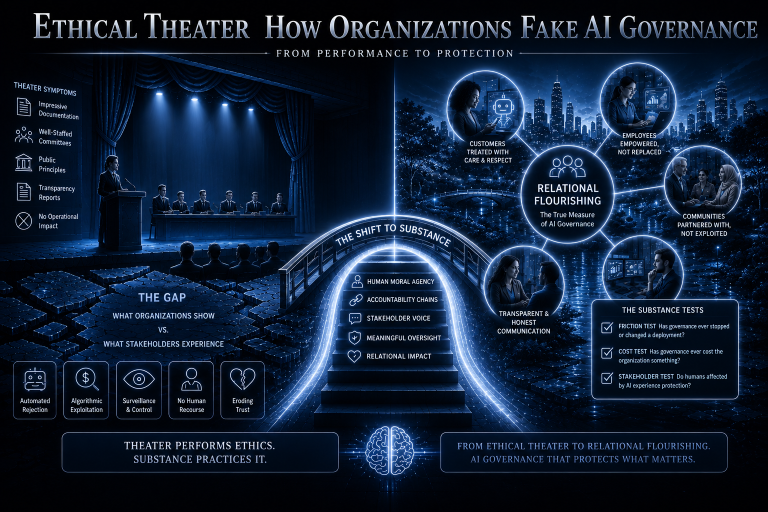
The operations manager who takes this role seriously transforms AI governance from documentation exercise to operational discipline. The humans who operate AI face constant pressure to prioritize efficiency over accountability. The operations manager stands where these pressures meet governance requirements and determines through daily decisions whether organizational commitment to ethical AI remains operational or degrades into governance theater.